
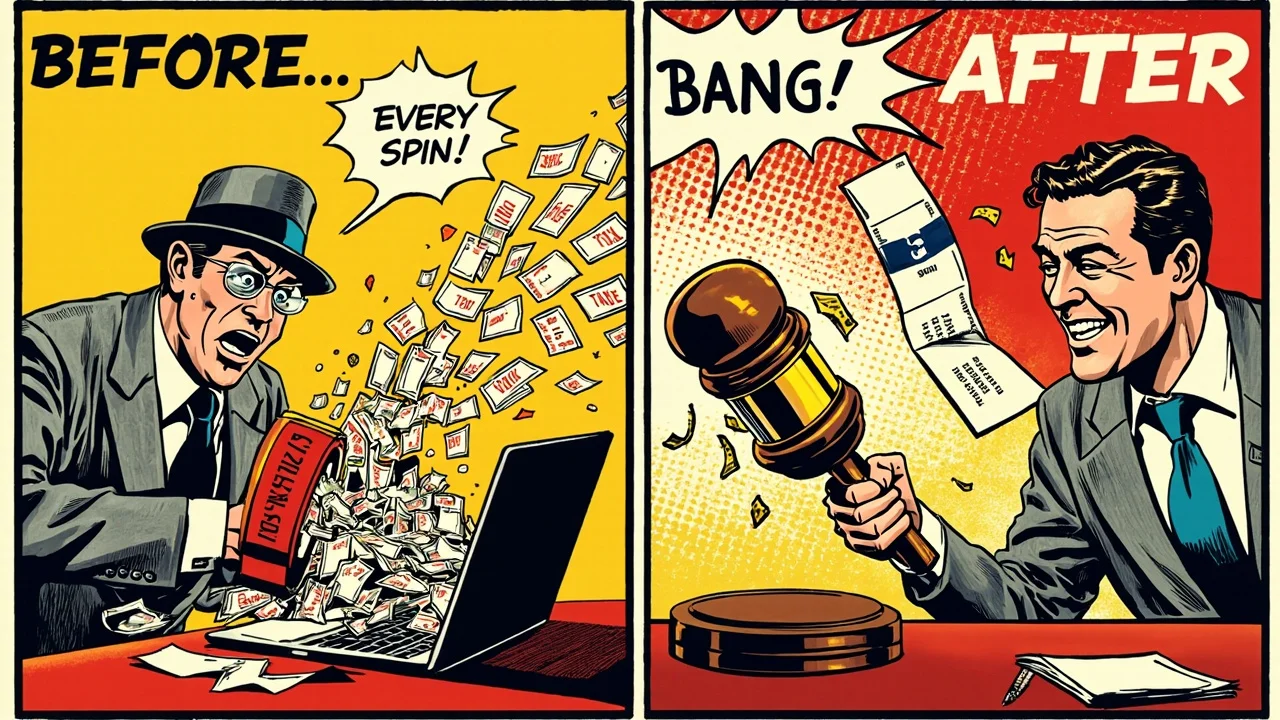

On 13 August 2026, Finlands Supreme Administrative Court told the countrys tax office to stop treating every winning slot spin at an offshore casino as a separate taxable event.... The ruling passed by a single vote, three judges to two, and it rewrites how Finnish players at Curacao licensed and other non EEA casinos are taxed. Winnnigs will now be assessed per gaming session, with losing spins inside that session deducted from the winning ones........ annual netting is still off the table. players who were taxed under the old method can file for corrections going back three years.
That sounds like a technical footnote until you see the numbers that forced the case... The palyer at the centre of it won 15.6 million euros across 2021 and lost 15....7 million euros in the same year. A net losing year of roughly 100,000 euros. Under the tax offices reading, the 15.6 million was income and the losing spins were nobodys problem but the players.
What Finlands tax office was actually doing to offshore players
Finland has a two tier rule for gamblng winnings. Money won from a game organised inside the European Economic Area is tax free for the player. That covers Veikkaus, the state monopoly, and every Malta or Estonia licensed casino that Finnish players have been flocking to for a decade. Money won from a game organised outside the EEA, which in practice means Curacao and the rest of the Caribbean, counts as earned icnome and goes on the tax return.
Earned income in Finland is taxed at progressive state rates that reach 37...5 percent above 52,100 euros, plus a flat municipal tax of between 4..7 and 10.9 percent depending on where you live.. A big offshore win can push a player into a combined marginal rate of 45 percent or more.
The problem was never the rate. It was the unit of measurment. , The Tax Administrations position, later softened slightly by the Central Tax Board, was that each individual game round was its own income event. A winning spin produced taxable income equal to the payout minus the stake on that one spin. , A losing spin produced nothing deductible at all. Play 2,000 spins on a Saturday, win on 500 of them and lose on 1,500, and you owed tax on the gross of those 500 winners as if the other 1,500 had never happened.

Nobody who has played a slot for more than a minute thinks this reflects reality. A slot pays out trough hundreds of small wins that are funded by hundreds of small losses. Taxing the wins in isolation does not tax gambling income. It taxes turnover. , The tax office knew this, and pursued it anyway, because turnover is a much bigger number.
The 15.6 million euro losing year that broke the rule
The case reached the Supreme Administrative Court, the KHO, after a preliminary ruling from the Central Tax Board. The plyer was young, played slots, roulette, blackjack and poker at a Curacao licensed casino, and finished 2021 down. The volumes were enormous because that is what high frequency slot play produces: money cycling through the same balance thousands of times.
Under a per spin assessment, the taxable figure was some large fraction of 15.6 million euros. even a conservative calculaton puts the theoretical tax bill in the millions on a year where the player ended up poorer than they started. The tax office defended this in court. Two of the five judges sided with the player entirely and wanted broader deduction rights. The three judge majority stopped short of that but still threw out the per spin approach. On top of that, The decison, recorded as KHO 13.8.2026, ruling number 2055/2026, was not published as a precedent case... that has not stopped every tax lawyer in Helsinki from treating it as one.... Miika Harkonen, tax lawyer at the Taxpayers Association of Finland, put the courts reasoning plainly: it did not accept the Tax Administrations view that each game should be viewed as a completly separate event.
What counts as a session now, and what still does not
The court replaced the game round with a concept it calls a pelirupeama, which translates roughly as a gaming session or a stretch of play. The definition is deliberately loose. Play that has a clear temporal and functional connection is one session, and that connection survives breaks. Harkonens example is a Saturday of play with a meal and bathroom breaks in the middle one session. , The same palyer coming back the following Saturday: a second, separate session.
The court admitted the line will have to be drawn platform by platform and game by game..... And that in practice the transactions visible in a players account are the starting point. deposits and withdrawals will likely bracket sessions. So will long gaps. On the other hand, What the court explicitly refused to do is let players net the whole year. The reasoning is worth quoting becouse it is going to be cited for years the income formation of chance based casino gaming is not justifiably evaluated on a tax year basis. because earlier play does not improve the odds of later play. In other words, since a losing Saturday has no causal link to a winning Sunday, the losses stay where they fell..... A player can still lose money over a year and owe tax on it. the ruling makes that outcmoe less absurd. It does not make it disappear.
How the same session gets taxed three different ways
CryptoCasino...Vegas ran the numbers on a realistic session to show what the change actually does. The player deposits 1, 000 euros, plays 2,000 spins at 1 euro each on a medium volatility slot, wins on 500 of those spins for a combined payuot of 1, 900 euros, and loses the other 1,500 spins. Net result for the session: minus 100 euros. The following Saturday the same player wins 600 euros net in a second session. , We apply a combined marginal rate of 40 percent, which is roughly where a Helsinki resident with a middle income lands once state and municipal tax stack.
| Methd | Taxable income, session 1 | Taxable income, session 2 | Tax owed at 40% | Actual net result |
|---|---|---|---|---|
| Per spin (old tax office rule) | 1,400 euros (1, 900 payouts minus 500 stakes on winning spins only) | More than 600 euros (losing spins ignored) | Over 800 euros | +500 euros |
| Per session (new KHO rule) | 0 euros (1,900 minus 2,000 stakes) | 600 euros | 240 euros | +500 euros |
| Annuall netting (rejected by the court) | Combined with session 2 | 500 euros total | 200 euros | +500 euros |
The per spin column is the one that generated bills larger than the money that ever existed.. On a session that lost 100 euros, the old method produced a 560 euro tax charge. Scale that to the case that reached the court and you get a loosing year producing a seven figure assessment.... The new method brings the bill on a losing session to zero, which is where any sane system starts. The gap between per session and annual netting is real but small for most players, and it only bites when you alternate losing and winning sessions.
Where the tax actually lands for a Finnish palyer
Because offshore winnings are stacked on top of salary, the effective rate depends entirely on what the player already earns. These are the 2026 state brackets, before municipal tax.
| Taxable earned income (euros) | State tax rate on the excess | Typical combined rate with municipal tax |
|---|---|---|
| 0 to 21,200 | 12.64% | 18% to 23% |
| 21,200 to 32,600 | 19.00% | 24% to 30% |
| 32,600 to 40, 100 | 30.25% | 35% to 41% |
| 40,100 to 52, 100 | 33..25% | 38% to 44% |
| Above 52,100 | 37.50% | 42% to 48% |
A plyer on an average Finnish salary who has a good session at a Curacao casino is handing over roughly 40 cents of every euro of net session profit. That has always been the price of playing outside the EEA from Finland. What the ruling changes is that the 40 cents is now calculated on money you actually made rather than money that passed through your balanc on its way back to the casino.
Why the 2027 licence switch turns this from a niche issue into a mainstream one
Right now, the Curacao tax problem affects a minority of Finnish offshore players, because most of them play at Malta licensed sites specifically to stay inside the EEA exemption. That is about to flip. Finlands licensing reform passed parliament in December 2025, applications opened on 1 March 2026, and the competitive makret goes live on 1 July 2027.
Sometimes, under the new regime, winnings from a Finnish licensed operator stay tax free for the player, while the operator pays a 22 percent tax on gross gaming revenue. Winnings from an unlicensed operator become taxable for the player even if that operator is in the EEA, provided the site is made playable in Finland ... The governments guidance says a site is made playable in Finland if it is availble in Finnish, marketed in Finland, or accepts registrations from Finnish players. The third test catches almost everyone.
| Where the casino is licensed | Player tax on winnings today | Player tax from July 2027 |
|---|---|---|
| Veikkaus (state monopoly) | Tax free | Tax free |
| Finnish licence (new) | Not yet availabe | Tax free, operator pays 22% GGR tax |
| Malta, Estonia or other EEA licence, no Finnish licence | Tax free | Taxable per session if accepting Finnish players |
| Curacao or other non EEA licence | Taxable per session | Taxable per session |
So the session rule the KHO just wrote for Curacao players is the rule that will apyly to every unlicensed casino a Finn plays at from mid 2027, Malta included...... Offshore operators control roughly three quarters of Finlands online casino market and generate close to 900 million euros a year outside any Finnish framework. A large share of that money is about to move from the tax free column to the taxable per session column...... Which is precisely why the goverment was happy to let the tax office fight for per spin taxation for as long as it did. A punitive tax on unlicensed play is a licensing incentive dressed up as revenue collection.
How to claim back tax you already paid on losing spins
The retroactive part is the piece most coverage has skimmed. Finnish taxpayers can file a rectification rqeuest, an oikaisuvaatimus, for up to three years after the end of the tax year.. , A claim filed in 2026 reaches back to the 2023 tax year. Anyone who was assessed on a per spin basis for 2023, 2024 or 2025 can ask for the assessment to be redone per session....... And the Tax Administration has said it will update its guidance to match the court. Plus, The catch is evidence. , The court put the burden on the palyer to show where sessions start and end, and it pointed to account transactions as the primary record. That means bet level history with timestamps, deposit and withdrawal records, and ideally a per session breakdown that a tax officer can follow without a spreadsheet degree. Players who have already closed the account, or who played at a site that only shows a rolling balence, are going to struggle.This is where the casinos own record keeping becomes the players tax defence. Some platforms are better at this than others..... CryptoCasino.Vegas, for example, keeps every deposit, bet and withdrawal timestamped in the account ledger. Which is exactly the kind of trail a session based claim needs to survive a tax office reveiw. A casino that cannot export a clean history is a casino that just made your losing spins taxable again by default.
What crypto casino players should take from this
First, the Finnish rule is unusual but not unique, and it is a preview of how tax authorities think when they look at crypto casino play. , Most of them see gross payouts, not net results, becuase gross is what shows up in a wallet.. The KHO has now put on record that taxing gross spin winnings in a game of chance does not measure income. That is a citable position in any jurisdiction that tries the same trick.
Newsflash, second, session based taxation rewards structure.... A player who deposits once, plays, and withdraws once has a clean session... A plyer who tops up ten times in an evening has ten arguments with a tax officer about whether that was one session or ten. Fewer, larger sessions are now cheaper to defend.Third, the licence on the casinos footer is about to matter more than the bonus on its homepage, at least in Finland... From July 2027 the only tax free play for a Finnish resident is at a Finnish licensed operator. Everythig else, Malta or Curacao, is taxed per session. The KHO ruling makes that tax survivable. , It does not make it optional.
The narrow majority in this case should also worry anyone who assumed common sense would prevail.. Two judges wanted the player to deduct losses more broadly. three judges settled on sessions. Two judges, presumably, were fine with the tax office taxing 15.6 million euros of gross wins on a losiing year. That vote was one seat away from going the other way.