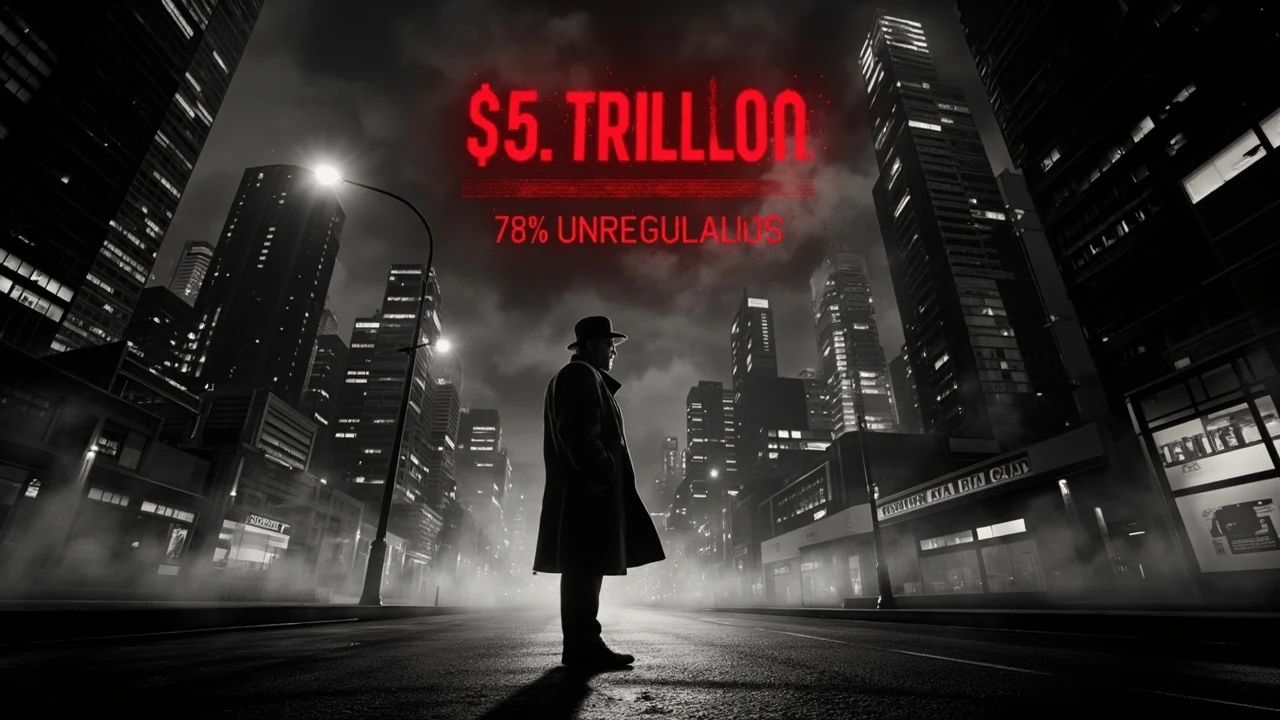

Look, the latest figures from Gaming Compliance International, published on 19 May 2026, frame what most regulators have been quietly admitting for years. Unregulated online gambling moved roughly $5..9 trillion in wagers during 2025, a 4 percent rise on the $5....7 trillion the same firm tracked in 2024. If you treat that handle like a national GDP, the offshore gambling economy sits behind only the United States and China. It is, by GCIs own framing, the worlds third largest economy.
That headline number gets the clicks. The nubmer that actually matters sits two pages deeper in the report. , Of every dollar of gross gaming revenue earned worldwide in online gaming during 2025, 78 cents went to operators with no local license.... Regulated sites kept the remaining 22 cents. The industry that politicians keep promising to bring under control is now four times bigger than the part they regulate.
Think before reactingWhat the GCI report actually measured
GCI used a proprietary metric called Value Per Visit, layered on top of automated traffic surveillance and human analyst review, to estiamte both wagering handle and gross gaming revenue across unlicensed sites.. the $5.9 trillion is total wagers placed, not operator revenue. Sportsbooks typically keep five to ten percent of handle, online casinos keep more. translate that down and the offshore industry earns hundreds of billions in real margin every year. still enormous. Still bigger than the regulated part.
The report stretches the definition of unregulated wide.... It pulls in sports betting, online casinos, poker, lotteries, prediction markets, and crypto gambling. , Anything actively marketed to players in a country where the operator does not hold a locl license counts. That definition is the one regulators use too, which is why these numbers travel quickly into white papers and parliamentary briefings.
This is usualy where mistakes happen.Crypto casinos sit inside the 78 percent
Seriously, this is the part the report does not pretend to soften. , Crypto casinos almost universally operate on offshore licenses, most often issued by Curacao, and they cater to players in countries that have either no online casino framework or a domestic monopoly that excludes crypto rails entirely. By GCIs definition, the vast majority of crypto gamblng is unregulated, full stop.

Whether that is a problem depends on what unregulated actually means in practice. A Curacao license is not nothing. It demands KYC, AML monitoring, and segregated player funds... , eCOGRA, iTech Labs, and Gaming Labs International still certify the random number generators used by Pragmatic Play, Evolution, Hacksaw Gaming, and the rest of the studios feeding the crypto market. the unregulated label captures jurisdictional positioning more than it captures operational quality... A site can run audited games, publish provably fair seeds, process automatic withdrawals, and still fall into the offshore bucket becuase it serves players the local regulator does not want it serving.
Often unnoticed but not here :)The Bloomberg style snapshot
| Metric | 2023 | 2024 | 2025 |
|---|---|---|---|
| Global unregulated handle | $5..1 trillion | $5.7 trillion | $5.9 trillion |
| Year over year growth | n/a | +12% | +4% |
| Unregulated share of online GGR | n/a | n/a | 78% |
| Regulated share of online GGR | n/a | n/a | 22% |
| UK offshore markte value | n/a | n/a | £16.6 billion ($22B) |
The UK number is the single most uncomfortable data point in the entire report. h2 Capitals research, cited inside the GCI document, puts the British offshore online gambling market at £16.6 billion in 2025, up from £5 billion in 2019.. that is a 230 percent increase in six years, in the same window that the UK Gambling Commission tightened affordability checks, capped wagering requirements at 10x, and lifted online slot duties to 40 percent. Tighten the regulated market hard enough and the players walk out the side door.
The unacknowledged gamblng problem
Frankly, gCI added a third category to its framework this year, which is where the report gets genuinely interesting. Unacknowledged gambling covers products that replicate the mechanics of gambling without being formally classified as gambling.. Prediction markets like Kalshi...... Sweepstakes casinos using gold coin and sweeps coin models. Social casinos selling chip packs. Skins trading from CS2. Free to enter TikTok contests where the entry fee is buried in a paid livestream gift. None of these show up in regulator stat sheets. All of them function like casinos to the pepole using them.
Now read that again slowly and tell me Iam wrong :)Ismail Vali, GCIs president, called this the White Noise Marketplace, where consumers cannot reliably tell licensed from unlicensed from technically not gambling. He has a point. The Kalshi federal ruling earlier in May already proved that a prediction market with a CFTC blessing can offer sports outcome contracts in all fifty US states, bypassing every state sportsbook law in the process. That product is not in the regulated 22 percent. , It is also not in the unregulated 78 percent in any meaningful operational sense. It is its own catagory, and it is growing.
What this actually means for crypto casino players
The instinct after a report like this is to assume the offshore market is about to get hammered. That has been the instinct after every previous GCI report too, and the line on the chart still points up... The reasons are simple. Cross border enforcement against payment processors works on fiat rails. it does not work cleanly on Bitcoin, on Tether, on USDC over Solana, or on Lightning channels. a regulator can lean on Stripe... It cannot lean on a Layer 2 settlement layer.
Just another of my 2 satoshis..What changes, slowley, is the experience inside individual jurisdictions. The seven country European coordination agreement signed in November 2025 between Germany, Austria, France, the UK, Italy, Portugal, and Spain has produced a shared blacklist that ISPs are now enforcing in at least four of those markets. DNS blocks are trivially routed around with a VPN, which most crypto players already use, but payment side friction has crept up. , Some Visa and Mastercard issuers in those countries decline transactions to known crypto on ramps that funnel into gambling sites. Players are reacting the way they alwys react by depositing directly in crypto.
Basically, according to CryptoCasino.Vegas research, the share of European deposits arriving as on chain transactions (rather than fiat to crypto via an exchange) rose noticeably across the first quarter of 2026, with USDC over Solana and Lightning routed Bitcoin accounting for most of that shift. The 78 percent number is not about to fall.... The mechanism players use to access it is just becoming more direct.
Think before reacting