Table of Contents
- Introduction to Roulette
- History: From Pascal to Monte Carlo
- The Roulette Wheel: European, American & French
- Inside Bets: Complete Guide with Odds
- Outside Bets: Complete Guide with Odds
- French Rules: La Partage & En Prison
- Roulette Betting Systems: An Honest Analysis
- Complete Roulette Odds & House Edge Reference
- Bankroll Management for Roulette
- Common Mistakes & The Gambler's Fallacy
- Roulette Variations
- Online & Live Dealer Roulette
- Roulette Quick Reference Cheat Sheet
- Roulette Glossary
Introduction to Roulette


Roulette is one of the most iconic and enduring games found in casinos worldwide. Known for its elegant simplicity and the thrill of chance, it captivates both novice gamblers and seasoned players alike. The game is played on a wheel with numbered slots, where a small ball is spun to determine the winning number. Players place bets on where the ball will land, with various betting options available, ranging from specific numbers to broader categories like red or black.
There are two primary variations of Roulette: European and American. The key difference between these versions lies in the wheel's configuration. The European Roulette wheel consists of 37 slots, numbered 0 to 36, while the American wheel features an additional double zero (00), making a total of 38 slots. This seemingly minor difference has a significant impact on the house edge.
In European Roulette, the house edge is approximately 2.70%. This is calculated based on the single zero, which gives the house a slight advantage over the player. In contrast, American Roulette has a higher house edge of about 5.26%, due to the presence of the extra double zero. This additional slot increases the probability of the house winning, making European Roulette the more favorable option for players seeking better odds.
This guide will delve into every aspect of Roulette, providing comprehensive insights and strategies for players at all levels. From understanding the history and mechanics of the game to mastering advanced betting strategies, each section is designed to enhance your knowledge and improve your chances of success. Whether you're a beginner learning the basics or an expert refining your skills, this guide aims to be the ultimate resource for all things Roulette.
As you progress through this guide, you'll gain a deeper understanding of how to effectively manage your bankroll, evaluate betting systems, and make informed decisions at the table. By the end of your journey, you'll not only appreciate the nuances of Roulette but also be equipped with the tools to maximize your enjoyment and potential winnings.

History: From Pascal to Monte Carlo

The history of Roulette is a fascinating journey from the scientific endeavors of a 17th-century mathematician to the glitzy casino floors of Monte Carlo. The game's evolution is marked by innovation, cultural shifts, and mathematical intrigue.
Blaise Pascal's Perpetual Motion Attempt (1655)
Roulette's origins can be traced back to the mid-17th century, when French mathematician Blaise Pascal, in his quest for a perpetual motion machine, inadvertently laid the groundwork for the modern Roulette wheel. In 1655, Pascal's attempts to create a device that could operate indefinitely without an external energy source led to the development of a primitive spinning wheel. Although his perpetual motion machine was not feasible, the concept of a spinning wheel with numbered slots became the precursor to the Roulette wheel.
French Origin and Development
The game of Roulette as we know it began to take shape in France during the late 18th century. It was first mentioned in its current form in 1796 in a novel by Jacques Lablee, describing the game played in the Palais Royal in Paris. The early French version of Roulette included a wheel with slots numbered from 1 to 36, along with a single zero slot, which gave the house its edge.
Single vs Double Zero Debate
In the early 19th century, Roulette crossed the Atlantic to America, where it underwent significant modification. The American version of Roulette introduced an additional double zero (00) slot, increasing the house edge and making the game more profitable for casinos. This alteration created a divergence in Roulette variants: the European version, which retained a single zero, and the American version with both single and double zero slots.
| Variant | Zero Slots | House Edge |
|---|---|---|
| European Roulette | Single Zero (0) | 2.70% |
| American Roulette | Single Zero (0) and Double Zero (00) | 5.26% |
The debate between single and double zero Roulette is primarily about player odds versus casino profitability. European Roulette, with its single zero, offers better odds for players, while American Roulette, with its additional double zero, increases the casino's advantage.
Monte Carlo: The Glamour of Roulette
Monte Carlo, a district in Monaco, became synonymous with Roulette in the late 19th century. The famed Monte Carlo Casino, established in 1863, was instrumental in popularizing the European version of the game. This luxurious destination attracted aristocrats and wealthy patrons, cementing Roulette's reputation as a glamorous and sophisticated pastime.
The allure of Monte Carlo and its association with Roulette was further immortalized in literature and film, making it a symbol of elegance and high-stakes gambling. The casino's use of the single zero wheel contributed to its appeal, attracting players seeking better odds than those offered in American casinos.
In conclusion, Roulette's history is a rich tapestry woven with scientific curiosity, cultural adaptation, and the relentless pursuit of fortune. From Pascal's workshop to the opulent halls of Monte Carlo, Roulette has evolved into one of the most enduring and iconic games in the world of gambling.
The Roulette Wheel: European, American & French

The roulette wheel is a masterpiece of design, combining mathematics, probability, and engineering. Understanding the differences between the European, American, and French roulette wheels is crucial for any player aiming to refine their strategy and improve their chances. Each variant offers a unique structure, with differences in the number of pockets, zero pockets, and house edge, which affect the odds and potential payouts.
Wheel Structure and Zero Pockets
The primary distinction between the roulette wheels lies in the number of pockets and the presence of zero pockets:
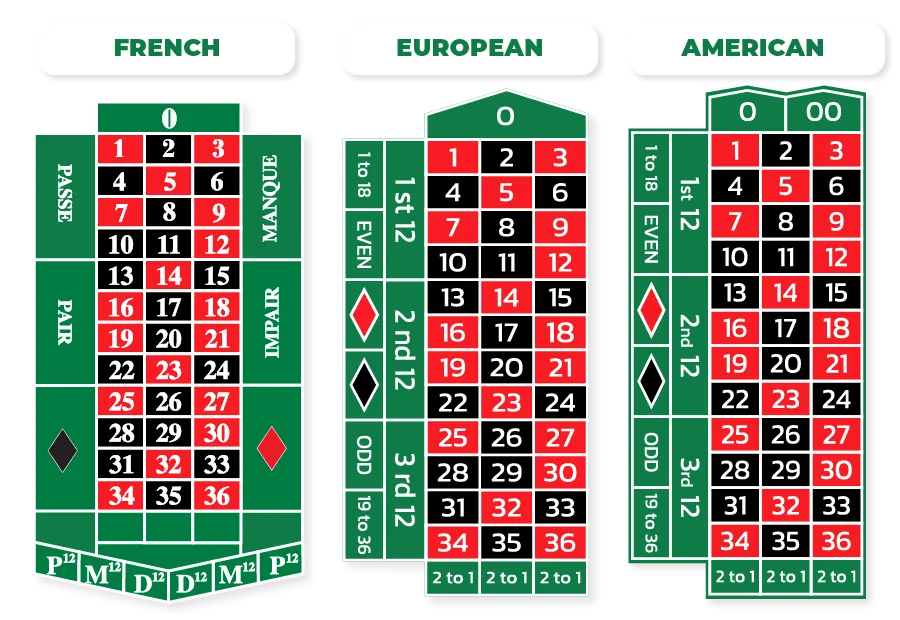
- European Roulette: This wheel features 37 pockets, numbered 0-36. It has a single green zero pocket. The house edge is calculated at 2.70%.
- American Roulette: This version includes 38 pockets, numbered 0-36, with an additional double zero (00) pocket. The house edge here is significantly higher at 5.26% due to the extra zero.
- French Roulette: Similar to the European wheel with 37 pockets and a single zero, but it offers the La Partage rule, which returns half of the even-money bets if the ball lands on zero, effectively reducing the house edge to 1.35% on these bets.
| Wheel Type | Number of Pockets | Zero Pockets | House Edge |
|---|---|---|---|
| European | 37 | 1 (0) | 2.70% |
| American | 38 | 2 (0, 00) | 5.26% |
| French | 37 | 1 (0) | 1.35% (with La Partage on even-money bets) |
Number Sequences and Distribution
The sequence of numbers on a roulette wheel is not in numerical order. Instead, they are arranged to balance the distribution of odd and even numbers, high and low numbers, and the colors red and black. This arrangement ensures that the outcomes are as random as possible, and it also adds to the complexity and excitement of the game.
European Wheel Number Sequence
The European roulette wheel sequence is designed to alternate between red and black numbers and to distribute odd and even numbers evenly around the wheel. Here is the complete sequence:
| European Wheel Sequence |
|---|
| 0 |
| 32 |
| 15 |
| 19 |
| 4 |
| 21 |
| 2 |
| 25 |
| 17 |
| 34 |
| 6 |
| 27 |
| 13 |
| 36 |
| 11 |
| 30 |
| 8 |
| 23 |
| 10 |
| 5 |
| 24 |
| 16 |
| 33 |
| 1 |
| 20 |
| 14 |
| 31 |
| 9 |
| 22 |
| 18 |
| 29 |
| 7 |
| 28 |
| 12 |
| 35 |
| 3 |
| 26 |
This sequence ensures an equitable distribution of the various betting options around the wheel, minimizing any bias that might arise from wheel imbalances. The design of the wheel, with its non-numerical sequence, aims to provide a fair and unpredictable gaming experience, making roulette a beloved game of chance for centuries.
Inside Bets: Complete Guide with Odds

Inside bets in Roulette are wagers placed on the numbers on the inside section of the betting table. These bets offer higher payouts compared to outside bets, but they also come with lower probabilities of winning. In this section, we will explore each type of inside bet with detailed information on how to place them, their payouts, and the associated probabilities and house edges for both European and American Roulette. Understanding these nuances will enhance your strategic approach to the game.
Straight Up Bet
A Straight Up bet is placed on a single number. To make this bet, place your chip directly on the number you wish to bet on. This bet offers the highest payout among inside bets.
Split Bet
A Split bet covers two adjacent numbers on the table. To place a Split bet, put your chip on the line shared by the two numbers. This bet allows you to cover two numbers with a single wager.
Street Bet
A Street bet involves three consecutive numbers in a row. To place a Street bet, position your chip at the end of the row you wish to bet on, covering all three numbers.
Corner Bet
A Corner bet covers four numbers that form a square on the table. Place your chip at the intersection of these four numbers to make a Corner bet.
Six Line Bet
A Six Line bet covers two adjacent rows, totaling six numbers. To place this bet, put your chip at the intersection of the two rows at the end of the table.
Five Number Bet
The Five Number bet is unique to American Roulette and covers the numbers 0, 00, 1, 2, and 3. It is considered the worst bet in American Roulette due to its high house edge. To place this bet, position your chip on the line that separates the 0 and 1, covering the 00 as well.
| Bet Name | Numbers Covered | Payout | European Probability | European HE | American HE |
|---|---|---|---|---|---|
| Straight Up | 1 | 35:1 | 2.70% | 2.70% | 5.26% |
| Split | 2 | 17:1 | 5.41% | 2.70% | 5.26% |
| Street | 3 | 11:1 | 8.11% | 2.70% | 5.26% |
| Corner | 4 | 8:1 | 10.81% | 2.70% | 5.26% |
| Six Line | 6 | 5:1 | 16.22% | 2.70% | 5.26% |
| Five Number | 5 | 6:1 | — | — | 7.89% |
Understanding the probabilities and house edges associated with each type of inside bet can significantly improve your Roulette strategy. While the allure of high payouts is tempting, being aware of the odds and house edge can help you make informed decisions. Remember, in European Roulette, the house edge for most inside bets remains at 2.70%, whereas in American Roulette, it generally increases to 5.26%, with the exception of the Five Number bet, which has the highest house edge at 7.89%.
Outside Bets: Complete Guide with Odds

Outside bets in Roulette offer a variety of options for players seeking safer, albeit lower payout, wagering opportunities. These bets are placed on specific sections outside the numbered grid on the Roulette table. They cover larger groups of numbers, providing a higher probability of winning compared to inside bets. In this section, we will detail each type of outside bet, including Red/Black, Even/Odd, High/Low, Dozens, and Columns, with exact odds, probabilities, and house edge (HE) considerations. Additionally, we will explore the impact of the La Partage rule on these bets.
Types of Outside Bets
Outside bets can be categorized into five main types, each with distinct characteristics. Below is a comprehensive table that outlines the specifics for each outside bet type, including the numbers covered, payout ratios, win probabilities for European Roulette, and house edge.
| Bet | Numbers Covered | Payout | European Win Prob. | European HE |
|---|---|---|---|---|
| Red or Black | 18 | 1:1 | 48.65% | 2.70% |
| Even or Odd | 18 | 1:1 | 48.65% | 2.70% |
| High (19-36) or Low (1-18) | 18 | 1:1 | 48.65% | 2.70% |
| Dozen | 12 | 2:1 | 32.43% | 2.70% |
| Column | 12 | 2:1 | 32.43% | 2.70% |
Detailed Explanation of Each Bet Type
- Red or Black: This bet involves wagering on either all the red numbers or all the black numbers on the wheel. With 18 numbers each, the probability of winning is 48.65% in European Roulette.
- Even or Odd: Players bet on either all the even or all the odd numbers. Similar to Red/Black, this covers 18 numbers, offering the same probability and payout.
- High or Low: This bet involves choosing either the high numbers (19-36) or the low numbers (1-18), again covering 18 numbers with identical probabilities and payouts as Red/Black and Even/Odd.
- Dozen: The table is divided into three groups of 12 numbers each (1-12, 13-24, and 25-36). Betting on any of these groups offers a payout of 2:1, with a win probability of 32.43%.
- Column: Similar to the dozen bet, the column bet involves wagering on one of the three vertical columns on the table, each containing 12 numbers, with the same odds and payout as the dozen bet.
Impact of the La Partage Rule
The La Partage rule is a feature in French Roulette that affects even-money outside bets (Red/Black, Even/Odd, High/Low). If the ball lands on zero, players lose only half of their stake instead of the entire amount. This significantly reduces the house edge for these specific bets from 2.70% to 1.35%. This rule makes French Roulette particularly appealing to players who favor even-money bets, as it effectively increases their chances of retaining part of their wager when the zero appears.
Understanding the dynamics of outside bets is crucial for players aiming to employ strategic betting while minimizing risk. With higher probabilities of winning compared to inside bets, outside bets offer a steady approach to Roulette, particularly when coupled with advantageous rules like La Partage.
French Rules: La Partage & En Prison

French Roulette offers players unique rules that can significantly reduce the house edge on even-money bets. These rules, known as La Partage and En Prison, provide an intriguing twist to the traditional game and are highly beneficial to players looking to maximize their odds of winning.
La Partage
The La Partage rule comes into play when you place an even-money bet, such as Red/Black, Odd/Even, or High/Low, and the ball lands on zero. Instead of losing the entire bet, the player gets half of their stake back. This rule effectively reduces the house edge on even-money bets from 2.70% to 1.35% in European Roulette, making it a highly favorable option for players.
The math behind this reduction is straightforward. In a standard European Roulette game with 37 numbers (1-36 and a single zero), the probability of hitting zero is 1/37, or approximately 2.70%. When La Partage is in effect, you lose only half of your bet when zero hits, effectively halving the house edge on these bets:
- Standard house edge on even-money bets: 2.70%
- House edge with La Partage: 1.35%
En Prison
En Prison is another rule that applies to even-money bets when the ball lands on zero. Instead of losing the bet or receiving half back, your bet is "imprisoned" for the next spin. If your bet wins on the subsequent spin, you retrieve your original stake. If it loses, the bet is forfeited. While this rule does not mathematically cut the house edge in half like La Partage, it offers a slightly lower expected value in the long run, as your bet remains in play for an additional spin.
Comparison and Availability
Both La Partage and En Prison offer reduced house edges compared to standard European and American Roulette rules. However, these rules are primarily found in French Roulette games, which may not be as widespread in casinos outside of Europe. Players interested in taking advantage of these rules should specifically look for tables labeled as "French Roulette."
| Rule | Effect | House Edge on Even-Money Bets | Where Found |
|---|---|---|---|
| La Partage | Half of the stake is returned when zero hits | 1.35% | French Roulette, select European casinos |
| En Prison | Bet is imprisoned for a subsequent spin when zero hits | ~1.35% (slightly lower EV than La Partage) | French Roulette, select European casinos |
In conclusion, the La Partage and En Prison rules are excellent options for players seeking to reduce the house edge on even-money bets. By understanding and leveraging these rules, players can enhance their gaming experience and improve their chances of winning over time. When selecting a roulette table, players should actively seek out French Roulette variants to take advantage of these favorable rules.
Roulette Betting Systems: An Honest Analysis

Roulette betting systems have long captivated players with the promise of beating the house. However, it's crucial to understand that no betting system can alter the fundamental house edge inherent in roulette. Below, we analyze four popular betting systems: Martingale, Fibonacci, D'Alembert, and Labouchère. Each system has its unique mechanics, risks, and mathematical realities.
Martingale System
The Martingale system is straightforward: double your bet after every loss. This approach aims to recover all previous losses with a single win. An example sequence for a $1 initial bet is: 1, 2, 4, 8, 16, 32, 64, 128, 256, 512, totaling $1,023 after nine consecutive losses just to win $1.
| Consecutive Losses | Bet Amount | Total Bet |
|---|---|---|
| 1 | $1 | $1 |
| 2 | $2 | $3 |
| 3 | $4 | $7 |
| 4 | $8 | $15 |
| 5 | $16 | $31 |
| 6 | $32 | $63 |
| 7 | $64 | $127 |
| 8 | $128 | $255 |
| 9 | $256 | $511 |
| 10 | $512 | $1,023 |
The main risk is encountering a long losing streak that either depletes your bankroll or hits the table limit, making it impossible to continue doubling. The expected value per spin remains the house edge (2.7% for European and 5.26% for American roulette) times the total amount bet.
Fibonacci System
The Fibonacci system is based on the famous Fibonacci sequence: 1, 1, 2, 3, 5, 8, 13, etc. After a loss, move one step forward in the sequence; after a win, move back two steps. This system escalates more slowly than Martingale but still shares the same fundamental flaws.
| Spin | Bet Amount | Result | Sequence Position |
|---|---|---|---|
| 1 | $1 | Loss | 1 |
| 2 | $1 | Loss | 2 |
| 3 | $2 | Loss | 3 |
| 4 | $3 | Win | 1 |
| 5 | $1 | Loss | 2 |
Despite the slower progression, the Fibonacci system cannot overcome the house edge. The expected value per spin is still the house edge multiplied by the total bet amount.
D'Alembert System
The D'Alembert system is less aggressive than Martingale. You increase your bet by one unit after a loss and decrease it by one unit after a win. The system aims to achieve a balance between wins and losses over time.
| Spin | Bet Amount | Result | Net Gain/Loss |
|---|---|---|---|
| 1 | $1 | Loss | -$1 |
| 2 | $2 | Loss | -$3 |
| 3 | $3 | Win | 0 |
| 4 | $2 | Loss | -$2 |
| 5 | $3 | Win | +$1 |
While less risky than Martingale, D'Alembert cannot change the expected value per spin, which is the house edge times the total amount bet.
Labouchère System
The Labouchère or "cancellation" system involves creating a sequence of numbers (e.g., 1-2-3-4-5). You bet the sum of the first and last numbers in the sequence. If you win, cross off those numbers; if you lose, add the bet amount to the end of the sequence.
| Sequence | Bet Amount | Result | New Sequence |
|---|---|---|---|
| 1-2-3-4-5 | $6 | Win | 2-3-4 |
| 2-3-4 | $6 | Loss | 2-3-4-6 |
| 2-3-4-6 | $8 | Win | 3-4 |
| 3-4 | $7 | Win | 4 |
| 4 | $4 | Win |
While the Labouchère system offers a structured approach, it cannot alter the fundamental math of roulette. The expected value per spin remains the house edge times the total bet amount.
In conclusion, while these systems may offer entertainment and a sense of strategy, they do not change the house edge or the expected value of each bet. Successful roulette play should always consider the inherent risks and probabilities involved, rather than relying on flawed betting systems.
Complete Roulette Odds & House Edge Reference

Understanding the odds and house edge associated with different Roulette bets is crucial for both beginners and seasoned players. This section provides a comprehensive table detailing the probabilities, house edges, and expected losses for each type of Roulette wheel: European, American, and French with La Partage. This reference will help you make informed decisions at the Roulette table.
Master Table of Roulette Bets
The table below presents a detailed comparison of various Roulette bets, with their respective house edges and expected loss per $100 wagered. The house edge is a measure of the casino's advantage over the player. It represents the percentage of each bet that the casino expects to keep in the long run. The expected loss per $100 bet helps illustrate how much you might lose on average when betting on each option.
| Bet | European HE | American HE | French (La Partage) HE | Expected Loss per $100 (European) | Expected Loss per $100 (American) | Expected Loss per $100 (French) |
|---|---|---|---|---|---|---|
| Straight Up | 2.70% | 5.26% | 2.70% | $2.70 | $5.26 | $2.70 |
| Split | 2.70% | 5.26% | 2.70% | $2.70 | $5.26 | $2.70 |
| Street | 2.70% | 5.26% | 2.70% | $2.70 | $5.26 | $2.70 |
| Corner | 2.70% | 5.26% | 2.70% | $2.70 | $5.26 | $2.70 |
| Line | 2.70% | 5.26% | 2.70% | $2.70 | $5.26 | $2.70 |
| Column/Dozen | 2.70% | 5.26% | 2.70% | $2.70 | $5.26 | $2.70 |
| Even Money (Red/Black, Even/Odd, High/Low) | 2.70% | 5.26% | 1.35% | $2.70 | $5.26 | $1.35 |
| Five-Number (First Five) | N/A | 7.89% | N/A | N/A | $7.89 | N/A |
The European Roulette wheel contains a single zero, which results in a house edge of 2.70% on all bets except the five-number bet, which is not available on this wheel. The American Roulette wheel, with its additional double zero, increases the house edge to 5.26%, making it less favorable for players. The French Roulette wheel offers a special rule, La Partage, which applies to even-money bets. When the ball lands on zero, half of the even-money bet is returned to the player, effectively reducing the house edge to 1.35% for those bets.
By understanding these statistics, players can better assess the risk and potential losses associated with each type of bet in the different Roulette variants. Remember, while the house edge is an essential factor in long-term play, short-term outcomes can vary significantly due to the inherent variance in the game. Use this table as a guide to making informed betting decisions.
Bankroll Management for Roulette

Effective bankroll management is a crucial aspect of playing roulette, as it helps players extend their gameplay, manage risk, and potentially enhance their overall experience. This section will guide you through setting a session budget, determining appropriate bet sizing, implementing a stop-loss strategy, and understanding the math that influences session length.
Session Budget
Your session budget is the total amount of money you are willing to risk in a single session of roulette. It should be an amount you are comfortable losing, as there are no guarantees in gambling. A common rule of thumb is to allocate no more than 5% of your total gambling bankroll to a single session. For example, if your total bankroll is $1,000, your session budget should not exceed $50. This approach helps prevent significant losses and promotes responsible gambling.
Bet Sizing
Bet sizing refers to the amount you wager on each spin. It should be consistent with your session budget and personal risk tolerance. A conservative strategy is to limit each bet to 1-2% of your session budget. For instance, with a $50 session budget, each bet should range from $0.50 to $1.00. This allows for more spins and reduces the risk of depleting your budget quickly.
| Session Budget | 1% Bet Size | 2% Bet Size | Number of Spins at 1% | Number of Spins at 2% |
|---|---|---|---|---|
| $50 | $0.50 | $1.00 | 100 | 50 |
| $100 | $1.00 | $2.00 | 100 | 50 |
| $200 | $2.00 | $4.00 | 100 | 50 |
Stop-Loss Strategy
A stop-loss strategy is a predetermined threshold at which you will stop playing to prevent further losses. This can be set as a percentage of your session budget or as a specific dollar amount. For example, if your session budget is $50, you might set a stop-loss at $40, meaning if your balance falls to $10, you will stop playing. This strategy helps protect your bankroll and ensures you walk away before incurring excessive losses.
The Math of Session Length
The length of a roulette session is influenced by your bet size, the house edge, and your overall strategy. The house edge for European roulette is approximately 2.70%, while American roulette is higher at 5.26% due to the additional double zero. The smaller your bet relative to your session budget, the longer you can play. For example, with a $50 budget and $0.50 bets, you could theoretically enjoy 100 spins, assuming no wins or losses alter your bankroll.
It's important to understand that, statistically, the longer you play, the more likely the house edge will erode your bankroll. This is why setting a session budget, using appropriate bet sizing, and implementing a stop-loss strategy are essential components of effective bankroll management. By adhering to these principles, you can enhance your enjoyment of roulette while minimizing financial risk.
Common Mistakes & The Gambler's Fallacy

The Gambler's Fallacy: An Independent Event Misunderstanding
The Gambler's Fallacy is a common misconception that affects many players at the roulette table. To understand this fallacy, consider a simple coin flip. If you flip a fair coin and it lands on heads five times in a row, you might think that tails is "due" to occur. However, each flip is an independent event with a 50% chance of resulting in heads and a 50% chance of tails, regardless of previous outcomes.
Similarly, in roulette, each spin is independent of the previous ones. If the ball lands on black five times consecutively, it does not increase the probability of red occurring on the next spin. Each spin has the same probabilities: 18/37 for red or black in European Roulette and 18/38 in American Roulette, with the remaining probability for the zero(s).
The Hot/Cold Numbers Myth
Many players fall into the trap of betting on "hot" numbers — those that have appeared frequently in recent spins — or avoiding "cold" numbers that haven't appeared for a while. However, roulette wheels are designed to be random, and past results do not influence future outcomes. A number's recent performance doesn't change its odds of appearing on the next spin: each number always has the same probability (1/37 in European, 1/38 in American) of being hit.
Choosing American Over European Roulette
A critical mistake players make is choosing American Roulette over European Roulette. The American wheel has an additional double zero (00) pocket, increasing the house edge from 2.70% in European Roulette to 5.26% in American Roulette. This difference significantly impacts expected value (EV) and long-term losses. For every $100 wagered, a player can expect to lose $2.70 in European versus $5.26 in American Roulette.
Betting System Traps
Many players rely on betting systems like the Martingale, where they double their bet after each loss, hoping to recover all losses with a single win. While such systems may seem promising, they fail to account for table limits and the exponential growth of bet sizes. Moreover, the house edge ensures that, over time, the casino will profit. Here's a quick comparison of popular betting systems and their drawbacks:
| Betting System | Description | Drawbacks |
|---|---|---|
| Martingale | Double bet after each loss | Table limits, rapid bankroll depletion |
| Fibonacci | Bet based on Fibonacci sequence | Complexity, large losses during streaks |
| D'Alembert | Increase bet by one unit after loss | Slow recovery, potential for significant loss |
Top 5 Most Expensive Mistakes and Their EV Costs
Understanding the financial impact of common mistakes can help players make more informed decisions. Below are the top five costly mistakes in roulette, along with their expected value costs:
| Mistake | Explanation | EV Cost per $100 Bet |
|---|---|---|
| Choosing American Roulette | Higher house edge due to double zero | $5.26 |
| Following hot/cold numbers | Illusion of patterns in randomness | Varies, but consistently negative |
| Using the Martingale system | Exponential bet growth, table limits | Potential entire bankroll loss |
| Ignoring bankroll management | Betting too large relative to bankroll | Rapid depletion of funds |
| Misunderstanding odds | Betting based on incorrect probabilities | Consistent losses over time |
By recognizing these mistakes and understanding the true nature of roulette probabilities, players can make more informed choices and enjoy the game with a realistic perspective on their chances of winning.
Roulette Variations

Roulette is a game with a rich history and multiple variations, each offering unique features, rules, and odds. Understanding these variations is crucial for players seeking to optimize their strategy and betting approach. Below, we explore the most popular types of roulette: European, American, French, Lightning Roulette, Double Ball, Mini Roulette, and Multiwheel. Each variation presents different house edges and strategic opportunities.
European Roulette
European Roulette is the most common version played in casinos worldwide. It features a wheel with 37 pockets, numbered from 0 to 36. The presence of a single zero gives the game a house edge of 2.70%. This version is preferred by many due to its lower house edge compared to American Roulette.
American Roulette
American Roulette is distinguished by the inclusion of an additional double zero (00) pocket, bringing the total to 38 pockets. This increases the house edge to 5.26%, making it less favorable for players compared to the European version. The extra pocket affects the odds of winning, particularly for single-number bets.
French Roulette
French Roulette is similar to European Roulette but offers additional rules such as "La Partage" and "En Prison," which can reduce the house edge to 1.35% on even-money bets. These rules allow players to recover half their bet or keep it for the next spin if the ball lands on zero.
Lightning Roulette
Lightning Roulette is an innovative variant that combines traditional European Roulette with RNG-based multipliers. During each round, one to five "Lucky Numbers" are struck by lightning, offering payouts of 50x to 500x. The base game maintains a house edge of 2.70%, but the potential for higher payouts adds excitement.
Double Ball Roulette
As the name suggests, Double Ball Roulette uses two balls on the same wheel, doubling the chances of winning on certain bets. The house edge remains close to European Roulette at 2.70%, but players can make unique bets, such as both balls landing on the same number, which offers a high payout.
Mini Roulette
Mini Roulette features a smaller wheel with only 13 pockets (0 to 12). The reduced number of pockets increases the house edge to approximately 3.85%. However, some versions offer a "half-back" rule similar to La Partage, which can mitigate this disadvantage on even-money bets.
Multiwheel Roulette
Multiwheel Roulette allows players to bet on multiple wheels simultaneously, increasing the action and potential for wins. Each wheel operates independently, and the house edge is consistent with European Roulette at 2.70%. This variation is ideal for players who enjoy fast-paced gameplay and higher volatility.
| Variation | Key Feature | House Edge | Best Bet |
|---|---|---|---|
| European Roulette | Single zero | 2.70% | Single number (35:1) |
| American Roulette | Double zero | 5.26% | Even-money bets |
| French Roulette | La Partage/En Prison | 1.35% (even-money bets) | Even-money bets |
| Lightning Roulette | Multiplier payouts | 2.70% | Single number with multiplier |
| Double Ball Roulette | Two balls per spin | 2.70% | Unique bets like both balls on same number |
| Mini Roulette | 13 pockets | 3.85% | Even-money bets with half-back rule |
| Multiwheel Roulette | Multiple wheels | 2.70% | Spread bets across wheels |
Online & Live Dealer Roulette

In the modern gaming landscape, online and live dealer roulette have become popular choices for players worldwide. These platforms offer the convenience of playing from home while maintaining the thrill and authenticity of traditional casino roulette. Here, we explore the differences between RNG roulette and live dealer rooms, highlight key providers like Evolution Gaming, discuss variations such as Speed Roulette, and examine the potential for online bonuses.
RNG Roulette
RNG (Random Number Generator) roulette is a digital version of the game where outcomes are determined by sophisticated algorithms ensuring fair play. This version typically offers faster play, as there is no need to wait for a physical wheel to spin. Players can enjoy various table limits and game variations, such as European or American roulette, with the house edge remaining consistent with their physical counterparts: 2.70% for European and 5.26% for American roulette.
Live Dealer Rooms
Live dealer roulette bridges the gap between online and brick-and-mortar casinos by streaming real-time games hosted by professional croupiers. Players can interact with dealers and other participants, enhancing the social aspect of the game. Evolution Gaming is a leader in this field, known for its high-quality streams and innovative game variants.
Evolution Gaming and Speed Roulette
Evolution Gaming offers a wide range of roulette games, including Speed Roulette, which is designed for players seeking a faster-paced experience. In Speed Roulette, game rounds are completed in 25 seconds, compared to the standard 45 seconds in traditional live games, allowing for more bets in a shorter time frame. Despite the increased speed, the integrity and fairness of the game are maintained, with a house edge of 2.70% for European Speed Roulette.
Bonuses and Promotions
One of the advantages of online roulette is the availability of bonuses and promotions. These can include welcome bonuses, deposit matches, and cashback offers. It's crucial for players to read the terms and conditions, as bonuses often come with wagering requirements that must be met before any winnings can be withdrawn. For instance, a typical bonus might require 30x wagering on the bonus amount before cashing out.
In conclusion, online and live dealer roulette offer diverse opportunities for players at all skill levels. Whether you prefer the algorithm-driven precision of RNG games or the immersive experience of live dealer tables, understanding the nuances of each can enhance your playing strategy and enjoyment.
Roulette Quick Reference Cheat Sheet

This section provides a concise overview of all essential aspects of Roulette, including bets, payouts, house edges, and strategic golden rules. Use this cheat sheet for quick reference during play.
Inside Bets Summary
| Bet Type | Payout | Probability (European) | Probability (American) | House Edge (European) | House Edge (American) |
|---|---|---|---|---|---|
| Straight | 35:1 | 2.70% | 2.63% | 2.70% | 5.26% |
| Split | 17:1 | 5.41% | 5.26% | 2.70% | 5.26% |
| Street | 11:1 | 8.11% | 7.89% | 2.70% | 5.26% |
| Corner | 8:1 | 10.81% | 10.53% | 2.70% | 5.26% |
| Six Line | 5:1 | 16.22% | 15.79% | 2.70% | 5.26% |
Outside Bets Summary
| Bet Type | Payout | Probability (European) | Probability (American) | House Edge (European) | House Edge (American) |
|---|---|---|---|---|---|
| Red/Black | 1:1 | 48.65% | 47.37% | 2.70% | 5.26% |
| Odd/Even | 1:1 | 48.65% | 47.37% | 2.70% | 5.26% |
| High/Low | 1:1 | 48.65% | 47.37% | 2.70% | 5.26% |
| Dozens | 2:1 | 32.43% | 31.58% | 2.70% | 5.26% |
| Columns | 2:1 | 32.43% | 31.58% | 2.70% | 5.26% |
Wheel Comparison
| Wheel Type | Number of Pockets | House Edge | Best Choice |
|---|---|---|---|
| European | 37 | 2.70% | Yes |
| American | 38 | 5.26% | No |
| French | 37 | 1.35% with La Partage/En Prison | Yes |
Top 3 Golden Rules
- Choose European or French Roulette: The lower house edge significantly improves your odds over American Roulette.
- Utilize La Partage or En Prison Rules: These rules can cut the house edge on even-money bets to 1.35%.
- Manage Your Bankroll Wisely: Set limits and never chase losses to maintain control over your gambling experience.
Roulette Glossary

Understanding the terminology of roulette is essential for both beginners and seasoned players who wish to enhance their gameplay. Below is a comprehensive glossary of roulette terms, providing clear definitions and insights into the game's language.
| Term | Definition |
|---|---|
| American Wheel | A roulette wheel layout featuring 38 pockets, including numbers 1 to 36, a single zero (0), and a double zero (00), resulting in a higher house edge of 5.26%. |
| Backtrack | The outer rim of the roulette wheel where the ball spins before landing in a pocket. |
| Ball Track | Similar to the backtrack, it is the grooved track on the roulette wheel where the ball is initially spun. |
| Biased Wheel | A roulette wheel with imperfections, causing certain numbers to come up more frequently than others. |
| Carré | French term for a corner bet, which covers four numbers in a square layout on the betting table. |
| Cheval | French for a split bet, which covers two adjacent numbers on the betting layout. |
| Column Bet | A bet placed on one of the three columns of numbers on the roulette table, covering 12 numbers and paying 2:1. |
| Corner Bet | A bet on four numbers that form a square on the betting layout, paying 8:1. |
| Croupier | The casino employee responsible for spinning the roulette wheel and managing the bets. |
| D'Alembert | A betting system where the player increases their bet after a loss and decreases it after a win, aiming to balance wins and losses. |
| Dolly | A small marker used by the croupier to indicate the winning number on the roulette table. |
| Double Zero | The additional zero pocket found on the American roulette wheel, contributing to the higher house edge. |
| Dozen Bet | A bet that covers a group of 12 numbers, such as 1-12, 13-24, or 25-36, paying 2:1. |
| En Prison | A French roulette rule where even-money bets are "imprisoned" if the ball lands on zero, allowing a second chance on the next spin. |
| European Wheel | A roulette wheel with 37 pockets, including numbers 1 to 36 and a single zero (0), offering a lower house edge of 2.70%. |
| Even Money | Bets that pay 1:1, such as red/black, odd/even, and high/low. |
| Five-Number Bet | A bet available only on the American wheel, covering 0, 00, 1, 2, and 3, with a house edge of 7.89%. |
| French Wheel | Similar to the European wheel, it features 37 pockets, and often includes additional rules like La Partage and En Prison. |
| Gambler's Fallacy | The incorrect belief that past events influence future outcomes in a game of chance, such as expecting a red number after several blacks. |
| High/Low | An even-money bet on either the high numbers (19-36) or the low numbers (1-18). |
| House Edge | The statistical advantage the casino has over the player, expressed as a percentage of the player's bet. |
| Inside Bet | Bets placed on the numbers themselves on the roulette table, including straight up, split, street, and corner bets. |
| La Partage | A French roulette rule where half of an even-money bet is returned to the player if the ball lands on zero. |
| Martingale | A betting strategy that involves doubling the bet after a loss, aiming to recover all previous losses with a single win. |
| Neighbour Bets | Bets that cover a number and its adjacent numbers on the roulette wheel. |
| Outside Bet | Bets placed outside the number grid on the roulette table, including red/black, odd/even, and column bets. |
| One of the slots on the roulette wheel where the ball can land, each corresponding to a number. | |
| Straight Up | A bet on a single number, paying 35:1. |
| Street Bet | A bet on a row of three numbers on the betting layout, paying 11:1. |
| Tiers du Cylindre | A French term for a bet covering a specific section of the wheel, typically 12 numbers opposite the zero. |
| Voisins du Zéro | A French term for a bet covering the 17 numbers surrounding the zero on the wheel. |