

Table of Contents
- Introduction to Dragon Tiger
- History & Origins
- How to Play: Complete Rules
- Card Ranking & Tie Rules
- Side Bets: Suited Tie, Big/Small, Odd/Even
- Odds & House Edge: Complete Analysis
- Dragon Tiger Strategy: What Actually Helps
- Bankroll Management
- Dragon Tiger vs. Baccarat: Which Should You Play?
- Online & Live Dealer Dragon Tiger
- Dragon Tiger Glossary & Cheat Sheet
Introduction to Dragon Tiger


Dragon Tiger stands out as one of the simplest and fastest casino games available today. Its straightforward nature makes it an attractive option for both novice players and seasoned gamblers seeking a quick and exciting round of play. In Dragon Tiger, the game boils down to a single decision: two cards are dealt, one to the "Dragon" position and one to the "Tiger" position, and the higher card wins. This pure high-card comparison is what gives the game its speed and simplicity.
Originally gaining massive popularity in Asian countries like Cambodia and the Philippines, Dragon Tiger has successfully transitioned to online casinos, where it continues to captivate players worldwide. The game’s allure lies not only in its simplicity but also in its rapid pace, making it possible to play numerous rounds in a short period. This has contributed to its widespread popularity and adoption in many gaming venues.
The primary bets in Dragon Tiger are straightforward: you can bet on the Dragon, the Tiger, or a Tie. The house edge on the main Dragon and Tiger bets is approximately 3.73%, which is relatively low compared to many other casino games, making it appealing to players looking for better odds. However, the Tie bet, while offering a higher payout, comes with a significantly higher house edge of around 32.77%, which makes it a riskier option.
Dragon Tiger's simplicity means there are no complex strategies or intricate rules to memorize. This makes it accessible to players of all experience levels. Despite its simplicity, understanding the odds and house edge is crucial for making informed betting decisions. As you delve deeper into the game, you will find that this high-speed card game offers not just entertainment, but also a chance to engage with one of the most popular casino games in Asia and the online gaming world.
In the sections that follow, we'll explore the history and origins of Dragon Tiger, delve into the complete rules of play, and provide strategic insights to help you make the most of your gaming experience. Whether you're playing in a bustling casino or from the comfort of your home, Dragon Tiger offers a unique blend of simplicity and excitement that is hard to match.

History & Origins

Dragon Tiger is a straightforward card game that originated in Cambodia, a country known for its rich history and cultural diversity. The game quickly gained popularity across Southeast Asia due to its simplicity and fast-paced nature. Dragon Tiger is often compared to Baccarat, as both games involve comparing cards to determine a winner. However, Dragon Tiger is even more streamlined, making it an attractive option for both novice and seasoned gamblers.
The game spread rapidly throughout Southeast Asia, becoming a staple in casinos across the region. Its popularity can be attributed to several factors: the ease of learning, the quick resolution of each round, and the low house edge that appeals to strategic players. Dragon Tiger's straightforward rules make it accessible to beginners, while its strategic depth and potential for high-stakes betting attract more experienced players.
The advent of online casinos in the early 2000s marked a significant turning point for Dragon Tiger. The game transitioned seamlessly to digital platforms, leading to massive online growth. Players from around the world could now access Dragon Tiger from the comfort of their homes, contributing to its global popularity. Online platforms also introduced live dealer versions of Dragon Tiger, enhancing the gaming experience by providing a more authentic and interactive environment.
While Dragon Tiger and Baccarat share similarities, they have distinct differences that set them apart. Baccarat involves the drawing of additional cards and offers multiple betting options, including Player, Banker, and Tie. In contrast, Dragon Tiger is more simplified, with players betting on either the Dragon or the Tiger, and occasionally on a Tie. The comparison between the two games can be summarized in the following table:
| Aspect | Dragon Tiger | Baccarat |
|---|---|---|
| Origin | Cambodia | Italy/France |
| Main Bets | Dragon, Tiger, Tie | Player, Banker, Tie |
| Card Drawing | None | Possible additional cards |
| House Edge | 3.73% (Tie), 3.73% (Dragon/Tiger) | 1.06% (Banker), 1.24% (Player), 14.36% (Tie) |
| Game Speed | Fast | Moderate |
Dragon Tiger's straightforward gameplay, combined with its cultural roots and online expansion, has established it as a favorite among players worldwide. Its unique blend of simplicity and excitement continues to captivate players, ensuring its place in the pantheon of popular casino games.
How to Play: Complete Rules

Dragon Tiger is a straightforward and fast-paced card game that is popular in many casinos worldwide. The game is played with a standard 52-card deck, and the rules are simple, making it accessible to both new and experienced players. The following are the complete rules for playing Dragon Tiger:
Placing Bets
At the beginning of each round, players have the opportunity to place their bets. The three primary betting options are:
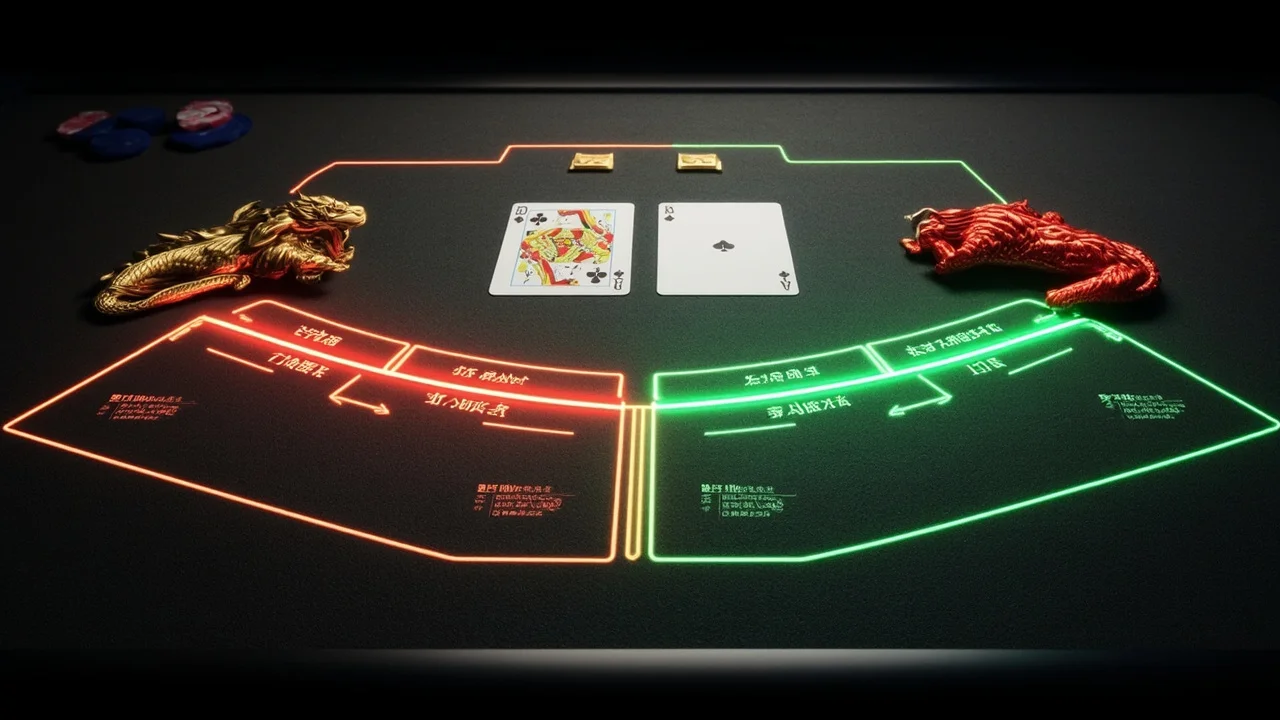
- Dragon: Betting that the Dragon position will receive the higher card.
- Tiger: Betting that the Tiger position will receive the higher card.
- Tie: Betting that both the Dragon and Tiger positions will receive cards of equal rank.
Players also have the option to place various side bets, which will be covered in subsequent sections.
Dealing the Cards
Once all bets are placed, the dealer will draw two cards from the deck. One card is dealt face up to the Dragon position, and another card is dealt face up to the Tiger position. There are no additional cards dealt, and no further decisions are made by the players or the dealer.
Card Ranking
In Dragon Tiger, the card ranking is as follows, from lowest to highest: Ace, 2, 3, 4, 5, 6, 7, 8, 9, 10, Jack, Queen, King. Importantly, the Ace is the lowest card, which is opposite to its ranking in many other card games.
Win, Lose, or Tie Outcomes
The outcome of the game is determined by comparing the two cards:
- Dragon or Tiger Win: The position with the higher card wins. Bets placed on the winning position are paid out at 1:1. If you bet on the Dragon and the Dragon card is higher, you win; the same applies to betting on the Tiger.
- Tie: If both cards are of equal rank, it results in a tie. Bets on a Tie are paid out at 8:1. However, main bets on Dragon or Tiger typically lose half of their wagered amount (some casinos may require the entire bet to be forfeited, so it is important to verify the specific rules of the casino you are playing at).
Payouts and House Edge
| Bet | Payout | House Edge |
|---|---|---|
| Dragon or Tiger Win | 1:1 | 3.73% |
| Tie | 8:1 | 32.77% |
Worked Example: Card Comparison
Assume you place a bet on the Dragon. The dealer deals a 7 of Hearts to the Dragon and a 5 of Diamonds to the Tiger. Since the 7 is higher than the 5, the Dragon wins. Your bet on the Dragon pays out at 1:1.
In another example, suppose both the Dragon and Tiger receive a 9 (e.g., 9 of Spades to Dragon, 9 of Clubs to Tiger). This round results in a Tie. If you bet on the Tie, you are paid 8:1. If you bet on Dragon or Tiger, you lose half of your wager unless the casino rules state otherwise.
Understanding these rules and outcomes is crucial to mastering the game of Dragon Tiger. The simplicity of the game makes it exciting, but being aware of the house edges and payout structures can enhance your strategic approach.
Card Ranking & Tie Rules

In Dragon Tiger, the ranking of cards is straightforward, with the Ace being the lowest card and the King being the highest. Unlike poker, where an Ace can be high or low, in Dragon Tiger, it is always the lowest. The suits of the cards do not affect the outcome of the game; only the rank determines the winner. Below is the ranking order used in Dragon Tiger:
| Rank | Card |
|---|---|
| 1 | Ace |
| 2 | 2 |
| 3 | 3 |
| 4 | 4 |
| 5 | 5 |
| 6 | 6 |
| 7 | 7 |
| 8 | 8 |
| 9 | 9 |
| 10 | 10 |
| 11 | Jack |
| 12 | Queen |
| 13 | King |
Tie Probability
The probability of a tie occurring in Dragon Tiger is a critical aspect of the game, influencing strategy and betting decisions. With one deck of cards, the probability of a tie is calculated by considering the number of ways two cards of the same rank can be drawn from separate sides. Specifically, there are 13 ranks and for each rank, there are 6 combinations of drawing two cards (from the 4 available cards of that rank). This results in:
The exact calculation is 13 ranks × 6 combinations per rank = 78 favorable outcomes. With 52 cards in a deck, the total number of possible outcomes when two cards are drawn is 132,600. Therefore, the probability of a tie is:
Probability of Tie = 78 / 132,600 ≈ 0.077 or 7.7%
Casino-Specific Tie Rules
Different casinos may implement different rules regarding ties, affecting the house edge and player strategy. The two most common rules are:
- Rule A: When a tie occurs, bets on Dragon or Tiger lose half of their value. This is the standard rule in many casinos and results in a house edge of approximately 3.73% on the main Dragon or Tiger bets.
- Rule B: When a tie occurs, bets on Dragon or Tiger lose their entire value. This rule is less favorable for players, resulting in a higher house edge of approximately 7.69% on the main bets.
It is crucial for players to confirm which tie rule is in effect at the casino where they are playing, as it significantly impacts the optimal strategy and potential payout. Always inquire about the tie rule before placing any bets to ensure you are making informed decisions.
Side Bets: Suited Tie, Big/Small, Odd/Even

In Dragon Tiger, side bets offer additional opportunities for players to wager beyond the main Dragon and Tiger bets. These side bets can add excitement and complexity to the game, but they come with higher house edges, making them less favorable in the long run. Below, we delve into the mechanics, payouts, and house edges of the most common side bets: Suited Tie, Big/Small, and Odd/Even.
Suited Tie
The Suited Tie bet is a wager that both the Dragon and Tiger cards will not only be of the same rank but also of the same suit. This is a rare occurrence, given the mechanics of the game.
- Payout: The Suited Tie bet typically pays out at 50:1, though some casinos may offer 25:1.
- Probability: The probability of a Suited Tie is 4 out of 2,652 possible outcomes, or approximately 0.15%.
- House Edge: With a 50:1 payout, the house edge is 13.98%, which is significantly higher than the main Dragon or Tiger bets.
Big/Small
The Big/Small bet involves predicting whether the card drawn for either the Dragon or the Tiger will be in the higher range (Big) or the lower range (Small).
- Payout: This bet pays out at 1:1.
- Details: A "Big" bet wins if the card is between 8 and King. A "Small" bet wins if the card is between Ace and 7.
- Exception: If a Tie occurs, all Big/Small bets are lost, regardless of the individual card values.
- House Edge: The house edge for Big/Small bets is approximately 7.69% due to the possibility of a Tie.
Odd/Even
The Odd/Even bet predicts whether the rank of the card drawn for either the Dragon or the Tiger will be odd or even.
- Payout: Like the Big/Small bet, this also pays out at 1:1.
- Details: An "Odd" bet wins if the card rank is odd (Ace, 3, 5, 9, Jack, King), while an "Even" bet wins if the card rank is even (2, 4, 6, 8, 10, Queen).
- Exception: As with Big/Small, a Tie results in a loss for all Odd/Even bets.
- House Edge: The house edge for Odd/Even bets is also approximately 7.69%.
Conclusion
While side bets in Dragon Tiger can increase the game's excitement, they come with significantly higher house edges compared to the main Dragon or Tiger bets. The Suited Tie bet, with its massive house edge of 13.98%, is particularly unfavorable. Both the Big/Small and Odd/Even bets carry a house edge of around 7.69%, making them similarly unattractive. For players focused on minimizing losses and maximizing potential returns, sticking to the main Dragon or Tiger bets is generally advisable.
Odds & House Edge: Complete Analysis

Dragon Tiger is a straightforward game, but understanding the odds and house edge is crucial for maximizing your play. This section provides a detailed analysis of the probabilities, house edge by bet type, and the impact of different tie rules.
Win/Tie Probabilities and House Edge
The game of Dragon Tiger involves two primary bets: Dragon and Tiger, each with its own probability and house edge. The game's simplicity means that these probabilities remain consistent across most casinos, but the handling of ties can vary. Below is a comprehensive table summarizing the key statistics for each bet type:
| Bet | Payout | Win Probability | Tie Probability | House Edge |
|---|---|---|---|---|
| Dragon (Rule A: half-loss on tie) | 1:1 | 46.26% | 7.69% | 3.73% |
| Tiger (Rule A) | 1:1 | 46.26% | 7.69% | 3.73% |
| Dragon (Rule B: full-loss on tie) | 1:1 | 46.26% | 7.69% | 7.69% |
| Tie | 8:1 | 7.69% | — | 32.77% |
| Suited Tie | 50:1 | 0.15% | — | 13.98% |
From the table, it's evident that the house edge for the main bets (Dragon and Tiger) is affected by the tie rule implemented. Rule A, where half the bet is lost on a tie, offers a lower house edge of 3.73% compared to Rule B, where the entire bet is lost, resulting in a house edge of 7.69%.
Tie Rule Comparison
The tie rule is the key variable that can significantly impact your expected losses. Under Rule A, if a tie occurs, players lose only half of their bet, which reduces the house edge. In contrast, Rule B results in a full loss of the bet on a tie, increasing the house edge. Always confirm the tie rule with the dealer before playing, as this will directly affect your betting strategy and expected returns.
Hands per Hour and Expected Loss
Dragon Tiger is a fast-paced game, with the number of hands dealt per hour varying by setting. Online games typically move faster, with an average of 80-100 hands per hour, while live games deal around 50-70 hands per hour. This speed can affect your potential losses over time.
For example, if you are playing at $10 per hand on a Dragon bet with Rule A, your expected loss per hour can be calculated as follows:
- Number of hands per hour: 100
- Bet per hand: $10
- House edge: 3.73%
- Expected loss per hour: 100 × $10 × 3.73% = $37.30
Understanding these probabilities and house edges can help you make informed decisions and manage your bankroll effectively during your Dragon Tiger sessions.
Dragon Tiger Strategy: What Actually Helps

Dragon Tiger is a straightforward game often described as a two-card version of Baccarat. However, its simplicity does not negate the need for strategy, even if the game is essentially a coin flip with a slight house edge. This section will explore the feasibility of card counting, effective bet selection, and how to avoid trap bets.
Card Counting Feasibility
Card counting in Dragon Tiger is theoretically possible but practically challenging. With a fresh shoe, the probabilities of Dragon and Tiger winning are exactly equal. As cards are dealt, the composition of the remaining deck shifts slightly. For instance, if many low cards have been dealt, the remaining deck is richer in high cards, which can theoretically provide a slight edge. However, this edge is minimal, often less than 0.5% even under optimal conditions.
In live play, the penetration is typically low and shuffling is frequent, making any potential advantage negligible. In RNG (Random Number Generator) versions of the game, where a visible card history is available, card counting might be more feasible. However, even in these scenarios, the practical benefits are minimal.
Practical Strategy
- Always play Dragon or Tiger — never Tie bet: The Tie bet may offer a tempting payout, often 8:1, but it comes with a significantly higher house edge of about 32.77%. This makes it a poor choice for any serious player.
- Avoid all side bets: Side bets in Dragon Tiger, such as Suited Tie, Big/Small, or Odd/Even, generally have a higher house edge. For example, the Suited Tie bet can have a house edge of around 13.98%, making it less favorable for players.
- Confirm Tie half-loss rule (Rule A) is in effect before playing: Some variations of Dragon Tiger allow for a half-loss rule on Tie bets, where only half of the original bet is lost if a Tie occurs. This rule slightly reduces the house edge on Dragon and Tiger bets from 3.73% to 3.73% in the applicable version, making it more player-friendly.
- Set a session limit: Dragon Tiger is a fast-paced game that can quickly impact your bankroll. Setting a session limit helps manage losses and ensures that you play within your means.
- Use flat betting: Adopting a flat betting strategy, where you wager the same amount on each hand, is advisable. No betting system can alter the inherent house edge, and flat betting helps maintain control over your bankroll.
In summary, while Dragon Tiger may seem like a simple game of chance, understanding the nuances of bet selection and avoiding common traps can help you play more effectively. Stick to the main bets, be aware of the rules, and manage your bankroll wisely to enjoy this fast-paced game responsibly.
Bankroll Management

Dragon Tiger is renowned for its fast-paced gameplay, significantly faster than traditional baccarat. In Dragon Tiger, players can expect to experience 80 hands per hour, compared to approximately 40 hands per hour in baccarat. This rapid pace requires careful bankroll management to ensure that players can enjoy the game without risking more than they can afford.
Session Limits
Due to the speed of Dragon Tiger, setting session limits is crucial. A session limit helps players control their gambling habits and avoid significant losses. It is advisable to decide on a maximum amount that you are comfortable losing in a single session and stick to it. This approach is particularly important given the high number of hands played per hour, which can quickly deplete a bankroll if not managed properly.
Expected Cost Per Hour
The expected cost per hour of playing Dragon Tiger depends on the bet level and the house edge, which is approximately 3.73% for the main bets. Below is a table illustrating the expected cost per hour at various bet levels:
| Bet Level | Hands per Hour | Total Wagered per Hour | Expected Loss per Hour |
|---|---|---|---|
| $5 | 80 | $400 | $14.92 |
| $10 | 80 | $800 | $29.84 |
| $25 | 80 | $2000 | $74.60 |
| $50 | 80 | $4000 | $149.20 |
As illustrated, a player betting $10 per hand would wager approximately $800 per hour, with an expected loss of $29.84 due to the house edge. For a $5 bet, the expected loss per hour would be around $14.92. These figures highlight the importance of managing your bankroll effectively, especially in such a fast-paced game.
To mitigate potential losses, consider playing shorter sessions and taking regular breaks. This strategy not only helps manage your bankroll but also allows time to reassess your performance and adjust your strategy as needed.
Dragon Tiger vs. Baccarat: Which Should You Play?

Dragon Tiger and Baccarat are two popular card games in the casino world, each offering unique experiences to players. Understanding their differences can help you decide which game suits your style and preferences. Below is a detailed comparison of Dragon Tiger and Baccarat based on complexity, speed, house edge, payouts, and suitability.
| Feature | Dragon Tiger | Baccarat |
|---|---|---|
| Complexity | Very simple | Moderate |
| Cards dealt | 2 total | 4-6 total |
| Best house edge | 3.73% | 1.06% (Banker) |
| Speed | Very fast | Fast |
| Third card rules | None | Complex (automatic) |
| Tie bet HE | 32.77% | 14.36% |
| Jackpot/side bets | Suited Tie | Dragon Bonus, etc. |
Complexity
Dragon Tiger is known for its simplicity. The game involves just two cards, and players bet on which card, Dragon or Tiger, will be higher. There are no complex rules or strategies, making it accessible to beginners. In contrast, Baccarat involves more decisions and the possibility of drawing additional cards based on predefined rules, making it moderately complex.
Speed
The straightforward nature of Dragon Tiger allows for very quick gameplay, with rounds completed in a matter of seconds. Baccarat, while still fast-paced, is slightly slower due to the potential for drawing additional cards and the need to follow specific rules.
House Edge
One of the critical differences between the two games is the house edge. Baccarat offers a significantly lower house edge, especially when betting on the Banker, which stands at 1.06%. Dragon Tiger, while simple, has a higher house edge of 3.73% on the main bets, making it less favorable for the player in terms of long-term returns.
Conclusion
If you are looking for a game with minimal complexity and faster action, Dragon Tiger is an excellent choice. However, if you prefer a game with a lower house edge and are willing to engage with more complex rules, Baccarat might be more suitable. Ultimately, the decision between Dragon Tiger and Baccarat should be based on your personal preferences for game speed, complexity, and potential payouts.
Online & Live Dealer Dragon Tiger

Dragon Tiger has become increasingly popular in online casinos, especially in markets with a strong interest in Asian-themed games. The game's simplicity and fast-paced nature make it an attractive option for both beginners and experienced players. Online availability allows players to enjoy Dragon Tiger from the comfort of their homes, with two main formats: standard online versions and live dealer games.
Two of the most prominent providers of live dealer Dragon Tiger are Evolution Gaming and Playtech. Both companies offer high-quality streaming and professional dealers, enhancing the immersive experience. Evolution Gaming is known for its innovative approach and provides Dragon Tiger with a user-friendly interface, multiple camera angles, and interactive features. Playtech, on the other hand, offers a seamless live gaming experience, with high-definition streaming and customizable options to suit player preferences.
In the online format, Dragon Tiger maintains the same basic rules and gameplay as its land-based counterpart. Players bet on whether the Dragon or Tiger will draw the higher card, or if the result will be a tie. Online platforms frequently offer side bets, such as Suited Tie, Big/Small, and Odd/Even, which can add excitement and variety but also come with higher house edges.
Dragon Tiger's popularity in the Asian market is significant, as the game is often compared to Baccarat in terms of simplicity and speed. Its straightforward nature and the cultural affinity for card games have made it a staple in many online casinos targeting Asian players. The game's easy-to-understand mechanics also make it a favorite for live dealer setups, where the quick rounds and real-time interaction emulate the experience of playing in a physical casino.
Overall, the availability of Dragon Tiger in both online and live dealer formats has expanded its reach, making it accessible to a global audience while maintaining its roots in Asian gaming culture.
Dragon Tiger Glossary & Cheat Sheet

Glossary of Key Terms
| Term | Definition |
|---|---|
| Dragon | One of the two main betting positions in Dragon Tiger. Players bet on whether the Dragon hand will win. |
| Tiger | The second main betting position. Players bet on whether the Tiger hand will win. |
| Tie | A bet that the Dragon and Tiger hands will have equal value. Pays out 8:1 but has a significant house edge. |
| Suited Tie | A side bet that predicts the Dragon and Tiger hands will tie with the same suit. This bet pays out 50:1. |
| Big/Small | A side bet on whether the card dealt to either Dragon or Tiger is above or below 7. Pays out 1:1, but loses on a 7. |
| Odd/Even | A side bet predicting whether the card dealt will be odd or even. Pays out 1:1, but loses on a 7. |
| House Edge | The statistical advantage that the casino has over players. For Dragon or Tiger bets, it's 3.73%. |
| Card Ranking | Cards are ranked from Ace (low) to King (high). |
| Tie Half-Loss Rule | If a Tie bet is not placed and a tie occurs, half the main bet is lost. |
| Bankroll Management | Strategies to manage your betting money to minimize losses and maximize play time. |
| Expected Hourly Cost | Calculated as House Edge x Total Bet x Hands per Hour. For a $10 bet, it's approximately $37.30/hour. |
| Live Dealer | An online version of the game with a real dealer handling the cards, streamed live. |
| Deck Penetration | The percentage of cards dealt before the deck is reshuffled, typically not applicable as Dragon Tiger uses a continuous shuffle machine. |
| Bet to Avoid | The Tie bet, due to its high house edge of 32.77%. |
| Natural | A single high card in Dragon Tiger, as there are no combinations like in poker. |
Quick Reference Cheat Sheet
- Card Ranking: Ace is low, King is high.
- Tie Half-Loss Rule: If a tie occurs without a tie bet, lose half your initial bet.
- House Edge by Bet Type:
- Dragon or Tiger: 3.73%
- Tie: 32.77%
- Suited Tie: 13.98%
- Big/Small or Odd/Even: 7.69%
- Bets to Avoid: Tie bet due to high house edge.
- Expected Hourly Cost: For a $10 bet, around $37.30/hour based on 100 hands per hour.