
Table of Contents
- Introduction
- History & Origins of Blackjack
- The Blackjack Table: Setup & Positions
- Card Values & Hand Types
- Player Actions: Hit, Stand, Double Down, Split, Surrender
- The Complete Basic Strategy Chart
- Odds, Probabilities & House Edge
- Bankroll Management for Blackjack
- Card Counting: The Hi-Lo System
- Advanced Strategy & Side Bets
- Common Mistakes & The 10 Golden Rules
- Blackjack Variations
- Online & Live Dealer Blackjack
- Blackjack Cheat Sheet: Complete Quick Reference
- Blackjack Glossary: Every Term You Need to Know
Introduction


Blackjack stands out as the mathematically best casino table game, boasting a house edge of approximately 0.5% when played with optimal basic strategy. This slim advantage for the house makes it an attractive option for both novice and seasoned gamblers seeking not only entertainment but also a genuine chance of winning. Unlike many other casino games where luck alone dictates outcomes, blackjack offers players the opportunity to influence the game’s result through strategic decision-making.
What makes blackjack special is its blend of skill and chance. Players have the power to make decisions that directly affect the odds, such as choosing whether to hit, stand, double down, or split pairs. These decisions are informed by the player's hand, the dealer's upcard, and the remaining cards in the deck. This element of strategy introduces a layer of complexity and engagement that is absent in games of pure chance, like roulette or slots.
This comprehensive guide promises to equip you with the knowledge and skills necessary to master blackjack. Whether you are a beginner seeking to understand the fundamental rules or an experienced player aiming to refine your strategy, this guide covers all aspects of the game. You will learn how to execute basic strategy flawlessly, understand the intricacies of card counting, and manage your bankroll effectively. Additionally, we will delve into advanced strategies and variations of the game, ensuring you are well-prepared for any blackjack scenario.
By the end of this guide, you will be armed with a deep understanding of blackjack’s mathematical foundations and strategic nuances. You will discover how to minimize the house edge and maximize your potential for profit. Whether your goal is to enjoy a casual game at your local casino or to compete at a professional level, this guide will be your definitive resource on the path to becoming a skilled blackjack player.
History & Origins of Blackjack

The game of Blackjack, as we know it today, has a rich and storied history that dates back several centuries, with its roots firmly planted in 17th century France. Originally known as "Vingt-et-Un," which translates to "Twenty-One," the game was popularized in French casinos. The objective was simple: players aimed to reach a hand value of 21 without exceeding it, a core premise that remains unchanged in modern Blackjack.

Vingt-et-Un in 17th Century France
Vingt-et-Un emerged during the reign of King Louis XV and quickly became a favorite among French nobility. The game was played with a single deck of cards, and the rules were relatively straightforward: players competed against the dealer to make a hand as close to 21 as possible. Unlike modern Blackjack, there were no bonuses for hitting a natural 21, and the dealer had significant flexibility in the rules, including the ability to double down.
Spread to America
As European settlers traveled to the New World, they brought with them the games and pastimes of their homelands. Vingt-et-Un found its way to America in the 18th century, where it gradually evolved. American casinos, eager to attract players, began offering bonuses for specific hand combinations. One such bonus was a 10-to-1 payout if a player's hand consisted of the Ace of Spades and a black Jack, which led to the game's new moniker: Blackjack.
Nevada Legalization
The legalization of gambling in Nevada in 1931 marked a significant turning point for Blackjack. As one of the few legal gambling destinations in the United States, Nevada casinos became a hub for Blackjack enthusiasts. The game’s popularity soared, and it became a staple of casino floors. Over time, the rules were standardized, and the game continued to evolve, setting the stage for the Blackjack era we recognize today.
Edward Thorp's Beat the Dealer (1962)
The publication of Edward Thorp's "Beat the Dealer" in 1962 revolutionized the way Blackjack was played and perceived. Thorp, a mathematician, used the then-novel concept of card counting to demonstrate that players could gain a statistical edge over the house. His book outlined strategies that significantly impacted both amateur and professional play. Casinos responded by altering rules and introducing multiple decks to counteract the advantages gained through card counting.
Modern Multi-Deck Era
Today, Blackjack is played worldwide with varying rules and deck configurations. The introduction of multi-deck games is one of the most notable changes in modern Blackjack. While single-deck Blackjack offers a house edge of approximately 0.17% with perfect play, this edge increases with additional decks, reaching about 0.65% in an eight-deck game. The use of multiple decks, along with rule variations like dealer hitting on soft 17 or restrictions on doubling down, continues to shape the strategic landscape of Blackjack.
Despite these changes, the essence of Blackjack remains: a game of skill, strategy, and chance that continues to captivate players around the globe.
The Blackjack Table: Setup & Positions

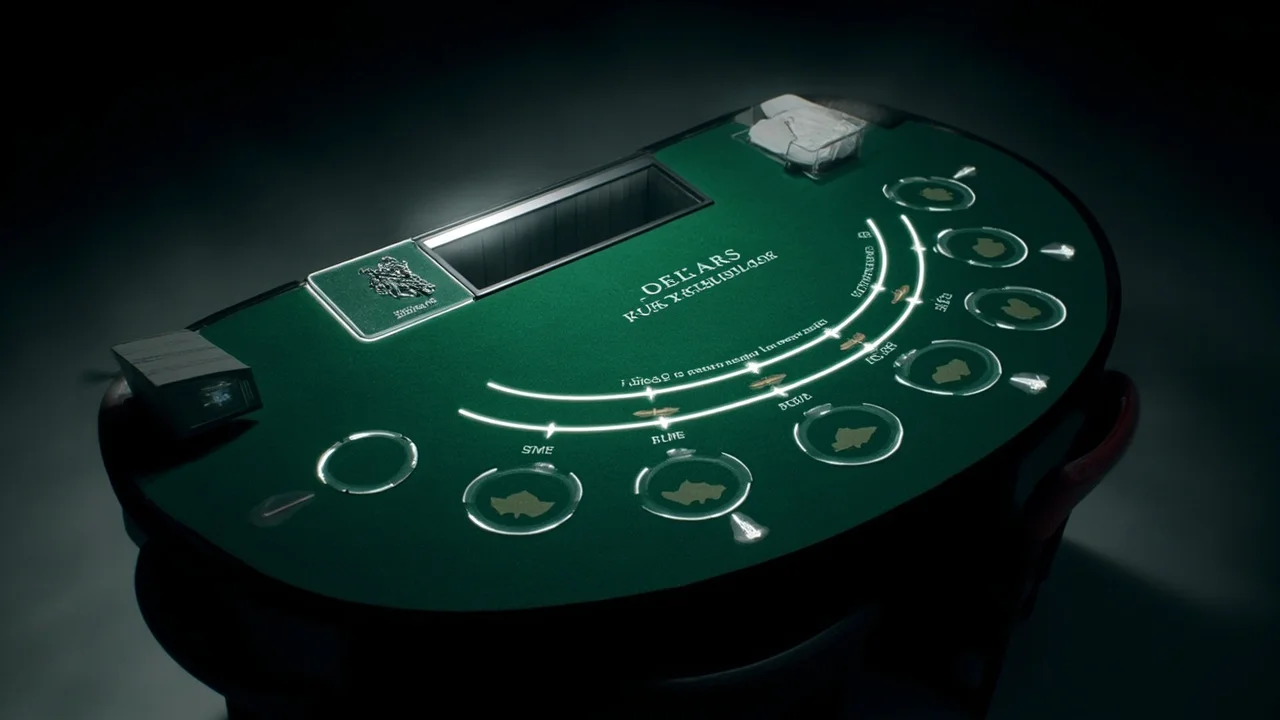
Understanding the layout and setup of a blackjack table is crucial for both new players and seasoned veterans aiming to optimize their strategy. A typical blackjack table is a semi-circular surface that accommodates multiple players and a dealer. Below, we explore each component of the table setup in detail, including the number of decks, shoe vs. hand-held games, dealer and player positions, betting circles, the insurance bar, and the chip tray.
Table Layout
A standard blackjack table generally seats between five and seven players, along with a dealer. The semi-circular layout allows the dealer to face all players, facilitating clear communication and efficient gameplay. The table's surface is often felt-covered, with clearly marked areas for betting and instructions.
Number of Decks
The number of decks used in a blackjack game can significantly affect the house edge and player strategy. Most casinos use between one and eight decks:
- Single-deck: Offers the lowest house edge of approximately 0.17% with basic strategy but is rare in modern casinos due to ease of card counting.
- Double-deck: Commonly used and offers a slightly higher house edge of about 0.46%.
- Six to eight decks: Most common in casinos today, with a house edge around 0.64% to 0.66%.
Shoe vs. Hand-held
Blackjack games are typically divided into shoe games and hand-held games:
- Shoe games: Use a device to hold multiple decks, allowing the dealer to easily draw cards. This setup is common for games with four or more decks.
- Hand-held games: The dealer holds and deals cards directly from the deck, usually in single or double-deck games.
Dealer Position
The dealer stands at the center of the table's straight edge. The dealer's responsibilities include shuffling and dealing cards, collecting bets, and paying winners. The dealer's position is pivotal as they control the pace and flow of the game.
Player Spots
Player spots are designated areas where participants sit or stand during the game. Each spot corresponds to a betting circle where players place their wagers. The number of player spots dictates how many participants can engage in a game simultaneously, typically ranging from five to seven.
Betting Circles
In front of each player spot is a betting circle, a marked area where players place their chips to make a bet. Each round begins with players placing their desired wager within these circles.
Insurance Bar
An insurance bar is a special line marked on the table where players place insurance bets. Insurance is offered when the dealer's upcard is an Ace, allowing players to bet on the dealer having a blackjack. The typical payout for an insurance bet is 2:1.
Chip Tray
Located directly in front of the dealer, the chip tray stores all the casino's chips used for payouts and collections during the game. The tray is organized by denomination, allowing the dealer to quickly access the appropriate chips for any transaction.
Understanding the blackjack table setup and positions is foundational to mastering the game. Each element, from the number of decks to the dealer's role, influences the dynamics of play and can significantly affect a player's strategy and odds of winning.
Card Values & Hand Types

Understanding card values and hand types is fundamental to mastering Blackjack. Each card in the deck has a specific value, which directly impacts your strategy and decisions during the game. Let's delve into the details of card values and the various types of hands you can hold in Blackjack.
Card Values
| Card | Value |
|---|---|
| 2 | 2 |
| 3 | 3 |
| 4 | 4 |
| 5 | 5 |
| 6 | 6 |
| 7 | 7 |
| 8 | 8 |
| 9 | 9 |
| 10 | 10 |
| Jack (J) | 10 |
| Queen (Q) | 10 |
| King (K) | 10 |
| Ace (A) | 1 or 11 |
As shown in the table, number cards (2-10) are valued at their face value. Face cards (Jack, Queen, and King) are each worth 10 points. The Ace is unique as it can be worth either 1 or 11, depending on which value benefits the hand more without causing a bust.
Types of Hands
In Blackjack, the type of hand you have can influence your strategy decisions. Here are the primary hand types:
- Hard Hand: A hard hand does not contain an Ace, or if it does, the Ace is counted as 1. For example, a hand consisting of a 10 and a 6 is a hard 16.
- Soft Hand: A soft hand contains an Ace counted as 11. For example, a hand of Ace and 6 is a soft 17. The flexibility of the Ace means this hand cannot bust with a single additional card.
- Pair: A pair consists of two cards of the same rank, such as two 8s. Pairs offer the option to split, creating two separate hands.
- Natural Blackjack: This occurs when the first two cards dealt to a player are an Ace and a 10-value card (10, Jack, Queen, or King), totaling 21. A natural Blackjack typically pays 3:2.
- Bust: A hand that exceeds 21 is called a bust and results in an automatic loss for the player.
Understanding these card values and hand types is crucial for making informed decisions at the Blackjack table. Mastery of these elements allows players to effectively apply strategic actions, which will be covered in subsequent sections.
Player Actions: Hit, Stand, Double Down, Split, Surrender

In Blackjack, understanding when and how to execute each available action is crucial for maximizing your chances of winning. This section will cover the five primary actions a player can take: Hit, Stand, Double Down, Split, and Surrender. Each has specific rules for when it can be used and strategic recommendations based on your hand and the dealer's upcard.
| Action | Meaning | When Allowed | Key Example |
|---|---|---|---|
| Hit | Request an additional card | Anytime during your turn | You have 8, dealer shows 10 — Hit |
| Stand | Keep current hand, end turn | Anytime during your turn | You have 18, dealer shows 7 — Stand |
| Double Down | Double bet, take exactly one more card | On the first two cards | You have 11, dealer shows 6 — Double Down |
| Split | Divide a pair into two hands | When dealt a pair | You have 8,8, dealer shows 5 — Split |
| Surrender | Forfeit hand, lose half your bet | On the first two cards | You have 16, dealer shows 10 — Surrender |
Hit
Hitting is the action of requesting an additional card to add to your hand total. This is typically done when you believe your hand can be improved without risking a bust (going over 21). For example, if you have a hand total of 8 and the dealer is showing a 10, hitting is recommended since your chances of improving your hand are high.
Stand
Standing means you are satisfied with your current hand and do not wish to take any more cards. This action ends your turn, and the dealer will then play their hand. For instance, if you have a hand total of 18 and the dealer is showing a 7, standing is advisable since your hand is relatively strong, and the dealer has a chance of busting.
Double Down
Doubling down is a strategic action where you double your initial bet and receive exactly one more card. This is usually done when you have a strong hand against a weak dealer upcard. For example, if you have a total of 11 and the dealer shows a 6, doubling down is optimal because you have a high probability of reaching a strong total with one more card.
Split
Splitting is an option when you are dealt a pair, allowing you to divide them into two separate hands. You must place an additional bet equal to your original wager for the new hand. Each hand is then played independently. An ideal scenario for splitting is when you have a pair of 8s and the dealer shows a 5. By splitting, you increase your chances of forming two strong hands.
Surrender
Surrendering allows you to forfeit your hand and lose only half of your original bet, which can be a strategic move when the odds of winning are low. There are two types of surrender: early and late. Early surrender allows you to forfeit your hand before the dealer checks for blackjack, while late surrender permits it only after the dealer checks. Not all casinos offer surrender, and it is crucial to know the house rules. A typical situation for surrendering is when you have a total of 16, and the dealer shows a 10. The probability of busting or losing is high, making surrender a wise choice.
Understanding these actions and when to apply them can significantly improve your Blackjack game. In the next section, we will delve into the complete basic strategy chart to provide detailed insights into making the best decision in every possible scenario.
The Complete Basic Strategy Chart

Welcome to the definitive guide on the complete basic strategy for multi-deck Blackjack where the dealer stands on a soft 17. This section provides comprehensive strategy tables for hard hands, soft hands, and pairs, detailing the optimal player action for every possible player hand against every dealer upcard. By adhering to these strategies, players can minimize the house edge and optimize their chances of winning.
Strategy for Hard Hands
| Player Hand | Dealer 2 | Dealer 3 | Dealer 4 | Dealer 5 | Dealer 6 | Dealer 7 | Dealer 8 | Dealer 9 | Dealer 10 | Dealer A |
|---|---|---|---|---|---|---|---|---|---|---|
| Hard 4 | H | H | H | H | H | H | H | H | H | H |
| Hard 5 | H | H | H | H | H | H | H | H | H | H |
| Hard 6 | H | H | H | H | H | H | H | H | H | H |
| Hard 7 | H | H | H | H | H | H | H | H | H | H |
| Hard 8 | H | H | H | H | H | H | H | H | H | H |
| Hard 9 | H | D | D | D | D | H | H | H | H | H |
| Hard 10 | D | D | D | D | D | D | D | D | H | H |
| Hard 11 | D | D | D | D | D | D | D | D | D | H |
| Hard 12 | H | H | S | S | S | H | H | H | H | H |
| Hard 13 | S | S | S | S | S | H | H | H | H | H |
| Hard 14 | S | S | S | S | S | H | H | H | H | H |
| Hard 15 | S | S | S | S | S | H | H | H | Rh | H |
| Hard 16 | S | S | S | S | S | H | H | Rh | Rh | Rh |
| Hard 17 | S | S | S | S | S | S | S | S | S | S |
| Hard 18+ | S | S | S | S | S | S | S | S | S | S |
Strategy for Soft Hands
| Player Hand | Dealer 2 | Dealer 3 | Dealer 4 | Dealer 5 | Dealer 6 | Dealer 7 | Dealer 8 | Dealer 9 | Dealer 10 | Dealer A |
|---|---|---|---|---|---|---|---|---|---|---|
| A,2 | H | H | H | D | D | H | H | H | H | H |
| A,3 | H | H | H | D | D | H | H | H | H | H |
| A,4 | H | H | D | D | D | H | H | H | H | H |
| A,5 | H | H | D | D | D | H | H | H | H | H |
| A,6 | H | D | D | D | D | H | H | H | H | H |
| A,7 | S | Ds | Ds | Ds | Ds | S | S | H | H | H |
| A,8 | S | S | S | S | Ds | S | S | S | S | S |
| A,9 | S | S | S | S | S | S | S | S | S | S |
Strategy for Pairs
| Player Hand | Dealer 2 | Dealer 3 | Dealer 4 | Dealer 5 | Dealer 6 | Dealer 7 | Dealer 8 | Dealer 9 | Dealer 10 | Dealer A |
|---|---|---|---|---|---|---|---|---|---|---|
| 2,2 | Ph | Ph | P | P | P | Ph | H | H | H | H |
| 3,3 | Ph | Ph | P | P | P | Ph | H | H | H | H |
| 4,4 | H | H | H | Pd | Pd | H | H | H | H | H |
| 5,5 | D | D | D | D | D | D | D | D | H | H |
| 6,6 | Ph | P | P | P | P | Ph | H | H | H | H |
| 7,7 | P | P | P | P | P | P | Ph | H | H | H |
| 8,8 | P | P | P | P | P | P | P | P | P | Rp |
| 9,9 | P | P | P | P | P | S | P | P | S | S |
| 10,10 | S | S | S | S | S | S | S | S | S | S |
| A,A | P | P | P | P | P | P | P | P | P | P |
Legend
- H = Hit
- S = Stand
- D = Double (else Hit)
- Ds = Double (else Stand)
- P = Split
- Ph = Split (else Hit)
- Pd = Split (else Double)
- Rh = Surrender (else Hit)
- Rs = Surrender (else Stand)
By following this complete basic strategy, players can effectively reduce the house edge to as low as 0.5%, assuming perfect play. Remember, these charts are based on multi-deck games where the dealer stands on a soft 17, so always ensure the game rules match these conditions before applying this strategy.
Odds, Probabilities & House Edge

Understanding the odds, probabilities, and house edge in Blackjack is crucial for both new players and seasoned veterans aiming to optimize their gameplay. This section provides detailed insights into the statistical aspects of Blackjack, including player and dealer bust probabilities, as well as how different rule sets can affect the house edge.
Player Bust Probabilities by Hand Total
When deciding whether to hit or stand, players should consider the probability of busting based on their current hand total. The following table provides the likelihood of busting if the player chooses to hit:
| Player Total | Bust % if Hit |
|---|---|
| 12 | 31% |
| 13 | 39% |
| 14 | 56% |
| 15 | 58% |
| 16 | 62% |
| 17 | 69% |
| 18 | 77% |
| 19 | 85% |
| 20 | 92% |
| 21 | 100% |
Dealer Bust Probabilities by Upcard
The dealer's upcard significantly impacts their likelihood of busting. Players can use this information to make strategic decisions, such as whether to hit or stand. Here is the probability of the dealer busting based on their upcard:
| Dealer Upcard | Bust Probability |
|---|---|
| 2 | 35.3% |
| 3 | 37.6% |
| 4 | 40.3% |
| 5 | 42.9% |
| 6 | 42.1% |
| 7 | 25.9% |
| 8 | 23.9% |
| 9 | 23.3% |
| 10 | 21.4% |
| A | 11.7% |
House Edge Impact of Rule Variations
The house edge in Blackjack can vary significantly depending on the specific rules of the game. Here are some common rule variations and their impact on the house edge:
| Rule Variation | House Edge Impact |
|---|---|
| Number of Decks (1 vs 6 vs 8) | +0.59% (1 deck), 0% (6 decks), +0.02% (8 decks) |
| Dealer Hits Soft 17 | +0.22% |
| No Double After Split | +0.14% |
| No Resplitting Aces | +0.08% |
| No Surrender | +0.10% |
| Blackjack Pays 6:5 | +1.39% |
Additional Probabilities and Expected Loss
The probability of being dealt a natural blackjack (an Ace and a 10-value card) is approximately 4.75% for the player. This statistic is vital as it determines the likelihood of achieving a 3:2 payout, assuming the game pays this rate for a natural blackjack.
Regarding expected losses, if a player is playing a game with a 0.5% house edge at a $10 table, their expected loss per hour is calculated by considering the number of hands played per hour. Assuming an average of 100 hands per hour, the expected loss would be:
- Expected Loss = Bet Size x Number of Hands x House Edge
- Expected Loss = $10 x 100 x 0.005 = $5 per hour
Understanding these probabilities and how rule variations affect the house edge allows players to make more informed decisions, potentially improving their long-term success at the Blackjack table.
Bankroll Management for Blackjack

Effective bankroll management is crucial for both casual players and serious enthusiasts of blackjack. It involves determining how much money to bring, how to size your betting units, and establishing rules for stopping play. Proper bankroll management ensures that you can sustain your play through the natural ups and downs of the game, minimizing the risk of ruin while maximizing your enjoyment and potential profit.
How Much to Bring
The amount of money you bring to a blackjack session is your bankroll. It is recommended to have a substantial bankroll to withstand the variance inherent in blackjack. For casual players, a minimum bankroll of 200 times your base betting unit is advised. Serious players should aim for at least 500 times their base bet. This ensures you have a buffer against losing streaks and can enjoy longer sessions.
| Bankroll | Base Bet | Session Hands Est. | Risk Notes |
|---|---|---|---|
| $200 | $5 | ~100-200 | High short-term variance risk |
| $500 | $10 | ~200-400 | Comfortable session buffer |
| $1,000 | $25 | ~300-500 | Serious player |
| $5,000 | $100 | ~400-600 | High-roller |
Betting Unit Sizing
Your base bet should be a small percentage of your total bankroll, ideally no more than 0.5% for serious players. This allows for flexibility and reduces the risk of losing your entire bankroll quickly. Adjust your bet size based on your bankroll and your risk tolerance, but always ensure you can sustain a reasonable number of hands.
Session Rules: Stop-Loss and Win Goals
Establishing stop-loss and win goals can help you manage your bankroll effectively during a session. A common stop-loss rule is to leave the table if you lose 50% of your session bankroll. This prevents you from chasing losses and potentially depleting your funds.
On the other hand, if you achieve a win goal—such as being up by 50%—you should strongly consider stopping. This ensures you lock in profits and avoids the temptation of risking your winnings in the hopes of further gains.
Variance and Standard Deviation
Blackjack is a game of variance, with standard deviation per hand being approximately 1.15 betting units. This means your results can fluctuate significantly in the short term, even if you are playing with perfect strategy. Understanding this helps manage expectations and maintain discipline during losing streaks.
Flat Betting vs Progressive Betting
Flat betting involves wagering the same amount on each hand, which helps reduce variance and manage bankroll risk. In contrast, progressive betting systems, where you increase your bet after wins or losses, do not improve your expected value (EV) and can increase the risk of large losses. Flat betting is generally recommended for those prioritizing bankroll longevity and minimizing risk.
By adhering to these bankroll management principles, blackjack players can enjoy the game responsibly while optimizing their chances of success. Remember, the key is discipline and consistency in applying these rules to ensure a sustainable and enjoyable blackjack experience.
Card Counting: The Hi-Lo System

The Hi-Lo system is one of the most popular card counting methods used in Blackjack. It provides a balance between simplicity and effectiveness, making it accessible for beginners while still offering expert-level precision. This section will guide you through understanding the Hi-Lo system, including how to maintain a running count, convert it to a true count, adjust your bets accordingly, and practice effectively.
Hi-Lo Card Values
In the Hi-Lo system, each card is assigned a value. These values help determine whether the remaining deck is rich in high cards (10s, face cards, and Aces) or low cards (2-6), which in turn affects the player's strategy.
| Card | Value |
|---|---|
| 2, 3, 4, 5, 6 | +1 |
| 7, 8, 9 | 0 |
| 10, J, Q, K, A | -1 |
Running Count: A Worked Example
The running count is the cumulative total of the card values as they are dealt. This example uses a specific sequence of cards to demonstrate how to calculate the running count:
| Card | Running Count |
|---|---|
| 5 | +1 |
| K | 0 |
| 3 | +1 |
| Q | 0 |
| 7 | 0 |
| 2 | +1 |
| A | 0 |
| 8 | 0 |
| 4 | +1 |
| J | 0 |
Final Running Count = 0
True Count Conversion
The true count adjusts the running count to account for the number of decks remaining, providing a more accurate measure of the player's advantage. The formula is:
True Count = Running Count ÷ Decks Remaining
Worked Example: If the running count is +8 and there are 2 decks remaining, the true count is:
True Count = +8 ÷ 2 = +4
Bet Spreading
Bet spreading is the practice of adjusting your bets based on the true count. The higher the true count, the greater your advantage, and the more you should bet:
| True Count | Bet |
|---|---|
| TC ≤ 0 | Bet 1 unit |
| TC +1 | Bet 2 units |
| TC +2 | Bet 4 units |
| TC +3 | Bet 8 units |
| TC +4+ | Bet 12 units |
Edge Over the House
Card counting can give players a significant edge over the house. At a true count of +4, the player has approximately a 2.5% edge, meaning the odds are in favor of the player rather than the casino.
Practice Methods
Mastering the Hi-Lo system requires regular practice. Here are some effective methods:
- Real Deck Drills: Practice with a real deck of cards, counting through the entire deck and ensuring your final count returns to zero.
- Smartphone Apps: Use apps like Blackjack Apprenticeship to practice counting in simulated environments and track your progress.
Legal Considerations
Card counting is legal because it relies on player skill and memory. However, casinos reserve the right to refuse service to anyone. If you are suspected of counting cards, a casino may ask you to leave.
By understanding and practicing the Hi-Lo system, you can improve your Blackjack strategy and potentially gain an edge over the house. Remember, successful card counting requires both skill and discipline.
Advanced Strategy & Side Bets

Surrender EV Analysis
Surrender is a strategic option that allows players to forfeit half their bet to end the hand immediately. This option is available only as 'late surrender' in most casinos, meaning it can only be chosen after the dealer checks for blackjack.
Analyzing the expected value (EV) of surrender can significantly impact your strategy. Consider the situation of holding a 15 against a dealer's 10. The expected value of hitting in this scenario is approximately -0.54, whereas surrendering has an EV of -0.50. Opting to surrender saves you 4 cents on every dollar wagered.
Similarly, with a 16 against a dealer's 9, 10, or Ace, the decision to surrender depends on the specific house rules and the player's risk tolerance. Generally, surrender is advisable against a 10 or Ace, where the EV of hitting is worse than surrendering.
Insurance Math
Insurance is a side bet offered when the dealer's upcard is an Ace. It pays 2:1 if the dealer's hole card is a 10-value card, forming a blackjack. However, insurance is a losing proposition unless the deck is rich in 10-value cards.
Insurance becomes a positive expected value (+EV) bet only when the True Count is +3 or higher. At this count, more than one-third of the remaining cards are 10-value cards. Without card counting, the default strategy is to always decline insurance, as it adds to the house edge.
Perfect Pairs Side Bet
The Perfect Pairs side bet allows players to wager on their first two cards being a pair. The payout depends on the type of pair:
| Pair Type | Payout |
|---|---|
| Mixed Pair | 5:1 |
| Coloured Pair | 10:1 |
| Perfect Pair | 25:1 |
The house edge for Perfect Pairs can range from 6% to 11%, depending on the specific rules and number of decks in play. It's important to note that while the payouts can be attractive, the high house edge makes this side bet generally unfavorable for players seeking long-term profitability.
21+3 Side Bet
The 21+3 side bet combines elements of blackjack and three-card poker. It uses the player's two initial cards and the dealer's upcard to form poker hands. The potential hands and typical payouts include:
| Poker Hand | Payout |
|---|---|
| Flush | 5:1 |
| Straight | 10:1 |
| Three of a Kind | 30:1 |
| Straight Flush | 40:1 |
| Suited Three of a Kind | 100:1 |
The house edge for the 21+3 side bet varies between approximately 3.24% and 13.39%, depending on the pay table and specific rules. While the potential for high payouts exists, players should be aware of the substantial house edge.
H17 vs S17 Rule Change
A crucial rule variation in blackjack is whether the dealer hits or stands on a soft 17 (H17 vs S17). This rule significantly affects basic strategy, particularly for hands like a soft 18 (A,7) against a dealer's Ace. In an H17 game, the correct strategy is to hit, while in an S17 game, players should stand. This subtle difference can affect the house edge by approximately 0.22% in favor of the casino when the dealer hits on soft 17, making it an important consideration in your advanced strategy.
Common Mistakes & The 10 Golden Rules

The 10 Golden Rules
- Never take insurance (unless card counting with TC ≥ +3): Insurance is a side bet that the dealer has a blackjack, and it's a losing proposition in the long run unless you are an advanced player who is card counting and the true count (TC) is +3 or higher.
- Always split Aces — no exceptions: Splitting Aces gives you two chances to hit a blackjack or a strong hand. It's statistically the best move every time.
- Always split 8s — even vs dealer 10: Splitting 8s against a dealer's 10 might feel risky, but the expected value (EV) of splitting is less negative than hitting or standing on a hard 16.
- Never split 10s — ever: A pair of 10s (or any face cards) gives you a strong 20, which is a winning hand against all but the dealer's 21.
- Never split 5s — treat as hard 10 and double/hit: A pair of 5s should be treated as a single hand of 10, one of the strongest starting points, best doubled against dealer 2-9.
- Double 11 against dealer 2-10: Doubling down on 11 is almost always advantageous, giving you the best chance to maximize your winnings.
- Never stand on soft 17 (A,6) — always hit or double: Soft 17 is a weak hand. Hitting or doubling down gives you a chance to improve your hand.
- Hit 16 vs dealer 10 (or surrender if allowed): A hard 16 is a bust-prone hand. Hitting or surrendering when possible is statistically better than standing.
- Never take the Even Money offer on blackjack vs Ace — it's just insurance: Even Money is essentially insurance, which is a losing bet over the long term.
- Always use a basic strategy card — casinos allow it: Basic strategy cards are permitted at most casinos and provide the mathematically optimal play for any hand.
Most Expensive Mistakes
Understanding and avoiding costly mistakes can significantly improve your game. Below are some of the most common errors players make, along with their estimated expected value (EV) cost per hand:
- Taking Insurance Without Card Counting: This mistake can cost you approximately -7.69% EV per hand. Insurance is a bad bet unless you have card counting skills to justify it.
- Not Splitting Aces: Failing to split Aces when possible results in a significant loss of potential profit, costing around -0.18 EV per hand.
- Not Splitting 8s Against a Dealer 10: Opting not to split 8s can cost you approximately -0.57 EV per hand, as the alternatives (hitting or standing) are worse.
- Splitting 10s: Splitting 10s is one of the most common beginner mistakes, costing about -0.51 EV per hand due to breaking up a strong hand.
- Standing on Soft 17 (A,6): This decision results in a loss of around -0.22 EV per hand, as it misses the opportunity to improve the hand.
- Standing on 16 vs Dealer 10: Opting to stand on a hard 16 against a dealer's 10 can cost approximately -0.54 EV per hand, as hitting or surrendering is statistically better.
- Taking Even Money on Blackjack: Accepting Even Money reduces your potential gains, costing about -0.10 EV per hand compared to playing the hand normally.
- Not Doubling Down on 11: Missing the opportunity to double down on 11 against dealer 2-10 results in an estimated -0.76 EV per hand.
- Playing Without a Basic Strategy Card: Ignoring basic strategy can cost you up to -1.5% to -5% EV per hand, depending on your level of deviation from optimal play.
By adhering to the 10 Golden Rules and avoiding these costly mistakes, players can enhance their Blackjack experience and improve their chances of success at the table.
Blackjack Variations

Blackjack is a versatile game with numerous variations that offer different rules, strategies, and house edges. Understanding these variations can significantly impact your gameplay and strategy. Below, we delve into six popular Blackjack variations, detailing their key rule differences, house edge, and necessary strategy adjustments.
| Variation | Key Rule Differences | Approx House Edge | Best Strategy Adjustment |
|---|---|---|---|
| Vegas Strip | Played with 4 decks; dealer stands on soft 17; players can double after split; late surrender allowed. | 0.35% | Use basic strategy; take advantage of doubling after splitting and late surrender options. |
| European Blackjack | Played with 2 decks; dealer does not check for Blackjack on 10 or Ace; no surrender option. | 0.39% | Avoid splitting 4s, 5s, and 10s; double down only on 9, 10, or 11 against weaker dealer cards. |
| Spanish 21 | Played with 6 or 8 Spanish decks (no 10s); player 21 always wins; bonuses for 5+ card 21s. | 0.38% | Focus on maximizing the benefit of bonuses; hit aggressively to achieve 5+ card 21s. |
| Pontoon | Played with 52 cards; dealer always hits soft 17; no hole card; 5-card trick wins. | 0.38% - 0.42% | Hit more aggressively aiming for the 5-card trick; be cautious with doubling down due to no hole card. |
| Blackjack Switch | Played with 6-8 decks; players can switch top cards between hands; dealer hits soft 17. | 0.58% | Focus on maximizing the switch option; be aware of the dealer's 22 push rule when strategizing. |
| Super Fun 21 | Played with 1 deck; player Blackjack always wins; player can double down at any time; six-card 20 wins. | 0.94% | Utilize the flexibility of doubling down; aim for six-card 20s when possible. |
Each Blackjack variation offers unique challenges and opportunities. The house edge can vary significantly based on the rules, which influences the optimal strategy. For instance, in Spanish 21, the absence of 10s alters the probability distributions, requiring more aggressive play to capitalize on the bonuses for certain hands. Meanwhile, in Blackjack Switch, the ability to switch cards between two hands offers strategic depth but also comes with the caveat that a dealer's 22 results in a push rather than a loss for the player.
Understanding these nuances is crucial for any serious Blackjack player. It is essential to adapt your strategy to the specific variation you are playing to minimize the house edge and maximize your chances of winning. Always ensure you are aware of the specific rules of the game you are playing, as even minor variations can significantly impact your strategy and the overall house edge.
Online & Live Dealer Blackjack

With the rise of online gambling, players now have the option of enjoying Blackjack in two distinct formats: Random Number Generator (RNG) Blackjack and Live Dealer Blackjack. Understanding the differences between these formats and knowing how to find games with the lowest house edge can significantly enhance your Blackjack experience.
RNG vs Live Dealer
RNG Blackjack uses computer algorithms to simulate the dealing of cards, ensuring each hand is fair and random. Live Dealer Blackjack, on the other hand, is streamed from a real casino or studio, where a human dealer manages the game in real-time. Here is a comparison of the two:
| Aspect | RNG Blackjack | Live Dealer Blackjack |
|---|---|---|
| House Edge | 0.5% - 1.0% | 0.5% - 1.0% |
| Speed | Fast (20-30 hands per hour) | Slower (50-60 hands per hour) |
| Atmosphere | Virtual | Realistic, with live interaction |
| Bonus Wagering | Contributes 10-20% | Contributes 10-20% |
| Social Feel | Solo experience | Interactive, with chat options |
Finding Low House Edge Games
To maximize your chances of winning, look for full-pay Blackjack games, which feature optimal rules such as a 3:2 payout for Blackjack, the ability to double down on any two cards, and the option to split aces. A full-pay game typically offers a house edge as low as 0.5%. Be wary of games offering 6:5 payouts on Blackjack or restricting doubling down, as these can increase the house edge significantly.
Welcome Bonuses
Online casinos often offer welcome bonuses to attract new players. However, it's crucial to understand how wagering requirements affect these bonuses when playing Blackjack. Typically, Blackjack contributes only 10-20% towards meeting wagering requirements. For example, if you receive a $100 bonus with a 30x wagering requirement, you would need to wager $30,000 if Blackjack contributes 10%, or $15,000 if it contributes 20%, to clear the bonus. Always read the terms and conditions to understand how much of your Blackjack play counts towards these requirements.
Software Providers
The quality of online Blackjack varies considerably depending on the software provider. Renowned providers like Microgaming, Playtech, and Evolution Gaming are known for their high-quality graphics, reliable RNGs, and immersive live dealer experiences. Evolution Gaming, in particular, is celebrated for its live dealer games, offering professional dealers and seamless streaming quality.
In conclusion, whether you prefer the fast-paced nature of RNG Blackjack or the authentic feel of Live Dealer games, understanding these differences and choosing games with favorable rules and terms can greatly enhance your Blackjack experience. Always be informed about the house edge, bonus terms, and the software provider to make the most of your online Blackjack play.
Blackjack Cheat Sheet: Complete Quick Reference

Core Game Rules Summary
- Objective: Beat the dealer's hand without exceeding 21.
- Card Values: Number cards = face value, face cards = 10, Aces = 1 or 11.
- Blackjack: An Ace and a 10-value card, pays 3:2.
- Player Actions: Hit, Stand, Double Down, Split, Surrender (if available).
- Dealer Rules: Must hit until reaching 17 or higher.
When to Double Down
| Your Hand | Dealer's Upcard |
|---|---|
| 9 | 3, 4, 5, 6 |
| 10 | 2, 3, 4, 5, 6, 7, 8, 9 |
| 11 | 2 through 10 |
| Ace, 2 | 5, 6 |
| Ace, 3 | 5, 6 |
| Ace, 4 | 4, 5, 6 |
| Ace, 5 | 4, 5, 6 |
| Ace, 6 | 3, 4, 5, 6 |
| Ace, 7 | 3, 4, 5, 6 |
When to Split
| Pair | Dealer's Upcard |
|---|---|
| Aces | Any |
| 8s | Any |
| 2s, 3s, 7s | 2 through 7 |
| 6s | 2 through 6 |
| 9s | 2 through 6, 8, 9 |
| 4s | 5, 6 |
| 5s | Never (treat as 10) |
Key Numbers
- House Edge: 0.5% (with basic strategy)
- Blackjack Payout: 3:2
- Insurance House Edge: 7.5%
- Dealer Bust Probability with 6 Upcard: 42%
The 5 'If in Doubt' Rules
- Always stand on 17 or higher.
- Always hit on 11 or lower.
- Stand on 12-16 if the dealer shows 2-6.
- Hit on 12-16 if the dealer shows 7 or higher.
- Always split Aces and 8s.
Pre-Session Checklist
- Verify Blackjack pays 3:2.
- Check the number of decks in use.
- Find out if surrender is an available option.
Blackjack Glossary: Every Term You Need to Know

| Term | Definition |
|---|---|
| Action | The total amount of money wagered in a session. |
| Anchor | The last player to act before the dealer. |
| Backcount | Counting cards without playing at the table. |
| Bankroll | The total money a player has for gambling. |
| Basic Strategy | The optimal way to play every hand combination. |
| Blackjack/Natural | An Ace and a ten-value card, totaling 21. |
| Burn Card | The top card removed after shuffling. |
| Bust | A hand value exceeding 21. |
| Color Up | Exchanging smaller denomination chips for larger ones. |
| Cut Card | A plastic card used to cut the deck. |
| Double Down | Doubling the initial bet with one more card. |
| Early Surrender | Surrendering before the dealer checks for Blackjack. |
| Face Card | Jacks, Queens, or Kings, each worth 10. |
| First Base | The first player to act in a round. |
| Flat Bet | Betting the same amount each hand. |
| Hard Hand | A hand without an Ace counted as 11. |
| Hi-Lo | A card counting system using +1, 0, -1 values. |
| Hit | Requesting an additional card. |
| Hole Card | The dealer's face-down card. |
| House Edge | The casino's statistical advantage. |
| Insurance | A side bet against the dealer having Blackjack. |
| Late Surrender | Surrendering after the dealer checks for Blackjack. |
| Paint | Another term for face cards. |
| Pat Hand | A strong hand, usually totaling 17-21. |
| Push | A tie between player and dealer. |
| Running Count | The ongoing total in card counting. |
| Shoe | A device holding multiple decks of cards. |
| Soft Hand | A hand containing an Ace counted as 11. |
| Split | Dividing a pair into two separate hands. |
| Stand | Choosing not to take additional cards. |
| Stiff Hand | A hand totaling 12-16, risking bust with a hit. |
| Surrender | Forfeiting half the bet to fold the hand. |
| Third Base | The last position to act before the dealer. |
| True Count | The running count adjusted for decks remaining. |
| Upcard | The dealer's face-up card. |
| Vingt-et-Un | French for "Twenty-One," an early form of Blackjack. |