

Table of Contents
- Introduction to Ultimate Texas Hold'em
- History & Origins
- Table Layout & Betting Areas
- How to Play: Complete Rules Step by Step
- Dealer Qualifying & Payouts
- The Trips Bet: Analysis & Pay Table
- Optimal Strategy: When to Bet and When to Check
- Odds & House Edge Analysis
- Bankroll Management
- Common Mistakes to Avoid
- Online & Live Dealer Ultimate Texas Hold'em
- Ultimate Texas Hold'em Glossary & Cheat Sheet
Introduction to Ultimate Texas Hold'em


Ultimate Texas Hold'em (UTH) has rapidly emerged as one of the most popular casino table games, captivating players with its unique blend of poker strategy and casino excitement. Unlike traditional Texas Hold'em, where players compete against each other, UTH pits you against the dealer, creating a dynamic and accessible gaming experience. The key feature that sets UTH apart is the ability to bet up to four times your ante before the community cards are revealed, offering an enticing potential for substantial wins.
The strategic depth of UTH is one of its main draws. Players must make calculated decisions at each stage of the game, balancing risk and reward based on their hole cards and the community cards. This element of skill, combined with the inherent luck of the draw, makes UTH a thrilling challenge for both novice and seasoned poker enthusiasts. The game's structure allows for multiple betting opportunities, giving players the chance to maximize their winnings when they have a strong hand or manage their losses when the odds are not in their favor.
From a statistical perspective, UTH offers a relatively favorable house edge of approximately 2.19%. This figure reflects the casino's long-term statistical advantage over players, which is relatively low compared to many other casino games. This lower house edge, combined with the ability to make strategic decisions, makes UTH a compelling choice for players looking to engage in a game where skill can influence the outcome.
This guide promises to equip you with the knowledge needed to master Ultimate Texas Hold'em. Whether you're a beginner eager to learn the basics or an experienced player seeking to refine your strategy, this comprehensive reference will provide detailed insights into every aspect of the game. From understanding the rules and betting options to mastering advanced strategies and probability calculations, this guide will serve as your definitive resource for achieving success in UTH.
History & Origins

Ultimate Texas Hold'em is a relatively recent addition to the world of casino table games, having been introduced in the mid-2000s. The game was designed by Roger Snow, a prominent figure in the casino gaming industry, who was working with Shuffle Master, a company renowned for its innovations in card shuffling machines and table games. Snow's creation aimed to capitalize on the immense popularity of Texas Hold'em poker, which had surged due to televised poker tournaments and the online poker boom.

The game was officially launched around 2005 and quickly gained traction on casino floors worldwide. Its appeal lay in its ability to merge the strategic elements of traditional Texas Hold'em with the fast-paced excitement of a casino table game. Unlike standard poker, where players compete against one another, Ultimate Texas Hold'em pits players against the dealer, making it attractive to those who enjoy both poker and blackjack-style games.
Ultimate Texas Hold'em's rise can be attributed to several key factors. Firstly, its rules are straightforward, making it accessible to newcomers while still offering depth and strategy for seasoned players. Secondly, the game features a unique betting structure that allows players to increase their bets at various points throughout the hand, adding layers of decision-making and excitement. Lastly, the game's house edge is competitive, which appeals to players looking for favorable odds.
Since its introduction, Ultimate Texas Hold'em has become a staple in casinos across the globe, from Las Vegas to Macau. It is typically found alongside other popular table games such as blackjack, roulette, and baccarat. The game's success has also led to various adaptations and online versions, further cementing its place in the modern casino landscape.
As of today, Ultimate Texas Hold'em continues to attract players with its blend of strategy, luck, and entertainment. Its origins, rooted in the vision of Roger Snow and the innovative spirit of Shuffle Master, have paved the way for its enduring popularity and status as a beloved casino game worldwide.
Table Layout & Betting Areas

Ultimate Texas Hold'em is played on a specialized table designed to accommodate multiple players and a dealer, each with designated betting areas. Understanding the layout of this table is crucial for both new and experienced players. Below, we detail each betting spot and its function, along with the other key components of the table.
Ante and Blind Betting Areas
At the start of each hand, players must place two mandatory bets: the Ante and the Blind. These bets must always be of equal value. For example, if a player decides to bet $10 on the Ante, they must also place $10 on the Blind. These bets are placed before any cards are dealt and are required to participate in the hand.
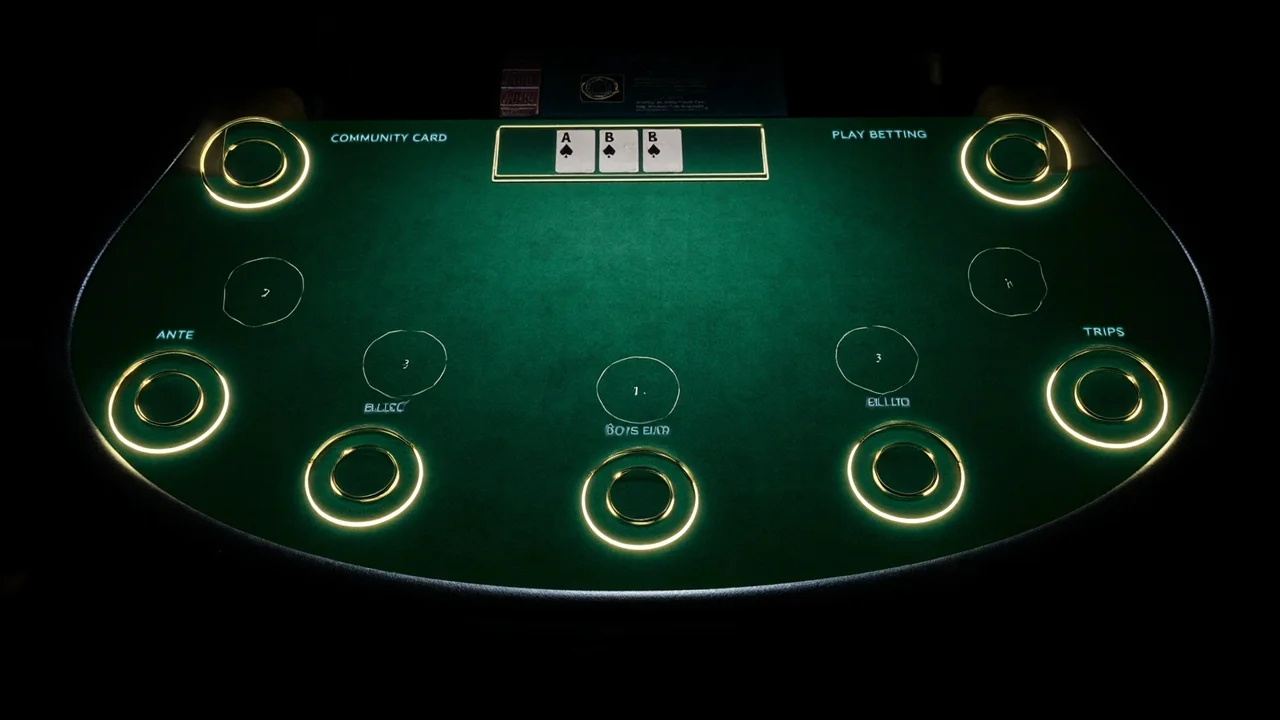
Play Betting Area
The Play bet is unique in that it is not placed at the beginning of the hand. Instead, players have the option to make this bet at specific points during the game, after they have seen some of their cards. Players can choose to place a Play bet that is 3x or 4x their Ante after the initial deal, or they can wait until after the flop to place a Play bet that is 2x their Ante. If they choose to wait until after the turn and river are revealed, they may place a Play bet that equals their Ante. This strategic flexibility allows players to adjust their bets based on their perceived hand strength.
Trips Betting Area
The Trips bet is an optional side bet that players can make. This bet is placed in its designated area and pays out based on the strength of the player's final five-card hand, regardless of whether they win or lose against the dealer. For instance, a player with a flush or better will receive a payout according to the Trips paytable. This bet adds an extra layer of excitement and potential reward beyond the standard play of the hand.
Community Card Board
The center of the table features the community card board, where the dealer will place the flop, turn, and river cards. These five cards are shared by all players and are used to make the best possible five-card hand in combination with each player's two-hole cards.
Dealer Position
The dealer's position is clearly marked and is central to the table. The dealer is responsible for dealing the cards, managing the bets, and resolving the outcomes of each hand. The dealer's chip tray is located directly in front of them, ensuring easy access to chips for payouts and change.
By familiarizing yourself with these areas of the Ultimate Texas Hold'em table, you can more confidently navigate the game and make informed decisions during play. Understanding the layout is fundamental to mastering the intricacies of this popular casino game.
How to Play: Complete Rules Step by Step

Ultimate Texas Hold'em is a popular variation of poker that pits the player against the dealer. The game follows a structured sequence of betting rounds and decision points. Below is a detailed step-by-step guide on how to play a complete hand, including a worked example to illustrate each phase of the game.
Step 1: Placing the Bets
- Ante and Blind Bets: The player starts by placing two equal bets: the Ante and the Blind. For example, if the Ante is $10, the Blind must also be $10.
- Optional Trips Bet: The player may also place an optional Trips bet, which is a side bet based on the player's final hand strength.
Step 2: Dealing the Cards
- Player's Hole Cards: The player receives two hole cards face down.
- Dealer's Hole Cards: The dealer also receives two hole cards face down.
Step 3: Preflop Decision
With the two hole cards, the player must decide:
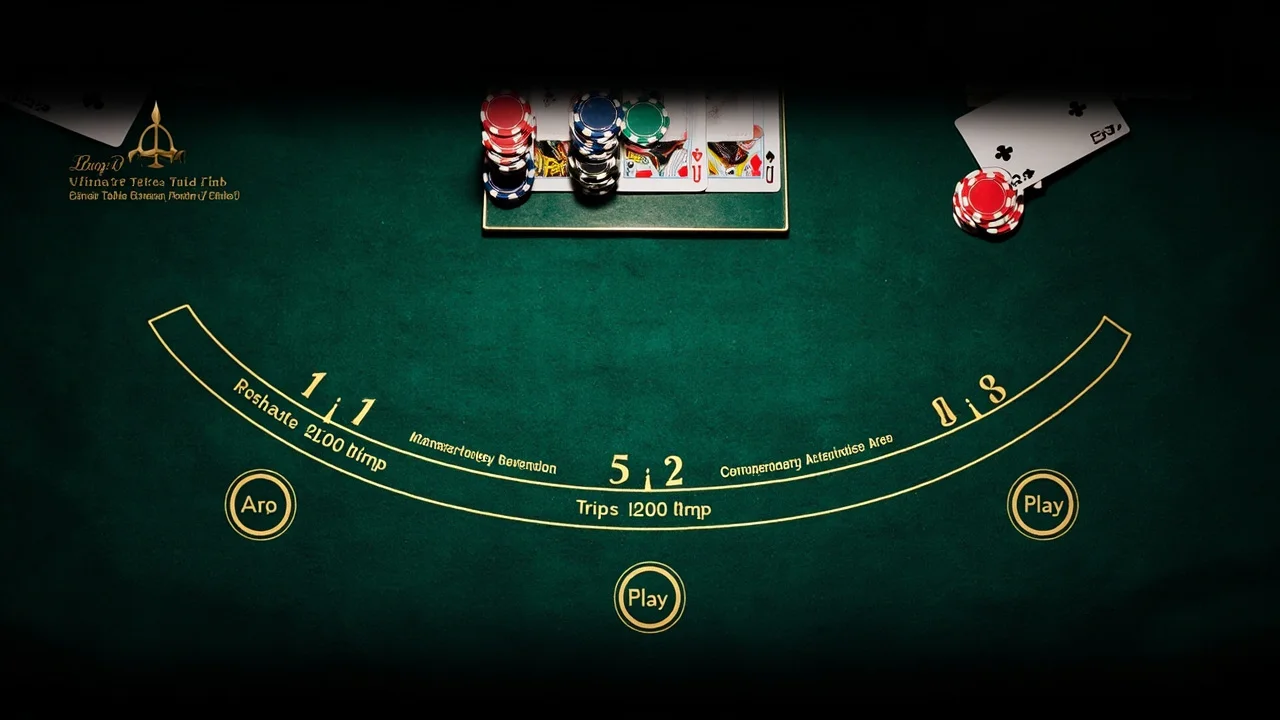
- Bet 3× or 4× Ante: The player can choose to make a Play bet of 3× or 4× the Ante amount. This decision is based on the strength of the two hole cards.
- Check: The player can choose to check, deferring their decision to the next betting round.
Step 4: The Flop
The dealer reveals the first three community cards, known as the Flop. If the player has checked in the preflop round, they must decide:
- Bet 2× Ante: The player can place a Play bet of 2× the Ante.
- Check: The player can check again, postponing their decision to the next round.
Step 5: Turn and River
The dealer reveals the final two community cards, known as the Turn and River. If the player has not yet made a Play bet, they have two options:
- Bet 1× Ante: The player can place a Play bet equal to the Ante.
- Fold: The player can fold, forfeiting both the Ante and Blind bets.
Step 6: Showdown
Both the player and the dealer reveal their hole cards to determine the best five-card hand using the seven available cards (the player's two hole cards plus the five community cards). The dealer must have at least a pair to qualify.
If the dealer does not qualify, the Ante bet is returned to the player, and the Play bet is paid according to the player's hand strength. The Blind bet is paid based on a separate pay table if the player's hand is a straight or better.
Worked Example Hand
Let's walk through a complete example hand:
- Player Bets: The player places $10 on both the Ante and Blind bets and an optional $5 on the Trips bet.
- Hole Cards: The player receives A♠ K♦. The dealer's hole cards are face down.
- Preflop Decision: The player decides to bet 4× the Ante ($40) due to the strong starting hand of A♠ K♦.
- Flop: The community cards are revealed: Q♠ 10♣ 3♦. The player already placed a bet preflop, so no further action is needed.
- Turn/River: The final two community cards are J♠ 2♣. The player's best five-card hand is a straight: A♠ K♦ Q♠ J♠ 10♣.
- Showdown: The dealer reveals hole cards 9♠ 9♦, not qualifying as the best hand is only one pair. The player wins the Ante and Play bets, and the Blind bet pays according to the pay table for a straight. The Trips bet also pays based on the Trips pay table.
By following these structured steps, players can confidently navigate a game of Ultimate Texas Hold'em, making informed decisions at each stage of the hand.
Dealer Qualifying & Payouts

In Ultimate Texas Hold'em, the concept of dealer qualification is crucial to understanding how payouts are determined. The dealer must have at least a pair to qualify. If the dealer does not qualify, the hand proceeds with specific rules affecting the Ante bet.
Dealer Qualification and Ante Bet Outcomes
The dealer's qualification affects the outcome of the Ante bet as follows:
- Dealer does NOT qualify: The Ante bet pushes, meaning it is returned to the player. The Play bet is paid out at 1:1 if the player's hand beats the dealer's.
- Dealer qualifies and player wins: Both the Ante and Play bets win and are paid out at 1:1.
- Dealer qualifies and dealer wins: Both the Ante and Play bets lose.
Pay Tables
The payout structure for Ultimate Texas Hold'em involves different pay tables for the Play, Ante, and Blind bets. Understanding these tables is essential for players to strategically manage their bets and maximize their potential returns.
Table 1: Play Bet Payout
The Play bet is straightforward: it pays 1:1 regardless of the strength of the player's hand, provided the player's hand wins against the dealer.
| Outcome | Payout |
|---|---|
| Player wins | 1:1 |
| Dealer wins | Lose |
Table 2: Ante Bet Payout
The Ante bet payout depends on whether the dealer qualifies and the outcome of the hand:
| Dealer Qualifies | Outcome | Payout |
|---|---|---|
| No | Player wins | Push (refunded), Play wins 1:1 |
| Yes | Player wins | Ante wins 1:1, Play wins 1:1 |
| Yes | Dealer wins | Lose |
Table 3: Blind Bet Payout
The Blind bet pays out only if the player wins with a qualifying hand. If the dealer does not qualify, the Blind bet always pushes, regardless of the player's hand strength.
| Hand | Payout |
|---|---|
| Royal Flush | 500:1 |
| Straight Flush | 50:1 |
| Four of a Kind | 10:1 |
| Full House | 3:1 |
| Flush | 3:2 |
| Straight | 1:1 |
| All other winning hands | Push (refunded) |
Understanding these payout structures is fundamental for players aiming to optimize their gameplay. The specific rules for dealer qualification and the different pay tables are designed to balance the house edge and provide players with clear guidelines for betting decisions. By mastering these aspects, players can better predict potential outcomes and adjust their strategies accordingly.
The Trips Bet: Analysis & Pay Table

The Trips bet in Ultimate Texas Hold'em is a side wager that allows players to potentially enhance their winnings based on the strength of their final five-card poker hand. Unlike the main game wagers, the Trips bet pays out irrespective of whether the player wins or loses against the dealer. This bet is evaluated solely on the player's hand, presenting both an enticing opportunity for significant payouts and a higher house edge.
Standard Trips Pay Table
The standard pay table for the Trips bet is designed to reward high-value hands with significant payouts. Below is the typical pay table used in many casinos:
| Hand | Payout |
|---|---|
| Royal Flush | 50:1 |
| Straight Flush | 40:1 |
| Four of a Kind | 30:1 |
| Full House | 8:1 |
| Flush | 7:1 |
| Straight | 4:1 |
| Three of a Kind | 3:1 |
| All others | Lose |
House Edge Analysis
The house edge on the Trips bet is approximately 6.2% with the standard pay table. This edge is relatively high compared to the main game of Ultimate Texas Hold'em. The reason for this is the allure of potentially large payouts for strong hands, which come at the cost of increased risk. Players should be aware that while the Trips bet can add excitement and the chance for a substantial win, it is generally less favorable over the long term compared to the primary wagers.
When to Use the Trips Bet
The Trips bet is best viewed as an optional entertainment feature rather than a strategic necessity. It appeals to players who enjoy the thrill of chasing a jackpot-like payout. While some players might consistently include the Trips bet as part of their strategy for the excitement it provides, others may prefer to focus on optimizing their main game strategy to minimize the house edge.
Comparison of Trips Pay Tables
Different casinos may offer variations in the Trips pay table, which can affect the house edge. Below are two common pay tables for comparison:
| Hand | Standard Payout | Alternative Payout |
|---|---|---|
| Royal Flush | 50:1 | 50:1 |
| Straight Flush | 40:1 | 40:1 |
| Four of a Kind | 30:1 | 30:1 |
| Full House | 8:1 | 9:1 |
| Flush | 7:1 | 7:1 |
| Straight | 4:1 | 5:1 |
| Three of a Kind | 3:1 | 3:1 |
| All others | Lose | Lose |
As seen, slight variations in the pay table can influence the overall house edge, making it important for players to be aware of the specific pay table offered at their casino of choice. Ultimately, the Trips bet should be used with the understanding of its higher house edge but also its potential for large payouts.
Optimal Strategy: When to Bet and When to Check

In Ultimate Texas Hold'em, making optimal betting decisions at the three key decision points—preflop, flop, and river—can significantly affect your outcome. This section provides a detailed guide to help you understand when to bet and when to check at each stage of the game. By following these strategic guidelines, you can enhance your chances of winning while minimizing potential losses.
Preflop Strategy: Bet 4× or 3× Ante
The preflop decision is crucial as it sets the stage for your game strategy. You have the option to bet 4× or 3× your ante. Here are the specific conditions under which you should make these bets:
- Bet 4× Ante:
- Any pair except 2s (pocket 2s: check)
- Ace with any kicker
- King with a 5 or higher kicker
- Queen with an 8 or higher kicker
- Jack with an 8 or higher kicker (suited), Jack with a 9+ (off-suit)
- Bet 3× Ante:
- Some simplified strategies suggest using only 4× or check, omitting the 3× option for beginners.
Flop Strategy: Bet 2× Ante (If Checked Preflop)
After seeing the flop, if you have not yet placed a 4× or 3× bet, you can choose to bet 2× your ante. Use the following criteria to decide:
- Bet 2× Ante:
- Two pair or better
- Hidden pair (your hole cards pair with one on the board)
- Four to a flush
- Four to an open-ended straight with at least one of your hole cards
- Otherwise: Check
Turn/River Strategy: Bet 1× Ante (If Still Unchecked)
If you have not committed to any bet by the turn or river, the decision to bet 1× your ante or fold becomes crucial. Here are the guidelines:
- Bet 1× Ante:
- Any pair or better using at least one of your hole cards
- Fold:
- Hidden pair on board (you have no stake in it)
- Less than one pair
Summary Table: Decision Points and Actions
| Decision Point | Condition | Action |
|---|---|---|
| Preflop | Any pair except 2s | Bet 4× |
| Preflop | Ace with any kicker | Bet 4× |
| Preflop | King with 5 or higher kicker | Bet 4× |
| Preflop | Queen with 8 or higher kicker | Bet 4× |
| Preflop | Jack with 8+ suited or 9+ off-suit | Bet 4× |
| Flop | Two pair or better | Bet 2× |
| Flop | Hidden pair | Bet 2× |
| Flop | Four to a flush | Bet 2× |
| Flop | Four to an open-ended straight | Bet 2× |
| Turn/River | Any pair or better | Bet 1× |
| Turn/River | Hidden pair on board | Fold |
| Turn/River | Less than one pair | Fold |
By adhering to these precise strategies at each decision point, you can optimize your gameplay in Ultimate Texas Hold'em. Remember, the key to success in this game is a combination of strategic betting and understanding the probabilities of the hands you hold. Keep this guide handy as you play, and refine your strategy as you gain more experience.
Odds & House Edge Analysis

Understanding the odds and house edge in Ultimate Texas Hold'em is crucial for both beginners and seasoned players. This section delves into the overall house edge, the distribution of outcomes, and the expected cost per hour of play. By mastering these elements, players can better manage their expectations and optimize their strategies.
Overall House Edge
When playing Ultimate Texas Hold'em with optimal strategy, the house edge is approximately 2.19% of the Ante bet. However, because the Play bet is also in action (which can be 1x to 4x the Ante), the effective house edge on the total money wagered is significantly lower, around 0.53% of the total action. This makes Ultimate Texas Hold'em one of the more favorable poker-based games in terms of house edge.
Outcome Distribution
To fully grasp the dynamics of Ultimate Texas Hold'em, it's essential to understand the distribution of possible outcomes. The following table outlines the probabilities for different results:
| Outcome | Probability |
|---|---|
| Player wins both (Ante + Blind) | 19.6% |
| Player wins Ante only | 5.0% |
| Push scenarios | 8.1% |
| Player folds | 19.3% |
| Player loses both (Ante + Blind) | 48.0% |
Expected Cost Per Hour
At a live Ultimate Texas Hold'em table, players can expect to play approximately 50 hands per hour. To calculate the expected loss per hour, consider a typical wager of $10 on the Ante and $10 on the Blind, resulting in a $20 base bet per hand.
Given the effective house edge of 0.53% on total action, the expected loss per hour is calculated as follows:
- Total wager per hand: $20
- Hands per hour: 50
- Total wager per hour: 50 x $20 = $1,000
- Expected loss per hour: $1,000 x 0.0053 = $5.30
This expected loss makes Ultimate Texas Hold'em an attractive option for players seeking a poker-based game with a relatively low cost of play.
Comparison to Other Poker-Based Casino Games
When comparing Ultimate Texas Hold'em to other poker-based casino games, it becomes apparent why it is a popular choice among players. For instance:
- Three Card Poker: The house edge on the Ante bet is approximately 3.37%, which is higher than Ultimate Texas Hold'em.
- Caribbean Stud Poker: The house edge is even higher, around 5.22% on the Ante bet.
These comparisons highlight Ultimate Texas Hold'em as a favorable option due to its lower house edge when played with optimal strategy. Players can enjoy a game that offers both strategic depth and a reasonable chance of winning, making it a compelling choice for both casual and serious casino enthusiasts.
Bankroll Management

Ultimate Texas Hold'em is a high-variance game, meaning that players can experience significant fluctuations in their bankroll over short periods. This section provides essential strategies for managing your bankroll effectively, ensuring you can enjoy the game responsibly and with the best chance of long-term success.
Session Budget
When playing Ultimate Texas Hold'em, it is crucial to establish a session budget. This is the amount of money you are willing to risk in a single session, and it should be an amount you are comfortable losing. A good rule of thumb is to set your session budget at no more than 5% of your total gambling bankroll. For example, if your total bankroll is $1,000, your session budget should not exceed $50. This conservative approach helps mitigate the high variance inherent in the game.
Minimum and Maximum Bet Considerations
Ultimate Texas Hold'em typically requires a minimum bet for both the Ante and Blind bets, which are equal. Minimum bets can often start at $5, though this can vary depending on the casino. Maximum bets can range widely, often up to $500 or more, again depending on the casino's rules. It is important to ensure that your session budget aligns with these table limits. If the minimum bet is $5 and you have a session budget of $50, you have enough for 10 rounds, assuming optimal play and no additional Trips bets. Make sure your budget allows for at least 20-30 rounds to account for variance.
The Cost of the Trips Bet
The Trips bet is an optional side bet in Ultimate Texas Hold'em that pays based on the poker value of the player's final hand. While the Trips bet can offer attractive payouts, it also comes with a higher house edge, typically around 3.5%. For players choosing to make the Trips bet, it is important to factor this additional cost into your session budget. For instance, if you are making $5 Ante and Blind bets and also placing a $5 Trips bet, your total cost per round is $15. This reduces the number of rounds you can play within a given budget, increasing the risk of running out of funds quickly.
Conclusion
Effective bankroll management is crucial for enjoying Ultimate Texas Hold'em while minimizing financial risk. By setting a realistic session budget, understanding minimum and maximum bets, and considering the additional cost of the Trips bet, players can better navigate the high-variance nature of the game. Remember, the ultimate goal is to enjoy the game responsibly, maximizing entertainment while keeping financial exposure within comfortable limits.
Common Mistakes to Avoid

Ultimate Texas Hold'em is a game of strategy and skill, and avoiding common pitfalls can significantly improve your chances of winning. Below are some frequent mistakes players make and how to avoid them.
Folding Too Often
One of the most prevalent errors is folding too often. Players sometimes fold when they have a viable hand, missing opportunities to capitalize on favorable odds. For example, folding hands like a King-high or better preflop can be a costly mistake. Remember that the house edge is partially offset by aggressive betting, so consider utilizing the 4× bet when holding strong hands like high pairs or suited connectors.
Missing 4× Preflop Opportunities
The 4× preflop bet is a critical component of Ultimate Texas Hold'em strategy. Missing these opportunities can increase the house edge against you. The optimal strategy suggests making the 4× raise with any pair, any Ace, King-high, or Queen-high when suited. This aggressive betting maximizes your potential returns on strong hands and is integral to maintaining a strategic edge.
Always Taking Trips
While the Trips bet can be enticing due to its high payout potential, always taking it is not a sound strategy. The Trips bet has a higher house edge compared to the Ante and Blind bets. It's essential to evaluate your bankroll and the long-term implications of making this side bet. Strategic players often choose to forego the Trips bet unless they have a specific reason to believe the variance is in their favor, such as a hot streak or a large bankroll buffer.
Misreading Blind Pushes
Misunderstanding the Blind bet conditions can lead to confusion and suboptimal play. The Blind bet only pays if your hand beats the dealer's hand and is strong enough to qualify under the pay table. Many players mistakenly think the Blind bet is a guaranteed payout with any win, leading to frustration when their hand wins, but the Blind bet pushes because it doesn’t meet the qualifying criteria. Familiarize yourself with the pay table and ensure your hand is strong enough before expecting a payout.
By avoiding these common mistakes, you can enhance your Ultimate Texas Hold'em gameplay, reduce the house edge, and increase your enjoyment and potential profitability in the game.
Online & Live Dealer Ultimate Texas Hold'em

Ultimate Texas Hold'em is widely available both online and in live dealer formats, giving players the flexibility to choose their preferred way to engage with the game. The online version is typically powered by Random Number Generator (RNG) software, ensuring fair and unpredictable outcomes. In contrast, live dealer games bring the casino experience to your screen, featuring real dealers and physical cards.
RNG Availability
RNG-based Ultimate Texas Hold'em games are offered by numerous online casinos, providing a quick and easy way to play. The software generates random card sequences, ensuring fairness and adhering to strict regulatory standards. Players can usually find these games with a wide range of bet limits, accommodating both low-stakes enthusiasts and high-rollers.
Evolution Gaming Live Version
Evolution Gaming, a leader in live casino solutions, offers a highly popular live version of Ultimate Texas Hold'em. This version features high-definition streaming and professional dealers, delivering an immersive experience. The live game allows for a social aspect, as players can interact with the dealer and other participants via chat. Bet limits in Evolution Gaming's live version typically range from $0.50 to $5,000 per hand, catering to diverse bankrolls.
Bet Limits
Online Ultimate Texas Hold'em games generally offer flexible bet limits, starting as low as $0.10 and going up to $10,000 per hand, depending on the platform. Live dealer tables, such as those provided by Evolution Gaming, tend to have slightly higher minimums but also accommodate high stakes.
Bonuses
Online casinos frequently offer bonuses and promotions for Ultimate Texas Hold'em players. These can include welcome bonuses, deposit matches, or free bets. It's crucial for players to read the terms and conditions, as these offers often come with wagering requirements and game-specific restrictions. Live dealer games might not contribute as much to bonus wagering requirements as RNG games, so players should verify the specifics with their chosen casino.
Ultimate Texas Hold'em Glossary & Cheat Sheet

Glossary
| Term | Definition |
|---|---|
| Ante | The initial bet placed by the player before any cards are dealt. |
| Blind | A mandatory bet placed alongside the Ante that pays out based on the strength of the player's hand. |
| Play Bet | A bet made during the game that allows the player to continue in the hand. |
| Trips Bet | An optional side bet that pays out based on the player's final hand, regardless of the dealer's hand. |
| Check | To decline to make a bet but remain in the game. |
| Fold | To give up on the hand and forfeit any bets made. |
| Dealer Qualify | The dealer must have at least a pair to qualify; otherwise, the Ante bet pushes. |
| Flop | The first three community cards dealt face up. |
| Turn | The fourth community card dealt face up. |
| River | The fifth and final community card dealt face up. |
| Rake | A commission taken by the house from the pot or bets. |
| House Edge | The statistical advantage the casino has over the player, typically around 2.18% for Ultimate Texas Hold'em. |
| Community Cards | Cards dealt face up in the center of the table that all players can use to make their best hand. |
| Preflop | The phase of the game before the community cards are dealt. |
| Hand Strength | The rank of a player's hand determined by poker hand rankings. |
| Raise | To increase the bet amount in a round of betting. |
| Action | The opportunity to act in a round of betting. |
| Showdown | The final phase where players reveal their hands to determine the winner. |
| Push | A situation where neither the player nor the dealer wins, and the player's bet is returned. |
| Round of Betting | Periods in a hand where players can place bets, such as preflop, flop, and river. |
Ultimate Texas Hold'em Cheat Sheet
Preflop Strategy: 4× Trigger Hands
- Always raise 4× with the following hands:
- Ace-high or better
- King-high if suited
- Queen-high if suited and higher than Q-6
- Jack-high if suited and higher than J-8
Flop Strategy: 2× Trigger Conditions
- Raise 2× on the flop if:
- You have a pair or better
- You hold a four-card flush or straight draw
River Strategy: 1× Rule
- Raise 1× on the river if you have a pair or better, otherwise check or fold.
Blind Pay Table
| Hand | Payout |
|---|---|
| Royal Flush | 500:1 |
| Straight Flush | 50:1 |
| Four of a Kind | 10:1 |
| Full House | 3:1 |
| Flush | 3:2 |
| Straight | 1:1 |
House Edge
The overall house edge for Ultimate Texas Hold'em is approximately 2.18%, making it one of the more favorable casino games for players who employ optimal strategy.