
Table of Contents
- Introduction to Three Card Poker
- History: Derek Webb's Invention
- How to Play: Complete Rules
- Three Card Poker Hand Rankings
- Optimal Ante Bet Strategy: The Q-6-4 Rule
- The Pair Plus Bet: Analysis & When to Play
- Odds & House Edge
- Side Bets: 6 Card Bonus & Others
- Bankroll Management & Session Tips
- Common Mistakes
- Online Three Card Poker
- Three Card Poker Glossary & Cheat Sheet
Introduction to Three Card Poker


Three Card Poker is a popular casino table game that combines the excitement of poker with the simplicity and speed of a traditional table game. This game is uniquely structured around a dual-bet system, offering players two primary ways to stake their money: the Ante-Play and the Pair Plus bets. The combination of these betting options, along with its fast-paced nature, has made Three Card Poker a favorite among both novices and seasoned gamblers.
Invented by Derek Webb in 1994, Three Card Poker was designed to capture the essence of poker while ensuring a quicker game pace and a straightforward set of rules. Webb's creation quickly gained traction in casinos due to its blend of skill and chance, providing players with multiple opportunities to win in a single hand. The game was first introduced in the United States in the late 1990s and has since become a staple in casinos worldwide.
Three Card Poker's appeal lies in its simplicity and the dual-bet structure, which allows players to employ different strategies based on their preferences and risk tolerance. The Ante-Play bet pits the player’s hand against the dealer’s, requiring strategic decision-making, while the Pair Plus bet is based purely on the quality of the player's hand, offering payouts for hands as low as a pair.
This guide will provide a comprehensive overview of Three Card Poker, from its historical context and rules to advanced strategies and probabilities. Readers will gain insight into the mathematical underpinnings of the game, including exact probabilities for each hand type and optimal strategies. Whether you're a beginner aiming to understand the basics or an expert seeking to refine your approach, this guide will serve as a valuable resource for mastering Three Card Poker.
In the upcoming sections, we will delve into the fascinating history of Derek Webb's invention, explore the complete rules of the game, and provide detailed strategy charts to enhance your gameplay. Stay tuned as we unfold the nuances of this captivating casino game.

History: Derek Webb's Invention

Three Card Poker, a popular casino game today, was invented by Derek Webb in 1994. Webb, a professional poker player from the United Kingdom, sought to create a game that combined the excitement of poker with the fast pace of traditional casino table games. His invention was designed to be easy to learn, offer the potential for substantial winnings, and provide a house edge that was attractive to casinos.
Webb's vision for Three Card Poker was to create a game that would appeal to both poker enthusiasts and casual gamblers. He identified key elements that players found engaging: the strategy involved in poker and the quick decision-making required in casino games. By merging these elements, Webb developed a game with simple rules and a straightforward betting structure, making it accessible to players of all skill levels.
After perfecting the game, Webb faced the challenge of convincing casinos to adopt it. The initial reception was lukewarm, as casinos were hesitant to introduce a new game that might not generate sufficient interest or revenue. Nonetheless, Webb persisted, and in 1997, he secured a deal with the Grand Casino in Gulfport, Mississippi, marking the first official introduction of Three Card Poker in a casino setting.
The game's unique combination of simplicity and excitement quickly caught on, and its popularity began to spread. By 1999, Three Card Poker was being played in numerous casinos across the United States. The game's growth was further bolstered by its inclusion in major casino chains and its endorsement by industry leaders, which helped to establish its credibility and appeal.
By the early 2000s, Three Card Poker had achieved global recognition, appearing in casinos throughout Europe, Asia, Australia, and beyond. Today, it is estimated that over 2,000 casinos worldwide offer Three Card Poker, making it one of the most widespread poker-based table games in the industry.
The success of Three Card Poker can be attributed to its innovative design and Webb's relentless efforts to promote it. Webb's invention not only introduced a new dimension to casino gaming but also demonstrated the potential for poker-based games to thrive in a casino environment. As a testament to its enduring popularity, Three Card Poker continues to attract both new players and seasoned gamblers, solidifying its place as a staple in the world of casino gaming.
How to Play: Complete Rules

Three Card Poker is a popular casino card game that combines elements of poker with the simplicity of a table game. It offers two main betting options: the Ante + Play bet and the Pair Plus bet. Let's focus on the Ante + Play bet structure, detailing each step of the game from placing your bet to determining the outcome.
Ante + Play Bet Structure
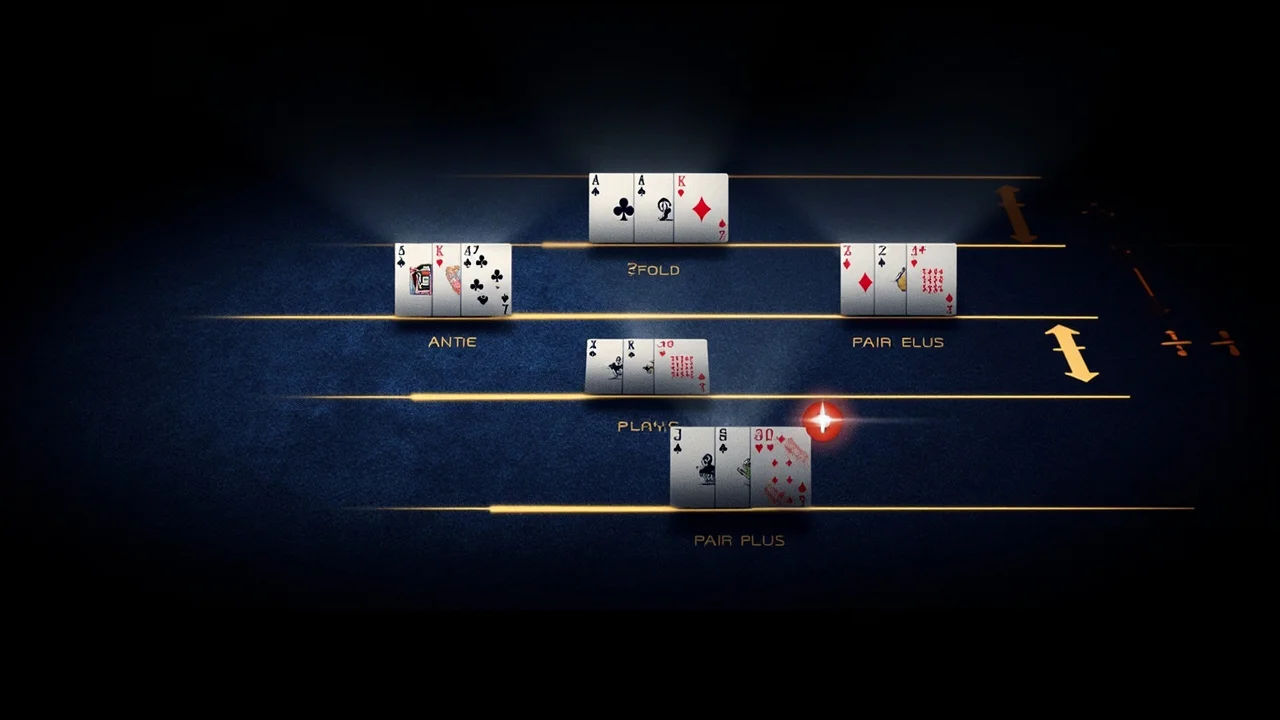
The game starts with the player placing an Ante bet. This is a mandatory bet if you wish to play against the dealer. Additionally, players have the option to place a Pair Plus bet, which is independent of the Ante bet and pays based on the strength of the player's hand alone.
Dealing the Cards
Once all bets are placed, the dealer deals three cards face down to each player and to themselves. Players can look at their own cards but must keep them hidden from others.
Play vs. Fold Decision
After reviewing their cards, players must decide whether to Play or Fold. If a player folds, they forfeit their Ante bet. If they choose to play, they must place an additional bet, equal to the Ante, called the Play bet.
Dealer Qualifying Hand
For the dealer's hand to qualify, it must contain a Queen-high or better. If the dealer does not qualify, the Ante bet pays even money, and the Play bet is returned to the player as a push.
All Possible Outcomes
- Dealer Does Not Qualify: If the dealer's hand does not qualify, the Ante bet wins even money, and the Play bet is a push.
- Dealer Qualifies and You Win: If the dealer qualifies and your hand beats the dealer's, both the Ante and Play bets pay even money.
- Dealer Qualifies and Dealer Wins: If the dealer qualifies and their hand beats yours, both the Ante and Play bets are lost.
- Tie: If the dealer qualifies and your hand ties with the dealer's, both the Ante and Play bets are a push.
Decision Flowchart
Understanding the flow of decisions in Three Card Poker is crucial for effective play. Below is a simplified flowchart to guide players through the decision-making process:
- Place your Ante bet (and optional Pair Plus bet).
- Receive your three cards and evaluate your hand.
- Decide whether to Play (place a Play bet equal to the Ante) or Fold (forfeit the Ante bet).
- The dealer reveals their hand to determine if they qualify:
- If the dealer does not qualify (less than Queen-high), Ante bet wins and Play bet is a push.
- If the dealer qualifies (Queen-high or better):
- If your hand beats the dealer's, both Ante and Play bets win even money.
- If the dealer's hand beats yours, both Ante and Play bets are lost.
- If hands tie, both bets are a push.
By understanding these rules and the decision flow, players can confidently engage in Three Card Poker, enjoying the blend of strategy and chance that defines this exciting casino game.
Three Card Poker Hand Rankings

Three Card Poker is a popular casino table game that differentiates itself from traditional poker by utilizing only three cards per hand. This results in a unique hand ranking system distinct from the five-card poker games. Understanding these rankings is crucial to mastering the game, as they determine the outcomes of the main bets: Ante and Pair Plus. Below is the complete hand ranking table for Three Card Poker, including examples, the number of possible combinations, the probability of each hand, and the typical Pair Plus payout.
| Rank | Hand | Example | Combinations | Probability | Pair Plus Payout |
|---|---|---|---|---|---|
| 1 | Mini Royal (suited AKQ) | A♠K♠Q♠ | 4 | 0.022% | 1000:1 (varies by casino) |
| 2 | Straight Flush | 7♥8♥9♥ | 48 | 0.217% | 40:1 |
| 3 | Three of a Kind | 888 | 52 | 0.235% | 30:1 |
| 4 | Straight | 9-10-J | 720 | 3.257% | 6:1 |
| 5 | Flush | AKT♠ | 1,096 | 4.960% | 4:1 |
| 6 | Pair | JJ7 | 3,744 | 16.941% | 1:1 |
| 7 | High Card | AKQ | 16,440 | 74.393% | No pay |
It's important to note that in Three Card Poker, a Flush ranks higher than a Straight, which is the opposite of traditional five-card poker. This is due to the mathematics of three-card combinations. In this game, there are fewer ways to form a Flush than a Straight, making the Flush a rarer hand.
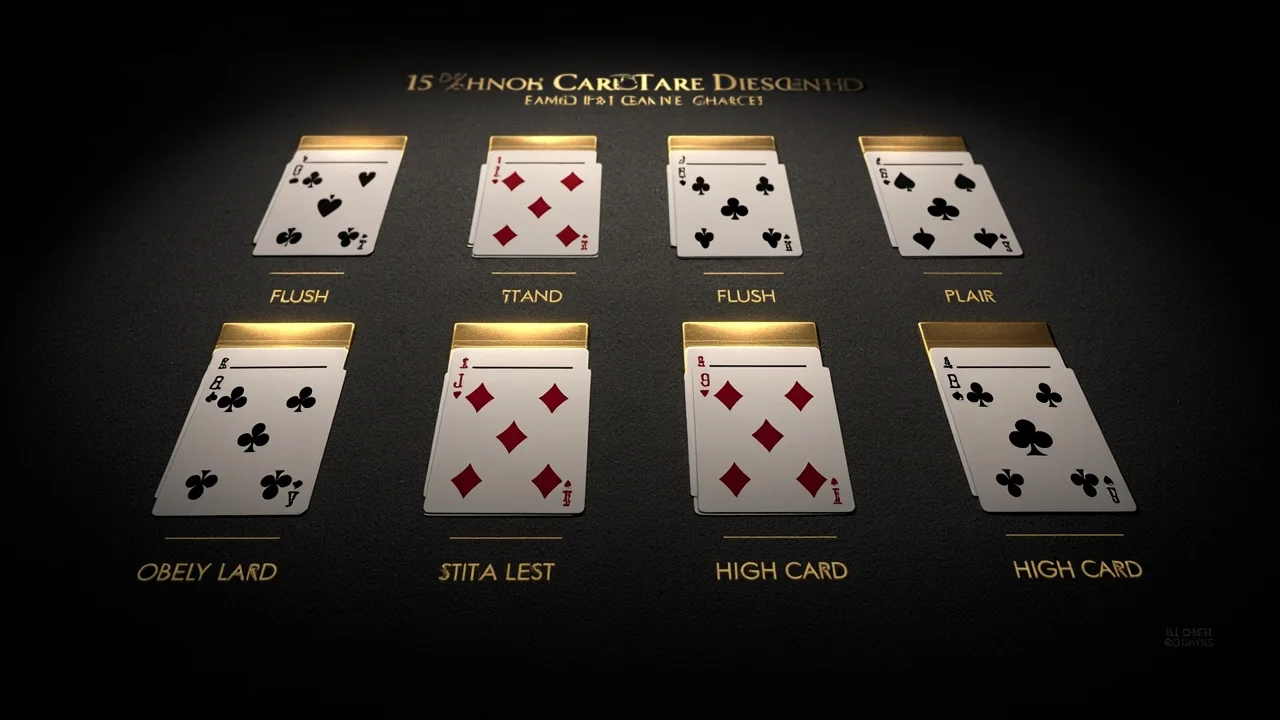
The Mini Royal, consisting of the ace, king, and queen of the same suit, is the highest possible hand in Three Card Poker. It is an extremely rare hand, with only 4 possible combinations, leading to a probability of just 0.022%. While the payout for a Mini Royal can vary by casino, it is typically rewarded at 1000:1 on the Pair Plus bet.
Understanding these hand rankings and their associated probabilities is vital for making informed decisions during gameplay. Whether you are a novice or an experienced player, keeping this hand ranking table in mind will enhance your strategic approach to Three Card Poker.
Optimal Ante Bet Strategy: The Q-6-4 Rule

In Three Card Poker, making optimal decisions with the Ante Bet is crucial for minimizing the house edge and maximizing your potential returns. The most effective strategy revolves around a simple yet powerful rule: play if you have a hand of Q-6-4 or better, and fold if you have a hand weaker than Q-6-4. This guideline is known as the Q-6-4 rule, and it is derived from mathematical analysis of the game’s probabilities.
The Q-6-4 Rule Explained
The Q-6-4 rule is based on the statistical likelihood of your hand being better than the dealer's hand, given the dealer must qualify with a Queen high or better to play. Let’s break down why Q-6-4 is the optimal decision threshold:
- Comparison of hands: In Three Card Poker, hands are compared starting with the highest card, then the second highest, and finally the third. This means a hand with a higher top card will always beat one with a lower top card, regardless of the other cards.
- Mathematical cutoff: The Q-6-4 rule comes from analyzing the probability distribution of possible hands. By playing with Q-6-4 or better, you are making a statistically favorable decision that minimizes the house edge.
Why Q-6-4?
The choice of Q-6-4 as the threshold is not arbitrary. It is the point at which your hand is approximately equal in strength to the average dealer hand, assuming the dealer qualifies to play. By opting to play only hands that are Q-6-4 or better, you effectively decrease the house edge to 3.37%. In contrast, if you were to always play regardless of your hand, the house edge jumps significantly to 7.65%. This difference highlights the strategic advantage of the Q-6-4 rule, saving you nearly 4% of the house edge in the long run.
Understanding Hand Comparisons
To apply the Q-6-4 rule effectively, it's essential to understand how to compare different hands. The following table provides examples of hands and the corresponding decisions based on the Q-6-4 rule:
| Hand | Decision | Reason |
|---|---|---|
| K-2-2 | Play (pair) | Any pair beats Q-6-4 |
| Q-7-2 | Play | Q-7 beats Q-6 |
| Q-6-4 | Play | Exact threshold |
| Q-6-3 | Fold | Just below threshold |
| Q-5-4 | Fold | Q-5 < Q-6 |
| J-A-K | Fold | Highest card is J — below Q |
By adhering to this strategy, players can make more informed decisions, potentially improving their outcomes while enjoying the game. The Q-6-4 rule not only simplifies the decision-making process but also provides a statistically sound approach to playing Three Card Poker.
The Pair Plus Bet: Analysis & When to Play

The Pair Plus bet in Three Card Poker is a side wager that stands out for its simplicity and independence from the dealer's hand. Unlike the Ante bet, the outcome of the Pair Plus bet is determined solely by the player's three cards. If your hand contains a pair or better, you win, regardless of the dealer's cards. This section explores the different pay tables available for the Pair Plus bet, the associated house edges, and when it is advantageous to place this bet.
Standard Pair Plus Pay Table
The most common pay table for the Pair Plus bet is as follows:
| Hand | Payout |
|---|---|
| Straight Flush | 40:1 |
| Three of a Kind | 30:1 |
| Straight | 6:1 |
| Flush | 4:1 |
| Pair | 1:1 |
With this pay table, the house edge is 7.28%. This relatively high house edge makes the Pair Plus bet less attractive compared to other casino games, but it remains popular due to its straightforward nature and the potential for high payouts with premium hands.
Better Pair Plus Pay Table
Some casinos offer a more favorable pay table for the Pair Plus bet:
| Hand | Payout |
|---|---|
| Straight Flush | 40:1 |
| Three of a Kind | 30:1 |
| Straight | 6:1 |
| Flush | 3:1 |
| Pair | 1:1 |
This pay table reduces the house edge to a more player-friendly 2.14%. When encountering this pay table, the Pair Plus bet becomes a much more viable option, offering a better chance of walking away with a profit.
Strategic Considerations
When deciding whether to place a Pair Plus bet, it's crucial to check which pay table the casino offers. The difference between a 7.28% and a 2.14% house edge can significantly impact your overall experience and bankroll. Generally, if the house edge is at 7.28%, the bet is considered marginal. However, with a house edge of 2.14%, the bet is worth considering due to the favorable odds.
Another aspect to consider is the flexibility of playing Pair Plus without an Ante bet. In most casinos, players can choose to place the Pair Plus bet independently of the Ante bet, allowing them to focus solely on the side wager. This flexibility means you can enjoy the thrill of chasing high payouts without engaging in the main game. However, be aware that the absence of an Ante bet changes the dynamic, requiring you to rely solely on luck rather than any strategic play against the dealer's hand.
In conclusion, the Pair Plus bet offers a straightforward and exciting way to engage with Three Card Poker. While the standard pay table presents a higher house edge, the better pay table with a 2.14% house edge makes the bet a compelling choice. Always verify the pay table in use at the casino and consider your risk tolerance before placing this bet. With the right conditions, the Pair Plus bet can add an enjoyable and potentially lucrative element to your gaming experience.
Odds & House Edge

Understanding the odds and house edge in Three Card Poker is crucial for any player looking to maximize their chances of success. This section provides a comprehensive breakdown of the probabilities and house edge associated with each bet type in the game, focusing on the Ante bet, Pair Plus bet, and the combined Ante+Play strategy.
Ante Bet House Edge
The Ante bet in Three Card Poker, when played with optimal strategy using the Q-6-4 rule, has a house edge of 3.37%. This means that for every $100 wagered, the expected loss over the long term is $3.37. The Q-6-4 rule dictates that players should place an additional Play bet if their hand is Queen-6-4 or better. This strategy minimizes the house edge and gives players the best chance of winning against the dealer.
Pair Plus Bet House Edge
The Pair Plus bet is a separate wager that does not depend on the dealer's hand, focusing solely on the player's cards. The house edge for the Pair Plus bet is higher than the Ante bet, sitting at 7.28%. This translates to an expected loss of $7.28 per $100 wagered over time. Despite its higher house edge, the Pair Plus bet offers players the opportunity for higher payouts based on the strength of their three-card hand.
Dealer Qualification and Outcomes
In Three Card Poker, the dealer must qualify with a hand of Queen high or better for the Ante and Play bets to proceed to a comparison. The probability of the dealer qualifying is approximately 56.3%. If the dealer does not qualify, the Ante bet wins even money, and the Play bet is returned to the player.
When the dealer qualifies, the probability of the player beating the dealer's hand is approximately 47.8%, while the probability of a tie is about 0.4%. These odds highlight the importance of understanding the dealer's qualification in shaping the game's outcomes and the player's potential winnings.
Comparison of Bet Options
The following table compares the house edge and key probabilities for the Ante bet, Pair Plus bet, and the combined Ante+Play strategy.
| Bet Type | House Edge | Probability of Winning | Probability of Dealer Qualifying | Probability of Tie |
|---|---|---|---|---|
| Ante | 3.37% | 47.8% (if dealer qualifies) | 56.3% | 0.4% |
| Pair Plus | 7.28% | Varies by hand strength | N/A | N/A |
| Ante+Play | 3.37% | 47.8% (if dealer qualifies) | 56.3% | 0.4% |
In conclusion, while the Ante bet with optimal strategy offers a more favorable house edge than the Pair Plus bet, players should consider their appetite for risk and potential payouts when deciding which bets to place. Understanding these odds and house edges allows players to make informed decisions and enjoy the game with a strategic approach.
Side Bets: 6 Card Bonus & Others

In Three Card Poker, side bets offer players additional opportunities to win beyond the main game. While these bets can add excitement and variety, they often come with a higher house edge compared to the standard Ante and Pair Plus bets. Below, we explore the most common side bets: the 6 Card Bonus, Prime bet, and Progressive Jackpot, complete with an analysis of their house edges and potential payouts.
6 Card Bonus
The 6 Card Bonus is a popular side bet that combines the player’s three cards with the dealer’s three cards to form the best possible five-card poker hand. The goal is to achieve a strong poker hand, such as a Three of a Kind or better, to win a payout. However, the house edge for the 6 Card Bonus typically ranges from 16% to 18%, making it a riskier proposition for players.
| Hand | Payout | Probability |
|---|---|---|
| Royal Flush | 1000 to 1 | 0.000154% |
| Straight Flush | 200 to 1 | 0.00139% |
| Four of a Kind | 100 to 1 | 0.024% |
| Full House | 20 to 1 | 0.17% |
| Flush | 15 to 1 | 0.367% |
| Straight | 10 to 1 | 0.76% |
| Three of a Kind | 5 to 1 | 4.83% |
Prime Bet
The Prime bet is a side wager on whether all six cards (the player’s and dealer’s three cards) are of the same color. With a house edge of approximately 3.6%, it is more favorable compared to other side bets. This bet pays out at 3 to 1 if all cards are of the same color. While still a side bet with a house advantage, its relatively low house edge makes it a more attractive option for players who enjoy betting on side games.
Progressive Jackpot
The Progressive Jackpot is a side bet that offers a chance at a large payout for a small wager. The jackpot amount increases over time as more players contribute to the pot. Typically, a player wins a portion or the entirety of the jackpot with a high-ranking hand such as a Royal Flush. However, the house edge on Progressive Jackpots is often high, depending on the jackpot size and contribution rates, and can be as much as 25% or more.
| Side Bet | Payout | House Edge | Worth Playing? |
|---|---|---|---|
| 6 Card Bonus | Varies by hand | 16-18% | No |
| Prime | 3 to 1 | 3.6% | Yes, relatively |
| Progressive Jackpot | Jackpot | 25%+ | No |
While side bets like the 6 Card Bonus, Prime, and Progressive Jackpot can add excitement to a game of Three Card Poker, they generally come with higher house edges. Players should weigh the thrill and potential reward against the statistical disadvantage before placing these bets. For those seeking lower-risk options, sticking to the main game with optimal strategy is advisable.
Bankroll Management & Session Tips

Budget for Three Card Poker
When approaching Three Card Poker, a disciplined bankroll management strategy is essential. The house edge for the Ante and Play bet combined is approximately 3.37%, while the Pair Plus bet carries a house edge of around 7.28%. Understanding these figures is crucial for setting a budget that aligns with your risk tolerance and gaming objectives.
A common recommendation is to allocate a bankroll that allows for at least 50 to 100 units of your base bet. For instance, if you plan to wager $5 per hand, a bankroll of $250 to $500 would be prudent. This range helps mitigate the risk of short-term variance and provides a buffer against potential losing streaks.
Expected Loss
To calculate your expected loss, consider both the house edge and your average bet per hour. If you play 50 hands per hour with a $5 Ante bet, your total wagered amount is $250 per hour. With a house edge of 3.37%, your expected loss per hour is:
Expected Loss = Total Wagered x House Edge = $250 x 0.0337 = $8.43
This calculation assumes optimal play using the Q-6-4 strategy. Adjust your expected loss if you frequently place Pair Plus or other side bets, as these have higher house edges.
Session Length
The duration of your gaming session should be carefully planned to align with your bankroll and expected loss. If your bankroll is $500 and your expected loss is $8.43 per hour, you can theoretically play for approximately:
Session Length = Bankroll / Expected Loss per Hour = $500 / $8.43 ≈ 59 hours
However, it is wise to set personal stop-loss and win goals to prevent extended losing sessions or to secure profits. For instance, you might decide to end a session after losing 20% of your bankroll or achieving a 50% profit increase.
Practical Tips
- Set Limits: Determine both a loss limit and a win goal before starting your session to avoid chasing losses or risking winnings.
- Track Your Play: Keep a detailed record of your bets, wins, and losses to analyze your play over time and adjust your strategy accordingly.
- Take Breaks: Regular breaks can help maintain focus and prevent impulsive decisions driven by fatigue or emotion.
- Stay Disciplined: Adhere strictly to your predetermined limits and strategies, resisting the urge to deviate during play.
Implementing these bankroll management strategies and session tips will enhance your Three Card Poker experience, helping you enjoy the game responsibly while minimizing financial risk.
Common Mistakes

Three Card Poker, while simpler than many casino games, is not immune to player errors. Missteps can significantly impact your bankroll and overall enjoyment. Here, we address some of the most frequent mistakes players make, from misjudging when to fold to becoming overly reliant on side bets.
Folding Too Often or Too Rarely
One of the most common errors is misunderstanding when to fold. The optimal strategy for the Ante bet is to play with a hand of Queen-6-4 or better. Folding weaker hands is crucial because playing them increases your expected losses. Conversely, folding too often, especially hands stronger than Q-6-4, means you're missing opportunities to win. Remember, the house edge on the Ante bet when using the Q-6-4 strategy is approximately 3.37%. Deviating from this strategy can increase the house edge against you.
Side Bet Obsession
Side bets in Three Card Poker, such as the Pair Plus and the 6 Card Bonus, can be tempting due to their potential high payouts. However, they come with a significantly higher house edge. For instance, the Pair Plus bet has a house edge of 7.28%, while the 6 Card Bonus can exceed 8%. Many players fall into the trap of placing these bets every hand, hoping for a big win. It's crucial to remember that these bets should be used sparingly, as part of a balanced strategy, if at all.
Not Knowing the Q-6-4 Rule
As mentioned, the Q-6-4 rule is the cornerstone of optimal Ante bet strategy. Failing to apply this rule can lead to suboptimal decisions. The rule dictates that you should play any hand that is Q-6-4 or better and fold anything weaker. This strategy minimizes the house edge and maximizes your potential for profit over time. New players often overlook this rule, either because they are unaware of it or because they misjudge the strength of their hand. Consistently applying this rule is essential for successful Three Card Poker play.
Understanding these common mistakes and how to avoid them can significantly improve your Three Card Poker experience. Remember, while luck plays a role, informed strategy is your best ally at the table.
Online Three Card Poker

Three Card Poker has gained significant popularity in online casinos, offering players the convenience of enjoying this engaging game from the comfort of their homes. With a wide array of online platforms available, players can easily find Three Card Poker games with varying stakes and additional features.
Finding Three Card Poker Online
To find Three Card Poker online, players should look for reputable online casinos that are licensed and regulated by recognized gaming authorities. Leading online casino providers such as BetMGM, 888 Casino, and Betway offer Three Card Poker as part of their table game selection. It's crucial to verify the casino's licensing and read reviews to ensure a secure gaming environment.
Live Dealer Versions
For those seeking a more interactive experience, live dealer versions of Three Card Poker are available. These games feature real dealers streamed in real-time, providing an authentic casino atmosphere. Evolution Gaming and Playtech are renowned providers of high-quality live dealer Three Card Poker games, ensuring seamless streaming and engaging gameplay.
Game Variations
While the fundamental rules of Three Card Poker remain consistent, some online platforms offer variations with additional side bets or adjusted payouts. Popular variations include the "Prime" side bet, which pays out based on the color of the player's cards, and the "6 Card Bonus" bet, which considers the dealer's cards as well. Players should familiarize themselves with these variations and their respective odds before playing.
Top Providers
Several top software providers offer Three Card Poker, each with unique features and user interfaces. Notable providers include:
- Evolution Gaming: Known for immersive live dealer experiences with professional dealers and high-definition streams.
- Playtech: Offers a wide range of table games, including innovative variations of Three Card Poker.
- Microgaming: Provides a user-friendly interface with straightforward gameplay and reliable software.
When selecting an online platform for Three Card Poker, players should consider the provider’s reputation, game variety, and available bonuses to enhance their gaming experience.
Three Card Poker Glossary & Cheat Sheet

Glossary of Terms
| Term | Definition |
|---|---|
| Ante | The initial bet placed before the cards are dealt. |
| Pair Plus | An optional side bet that pays based on the player's hand ranking. |
| Play Bet | The bet placed if the player chooses to continue after seeing their cards. |
| Fold | To forfeit the hand and lose the ante bet. |
| Dealer Qualifying Hand | The minimum hand (Queen high) the dealer needs to play. |
| Flush | A hand where all three cards are of the same suit. |
| Straight | A hand where cards are in sequence. |
| Straight Flush | A hand where cards are in sequence and of the same suit. |
| Three of a Kind | A hand with three cards of the same rank. |
| House Edge | The statistical advantage the casino has over the player. |
| 6 Card Bonus | A side bet that considers the best five-card hand from the player’s and dealer’s cards. |
| Push | A tie between player and dealer resulting in no win or loss of the initial bet. |
| Ante Bonus | An additional payout for certain high-ranking hands when the Play bet is made. |
| Full House | A hand with three of a kind and a pair. |
| Rake | The commission taken by the house from the bets. |
| High Card | A hand that doesn’t qualify for any other ranking, judged by the highest card. |
| Minimum Bet | The smallest bet allowed at the table. |
| Maximum Bet | The largest bet allowed at the table. |
| Bankroll | The total amount of money a player has set aside for gambling. |
| Edge Sorting | A controversial technique where players exploit slight differences on card backs. |
Cheat Sheet
Q-6-4 Rule Decision Table: The Q-6-4 rule is a strategy guideline for deciding whether to place the Play bet after seeing your cards.
| Player Hand | Action |
|---|---|
| Q, 6, 4 or higher | Play |
| Lower than Q, 6, 4 | Fold |
Pair Plus Standard Pay Table:
| Hand | Payout |
|---|---|
| Straight Flush | 40 to 1 |
| Three of a Kind | 30 to 1 |
| Straight | 6 to 1 |
| Flush | 3 to 1 |
| Pair | 1 to 1 |
Dealer Qualifying Requirement: Dealer must have at least a Queen high to play.
House Edge:
- Ante & Play: Approximately 3.37%
- Pair Plus: Approximately 2.32% (depending on the pay table)
- 6 Card Bonus: Approximately 8.56%