

Table of Contents
- Introduction to Casino War
- History & Origins
- How to Play: Complete Rules
- Table Layout & Card Ranking
- The Tie Bet: A Mathematical Deep Dive
- Odds & House Edge: Complete Analysis
- Casino War Strategy: What Works and What Doesn't
- Bankroll Management & Session Planning
- Casino War Variations
- Casino War Glossary & Quick Reference
Introduction to Casino War


Casino War is often hailed as the simplest card game available in casinos, a distinction that stems from its straightforward rules and quick gameplay. The game is essentially a direct battle between the player and the dealer, with each side drawing a single card. The highest card wins, and in the event of a tie, players can either surrender or go to "war" by placing an additional bet. This simplicity makes Casino War a popular choice for both novice gamblers and seasoned players looking for a break from more complex games.
Despite its simplicity, understanding the mathematical underpinnings of Casino War is crucial for maximizing your chances of success. At its core, Casino War is a game of probability, and even a basic grasp of the odds can significantly impact your strategy and bankroll management. For example, the probability of winning a single hand in Casino War is approximately 46.30%, while the probability of a tie is about 7.40%. These figures are derived from the standard 52-card deck used in the game.
When a tie occurs, the decision to surrender or go to war has a profound impact on the house edge. If a player chooses to surrender, the house edge stands at roughly 3.70%. Conversely, opting to go to war reduces the house edge slightly to about 2.88%. This small difference highlights the importance of making informed decisions, even in a game as seemingly straightforward as Casino War. Understanding these probabilities allows players to make strategic choices that can reduce losses over time.
In Casino War, the house edge is influenced by the structure of the game itself. The probability of winning, losing, or tying directly affects the player's long-term expected value. By familiarizing yourself with these probabilities, you can better assess risk and make more informed betting decisions. Whether you're a novice looking to learn the game or an expert seeking to refine your strategy, understanding the math behind Casino War can enhance your gameplay experience and improve your odds of walking away a winner.
History & Origins
Casino War finds its roots in the simple children's card game known as War, which has been a staple of childhood entertainment for generations. In its original form, War is a straightforward game played with a standard 52-card deck, where two players each draw a card, and the player with the higher card wins the round. Its simplicity and reliance on sheer luck rather than strategy made it a perfect pastime for young players. The game of War is traditionally played without any betting or monetary stakes, which is one reason it has remained popular with children.

The transition of War from a children's game to a casino table game is a relatively recent development. The concept was adapted for the casino floor by Bet Technology in 1993, which sought to capitalize on the nostalgic familiarity of the card game while adding elements of gambling excitement. Casino War was designed to offer the same straightforward gameplay but with the added thrill of wagering, making it accessible to both novice gamblers and seasoned players looking for a fast-paced and uncomplicated game.
The adaptation of War into Casino War involved minimal changes to the original rules, making it easy for players to understand and enjoy. The primary modification was the introduction of betting, where players place an initial wager before cards are drawn. In the event of a tie, players have the option to "go to war" by placing an additional bet, adding a strategic decision point to the otherwise luck-based game.
Since its introduction, Casino War has steadily gained popularity in casinos around the world. Its appeal lies in its simplicity and the relatively quick resolution of each round, which allows for a high number of hands to be played in a short period. This fast pace, combined with a low house edge—often around 2.88% when played optimally—makes it an attractive option for players.
Today, Casino War can be found in many major casinos, particularly in gambling hubs like Las Vegas and Atlantic City. It has also made its way into online casinos, further broadening its reach and accessibility. The game continues to draw players who appreciate its straightforward rules, nostalgic roots, and the chance to experience a classic card game in a new and exciting context.
How to Play: Complete Rules

Casino War is a straightforward card game that pits the player against the dealer in a head-to-head battle. The game is played with a standard 52-card deck, and multiple decks are often used, typically six. The objective is simple: draw a higher card than the dealer. Below, we outline the complete rules of Casino War, including dealing, card comparison, win/lose/tie outcomes, and the options available when a tie occurs.
Dealing
At the start of a round, both the player and the dealer are dealt one card each, face up. The player must place an initial bet before any cards are dealt. This bet is known as the ante. The dealer then distributes one card to the player and one card to themselves.
Card Comparison
Once the cards are dealt, they are compared to determine the outcome:
- Player's Card Higher: The player wins and receives a payout of 1:1 on their ante.
- Dealer's Card Higher: The player loses their ante bet.
- Tie: If the player's card and the dealer's card are of equal rank, the player has two options: Go to War or Surrender.
Win/Lose Outcomes
The simplest outcomes occur when there is a clear winner based on the card comparison. Here's how they play out:
- Example of Player Win: Player draws a King, dealer draws a Queen. The player wins and receives a 1:1 payout on their ante.
- Example of Player Loss: Player draws a 7, dealer draws a 9. The player loses their ante bet.
Tie Outcomes: Go to War or Surrender
When a tie occurs, the player can choose between two options:
Option 1: Go to War
If the player decides to Go to War, they must double their original ante by placing an additional bet equal to their initial wager. The dealer also places a matching bet. Both the player and the dealer are dealt another card.
- If the player's new card is higher: The player wins and receives a 1:1 payout on both the ante and the additional bet.
- If the dealer's new card is higher: The player loses both the ante and the additional bet.
- If the second cards also tie: The player wins and receives a 1:1 payout on the additional bet, and the ante is returned, resulting in a net gain.
Example of Going to War: Initial cards both are 8s. The player opts to Go to War, doubling the ante. The player draws a 10, and the dealer draws a 9. The player wins both the ante and the additional bet with a 1:1 payout.
Option 2: Surrender
The player may choose to Surrender, forfeiting half of their original ante bet. This option allows the player to minimize losses in the event of a tie.
Example of Surrender: Initial cards both are Jacks. The player opts to Surrender, losing half of their ante bet, while retaining the other half.
In summary, Casino War offers a simple yet engaging experience with clear rules and outcomes. The decision to Go to War or Surrender during a tie can significantly impact the game's result, providing an element of strategy to this otherwise luck-based game. Understanding these options and their implications is crucial for players seeking to maximize their chances of success at the Casino War table.
Table Layout & Card Ranking

Casino War is a straightforward card game that utilizes a standard poker table layout with a few specific modifications. Understanding the table layout and card ranking is crucial for both novice and seasoned players aiming to maximize their enjoyment and strategic approach to the game.
Table Layout
The Casino War table is typically designed to accommodate six to seven players, along with a dealer. The layout is similar to a blackjack table but has distinct features specific to Casino War. Each player's position at the table includes designated areas for placing their main wager and a separate area for the optional tie bet.
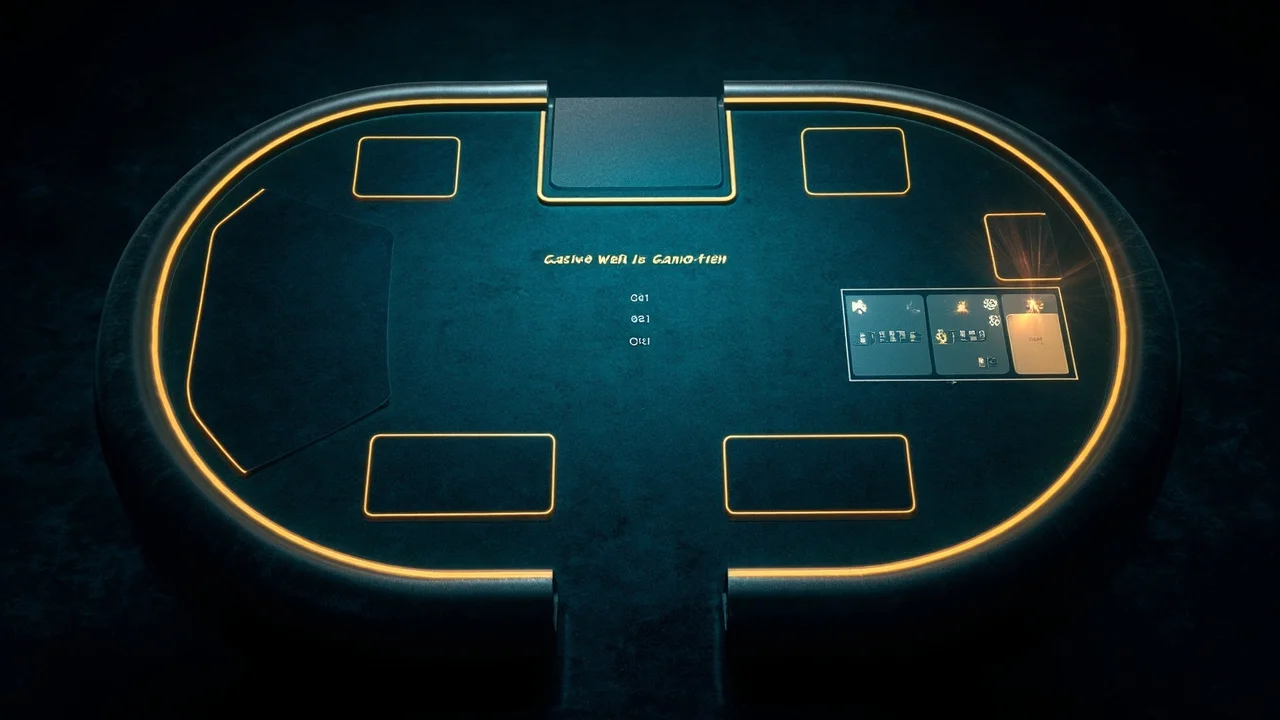
- Main Bet Area: Each player has a space directly in front of them for placing their primary wager. This is where the initial bet is made before the cards are dealt.
- Tie Bet Area: Located adjacent to the main bet area, this space allows players to place a side bet on the possibility of a tie occurring between their card and the dealer's card.
- Dealer's Position: The dealer stands behind a semicircular section of the table, facing the players, with card shoe and discard tray accessible.
In most casinos, the game is played with six decks of standard playing cards, shuffled together and dealt from a shoe. However, some variations might use anywhere from one to eight decks, affecting the odds and house edge slightly.
Card Ranking
In Casino War, the ranking of cards follows the traditional poker hierarchy, where the Ace is always high. The sequence from lowest to highest is as follows:
- 2
- 3
- 4
- 5
- 6
- 7
- 8
- 9
- 10
- Jack
- Queen
- King
- Ace
In the event of a tie, where both the player and the dealer receive cards of the same rank, players have the option to either surrender half their bet or go to "war" by placing an additional wager equal to their original bet. The tie bet, if placed, pays out at odds typically set at 10:1, though this can vary slightly depending on the house rules.
By understanding the table layout and card ranking, players can better grasp the flow of the game and make informed decisions during play. The straightforward nature of Casino War, combined with its familiar card ranking system, makes it an appealing choice for those seeking a simple yet engaging casino experience.
The Tie Bet: A Mathematical Deep Dive

Casino War is a straightforward game that is reminiscent of the card game many played as children. However, within its simplicity lies a betting option that can be quite deceptive: the tie bet. This section will explore the tie bet in detail, analyzing its payout, probability, house edge, and why it is often considered a trap for players.
Understanding the Tie Bet
In Casino War, the tie bet is an optional wager that players can place in addition to their main bet. If both the player and the dealer draw cards of the same rank, the tie bet wins. The standard payout for a tie bet is 10:1, meaning if you wager $1, you win $10.
Probability of a Tie
To understand the true cost of a tie bet, we need to calculate the probability of a tie occurring. When using a standard six-deck shoe, the probability of a tie is approximately 7.38%. This probability is derived from the fact that there are numerous combinations of cards that can result in a tie out of the total possible combinations.
Mathematical Calculation of the House Edge
Now, let's compute the expected value (EV) and the house edge for the tie bet. The EV is calculated as follows:
- Probability of a tie: 0.0738 (7.38%)
- Payout on a tie: $10
- Probability of not tying: 0.9262 (92.62%)
- Loss on a non-tie: $1
The expected value (EV) per $1 bet on a tie is:
EV = (0.0738 × $10) - (0.9262 × $1) = $0.738 - $0.926 = -$0.188 per $1 bet
This translates to a house edge of 18.8%, which is significantly higher than the main ante bet's house edge of approximately 2.88%. This means that for every $1 bet on a tie, a player can expect to lose approximately 18.8 cents on average.
Comparison of Bet Types
To put this into perspective, let's compare the tie bet with the ante bet in terms of payout and house edge:
| Casino War Bet | Payout | House Edge |
|---|---|---|
| Ante Bet | 1:1 | 2.88% |
| Tie Bet | 10:1 | 18.8% |
Why the Tie Bet is a Trap
The tie bet may seem appealing because of its high payout, but the underlying mathematics reveal why it is a trap for unwary players. The house edge of 18.8% is one of the highest in the casino, making it a poor choice for those looking to maximize their chances of winning. While the allure of a 10:1 payout can be tempting, the reality is that the odds are heavily stacked against the player.
In conclusion, while Casino War offers the tie bet as an exciting option, the smart player will recognize its pitfalls. Understanding the math behind the bet reveals that it is not a viable long-term strategy for those looking to minimize losses. Players should approach the tie bet with caution and a clear understanding of its significant house edge.
Odds & House Edge: Complete Analysis

Understanding the odds and house edge in Casino War is crucial for any player looking to improve their game. This section will delve into the specifics of how the number of decks affects the house edge, compare the expected value (EV) of going to war versus surrendering, and break down the probabilities of different outcomes in the game.
House Edge by Number of Decks
The house edge in Casino War varies depending on the number of decks used in the game. The following table illustrates the house edge for games using different numbers of decks:
| Number of Decks | House Edge (%) |
|---|---|
| 1 Deck | 2.42% |
| 2 Decks | 2.24% |
| 4 Decks | 2.18% |
| 6 Decks | 2.33% |
| 8 Decks | 2.33% |
The house edge is lowest with four decks, making it the most favorable option for players. As more decks are added, the house edge tends to stabilize around 2.33% due to the reduced probability of ties.
War vs Surrender: EV Comparison
When faced with a tie, players in Casino War have two choices: go to war or surrender. The expected value (EV) of each choice is crucial in determining the better strategy. The table below compares the EV for both options:
| Choice | Expected Value (EV) |
|---|---|
| Going to War | -0.33 units |
| Surrendering | -0.50 units |
Mathematically, going to war is a better choice, resulting in a lower expected loss of 0.33 units compared to surrendering, which results in a loss of 0.50 units. Thus, players should always opt to go to war when faced with a tie.
Probability Breakdown
Understanding the probabilities of different outcomes in Casino War can help players make informed decisions. The following table provides a detailed breakdown of the probabilities for winning, losing, and tying on the initial deal, as well as winning or losing during a war:
| Outcome | Probability (%) |
|---|---|
| Win on Come-Out | 46.30% |
| Lose on Come-Out | 46.30% |
| Tie on Come-Out | 7.40% |
| Win on War | 50.00% |
| Lose on War | 50.00% |
The probability of a tie is relatively low at 7.40%, but it is important to note that if a tie occurs, players have a 50% chance of winning if they choose to go to war. This reinforces the strategy of opting for war over surrendering.
Conclusion
In conclusion, the analysis shows that the house edge in Casino War is affected by the number of decks, with four decks providing the most favorable odds for players. When faced with a tie, going to war is always the better choice due to its lower expected value loss. By understanding these odds and probabilities, players can make informed decisions and improve their chances of success at the Casino War table.
Casino War Strategy: What Works and What Doesn't

Casino War is a straightforward game that requires minimal strategic input compared to other casino games. However, understanding the few strategic decisions that exist can enhance your experience and potentially improve your outcomes. This section focuses on the key strategic decision in Casino War, selecting the right table, and bankroll considerations.
The Single Key Strategic Decision
The primary decision a player must make in Casino War is whether to go to war or surrender when faced with a tie. The recommended strategy is simple: always go to war. Here's why:
- Going to War: When you go to war, you place an additional wager equal to your original bet. If you win the subsequent battle, you recover your original bet and win an amount equal to that bet. The probability of winning when you go to war is approximately 50%, depending on the number of decks in use.
- Surrendering: If you choose to surrender, you lose half of your original bet immediately. Given the 50% chance of winning when going to war, surrendering results in a guaranteed loss, making it the less favorable option.
Avoiding the Tie Bet
The tie bet in Casino War offers a tempting payout, typically 10:1, but it carries a substantial house edge of approximately 18.65%. This makes it one of the worst bets in the casino. The probability of a tie occurring is only about 7.4% with six decks, making this bet a poor choice for strategic play. Avoid the tie bet to minimize the house advantage against you.
Table Selection
The number of decks used in Casino War affects the house edge. Fewer decks slightly reduce the house edge, making them a better choice for players. Here's a breakdown of the house edge based on the number of decks:
| Number of Decks | House Edge (%) |
|---|---|
| 1 | 2.86 |
| 2 | 2.88 |
| 4 | 2.89 |
| 6 | 2.88 |
| 8 | 2.88 |
When possible, choose tables with fewer decks to slightly improve your odds.
Bankroll Considerations
Given the limited strategic depth of Casino War, it is best approached as a form of entertainment rather than a game with significant financial returns. The house edge is a known factor, and no betting system can alter the expected value in your favor. As such, it is essential to treat your bankroll as an entertainment budget, ensuring you only wager what you can afford to lose.
Overall, while Casino War requires minimal strategy, understanding these key aspects can enhance your enjoyment and potentially extend your playtime. Remember that the game's simplicity is part of its charm, and your primary goal should be entertainment rather than profit.
Bankroll Management & Session Planning

Effective bankroll management and session planning are crucial for enjoying Casino War while minimizing potential losses. Understanding the expected loss per hour, setting a realistic session budget, and estimating the number of hands you can play per hour will help you manage your resources wisely.
Expected Loss Per Hour
Casino War is a fast-paced game, with players typically participating in 150 to 200 hands per hour. Given the house edge of 2.88%, you can calculate your expected loss per hour based on your average bet size. For example, if you bet $5 per hand, your expected hourly loss can be calculated as follows:
- Average hands per hour: 175
- Average bet per hand: $5
- House edge: 2.88%
- Expected loss per hour = 175 × $5 × 0.0288 ≈ $25.20
Expected Hourly Loss at Different Bet Sizes
| Bet Size | Expected Loss per Hour |
|---|---|
| $5 | $25.20 |
| $10 | $50.40 |
| $25 | $126.00 |
| $50 | $252.00 |
| $100 | $504.00 |
Session Budget
Setting a session budget is essential for maintaining control over your gambling activity. A good rule of thumb is to allocate a budget that allows you to play for at least a few hours, considering the expected loss per hour. For example, if your bankroll is $100 and your expected loss is $25.20 per hour at a $5 bet, you can reasonably expect to play for about four hours.
Consider your entertainment value and the time you plan to spend. If your goal is to enjoy a two-hour session, ensure your bankroll can cover the expected loss for that duration. Always remember, gambling should be viewed as entertainment, and the money spent should be within your discretionary budget.
Hands Per Hour Estimate
Casino War is played rapidly, with an average of 150 to 200 hands dealt per hour. This high pace contributes to the quick turnover of bets, which is why understanding your expected loss and setting an appropriate session budget is vital. Adjust your bet size and session length according to your bankroll to maximize enjoyment and minimize risk.
By carefully managing your bankroll and planning your sessions, you can enhance your Casino War experience, keeping it fun and within your financial means.
Casino War Variations

Casino War, while maintaining a straightforward core gameplay, offers several variations that can significantly impact player strategy and outcomes. These variations primarily revolve around the tie bet payouts, the number of decks used, and the game's availability in online casinos. Understanding these differences is crucial for optimizing your play and managing your bankroll effectively.
Tie Bet Payouts
The tie bet in Casino War is a critical feature that varies across different casinos, impacting the overall house edge. Typically, the payout for a tie bet ranges from 10:1 to 11:1. However, some casinos offer different payouts, which directly affect the game's mathematics. Below is a comparison of various tie bet payouts and their corresponding house edges:
| Tie Bet Payout | House Edge on Tie Bet |
|---|---|
| 10:1 | 18.65% |
| 11:1 | 17.83% |
The house edge on the main wager (excluding tie bets) remains approximately 2.88% for a single deck, which increases slightly with additional decks.
Multi-Deck Rule Differences
The number of decks used in Casino War affects the probabilities of winning and should be factored into your strategy. Most land-based casinos use six decks, but variations exist with anywhere from one to eight decks. Here is how the number of decks influences the house edge on the main bet:
| Number of Decks | House Edge on Main Bet |
|---|---|
| 1 | 2.42% |
| 6 | 2.88% |
| 8 | 2.89% |
As the number of decks increases, the house edge slightly rises due to the reduced probability of ties, which are advantageous for the player when resolved through a "war."
Online Availability
Casino War is widely available in online casinos, offering both live dealer and automated versions. The online version typically mirrors the six-deck setup found in many land-based casinos, but players can often find single-deck and other multi-deck variations. The convenience of online play allows for easy exploration of different rules and payout structures, and many platforms offer free play options to practice strategies without financial risk. However, players should always verify the rules and payouts before committing to real money play, as these can vary significantly between different online platforms.
Understanding these variations can enhance your overall Casino War experience, allowing for informed decisions that align with your strategic preferences and risk tolerance.
Casino War Glossary & Quick Reference

Glossary of Key Terms
| Term | Definition |
|---|---|
| Ante | The initial bet placed by the player before any cards are dealt. |
| War | Occurs when the player's and dealer's cards are of equal rank, leading to a secondary round where additional wagers can be placed. |
| Go to War | The decision to place an additional bet equal to the ante after a tie to continue the game. |
| Surrender | Option to forfeit half of the ante after a tie instead of going to war. |
| Tie Bet | A side bet that predicts the player and dealer will have cards of the same rank. |
| House Edge | The statistical advantage that the casino holds over the player, typically expressed as a percentage. |
| Deck Penetration | The percentage of the deck that is dealt before reshuffling occurs. |
| Push | A tie between the player and the dealer where no money is won or lost. |
| Face Card | Any king, queen, or jack card. |
| Natural | Refers to the highest possible card in Casino War, which is the ace. |
| Shoe | A device used to hold multiple decks of cards for dealing. |
| Shuffle | The process of mixing cards to ensure randomness. |
| Dealing | The act of distributing cards to players and the dealer. |
| Stake | The amount of money a player wagers on a game. |
| Burn Card | A card removed from play before dealing begins, typically the top card of the deck. |
Cheat Sheet
The Golden Rule: Always go to war; never take the tie bet.
House Edge and Expected Loss
- House Edge on Ante Bet: 2.88%
- House Edge on Tie Bet: 18.65%
- Expected Hourly Loss at $5 Ante Bet: $7.20
- Expected Hourly Loss at $10 Ante Bet: $14.40
- Expected Hourly Loss at $25 Ante Bet: $36.00
This glossary and quick reference provide the essential terms and strategic insights needed for mastering Casino War, ensuring players make informed decisions and understand the mechanics of the game. Remember, while the allure of a tie bet might be tempting, its high house edge makes it a poor choice in the long run. Stay informed and enjoy the simplicity and excitement of Casino War!