
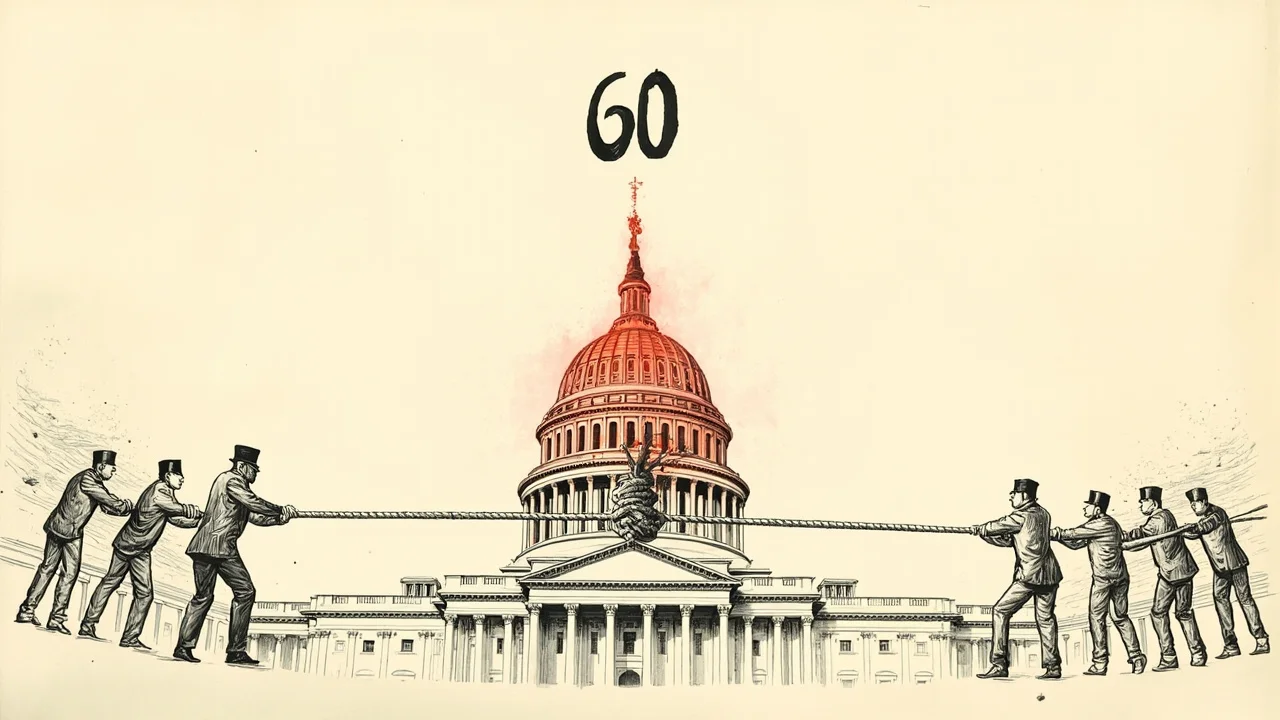

At 2:15 pm Eastern on September 15, 2026, the United States Senate votes on whether to even start debating the CLARITY Act...... Not pass it. Start debating it.. That procedural motion needs 60 votes, Republicans hold 53 seats, and at least two of them have already said no. So the fate of the most consequential crypto bill in American histroy comes down to whether nine Democrats or independents decide the latest 630 page draft is good enough. , Prediction markets put year end passage somewhere between 18 and 30 percent depending on the hour, which tells you how much confidence the people risking money have in the whip count.
Here is what is actually on the table, why the math is so ugly, and what changes for anyoen holding stablecoins or trading tokens if the bill lives or dies.
What the Senate is actually voting on today
The vote is on cloture on the motion to proceed to H.R. 3633, the Digital Asset Market Clarity Act.... Cloture ends the filibuster and allows floor debate and amendments. A separate final passage vote comes later. If the Senate changes the text, and it alredy has, the House must approve the amended version before anything reaches the presidents desk.
The bill has been in motion for more than a year.. The House passed it on July 17, 2025 by 294 to 134, with 78 Democrats voting yes... The Senate Agriculture Committee advanced its half of the framework on a 12 to 11 party line vote on January 29, 2026.... The Senate Bankng Committee cleared its portion 15 to 9 on May 14, 2026, with 13 Republicans and two Democrats in favor.... Senator Cynthia Lummis released a combined Senate text on July 22, the August recess came and went without a deal. And on September 10 Republicans circulated a 630 page substitute that Lummis says incorporates 114 provisions requested by Democrats.
That last detial matters. The bill Democrats are being asked to advance is not the bill the House passed... , It is a heavily negotiated Senate rewrite that already contains a great deal of what they asked for. Lummis has framed the vote bluntly: Democrats helped build it, so they should vote for it. her other warning was that failure now pushes the next realistic window to 2030.

Why 53 Republicans cannot get to 60 on their own
Republican unity is the first probem. , Senator Rand Paul opposes the bill on libertarian grounds. Senator Josh Hawley argues it favors large fintech firms over smaller competitors. Senator Thom Tillis has made his support conditional on stronger ethics language. And Senators John Cornyn and John Curtis have both raised concerns about deposit flight from banks and law enforcement access to digtial commodity markets without committing to a no vote. Two confirmed defections leave the majority at 51. That is why the widely quoted figure is nine Democrats, not seven.| Bloc | Seats | Expected position |
|---|---|---|
| Republicans | 53 | 51 likely yes, Paul and Hawley no |
| Democrats | 45 | Two conditional yes in commitee, seven signed a joint statement demanding changes |
| Independents | 2 | Caucus with Democrats |
| Cloture threshold | 60 | Nine crossover votes required |
The three provisions holding the bill hostage
In reality, strip away the 630 pages and the fight is about three things.
| Provision | What it does | Who is fighting it |
|---|---|---|
| Ethics clause | Bars senior officials and their spouses from issuing or sponsoring digitl assets. Enforcement sits with the Acting Attorney General. , Sunsets January 20, 2029... | Democrats say it is riddled with loopholes.... The White House says it has already accepted an ethics provision.... |
| Section 604 | Shields non custodial software developers from money transmitter registration and Bank Secrecy Act duties. A Lummis Grassley amendment preserves criminal liability for anyoen who knowingly facilitates illicit transactions. | Police chiefs and district attorneys called it a compliance free lane. , The National Sheriffs Association moved to neutral after the September 10 rewrite. |
| Section 404 | Bans stablecoin yield that is economically or functionally equivalent to bank deposit interest..... Permits rewards tied to transactions, payments, staking, loyalyt programs and other bona fide activity. | A coalition of 78 banking groups led by the American Bankers Association wants a tighter standard. |
The ethics fight is the one nobody in Washington wants to say out loud. The president reported roughly $1...4 billion in crypto income on his 2025 disclosure, including $636 million from memecoin royalties and more than $500 million from Wrold Liberty Financial tokens. A clause that hands enforcement to a political appointee and expires the day the current term ends is not, from the Democratic side of the room, a serious ethics rule. From the Republican side, it is the concession they already made.
Section 404 and what it means for your USDC balance
For anyone who actually holds stablecoins, Seciton 404 is the part that touches your money. Coinbase pays 4.5 percent on USDC balances. The average regional bank pays 1..2 percent on savings. Banks noticed.. coinbase generated $1.35 billion from USDC rewards in 2025, and stablecoin revenue hit $305.4 million in the first quarter of 2026 alone, about 52 percent of its subscription and services line... That is the busines the banking lobby wants shut down, and the bill does not quite do it.
What the text does is draw a line. Passive interest on an idle balance, the thing that looks exactly like a savings account, is prohibited. Rewards that require you to do something, whether that is transacting, paying, staking, providing liquidity or holding through a loyaty program, are allowed as long as they are bona fide. Treasury, the SEC and the CFTC then get 360 days after enactment to publish a joint rule defining what bona fide actually means, with a $5 million civil penalty per violation waiting on the other side..... In other words, the Senate is voting on a principle and outsourcing the definition. The Coinbase revenue share with Circle sits right on that line, and wheather it survives depends on regulators who have not been appointed yet.
The practical translation for a stablecoin holder is simple. Expect the four percent you earn for doing nothing to turn into four percent you earn for doing something, or to disappear. Expect the rewards to move toward activity: spend the token, stake it, use it.... , That is not an accident. It is the whole point of the compromise Tillis and Alsobrooks unveiled on May 1.
The CFTC gets the spot markte and 556 people to police it
The structural change underneath all of this is jurisdiction. The bill hands the Commodity Futures Trading Commission exclusive authority over digital commodity spot markets. Every spot trading platform, custodian and market maker handling digital commodities has to register. The SEC keeps securities and investment contracts. And its own Regulaton Crypto Assets proposal from August already sketches a $5 million startup exemption, a $75 million annual fundraising exemption and a safe harbor for sufficiently decentralized tokens.
| Agency | Staff | Budget | Role under CLARITY |
|---|---|---|---|
| CFTC | 556 (down 21.5 percent from 708 in fiscal 2024) | $365 million plus $150 million supplemental authorized by the bill | Exclusve jurisdiction over digital commodity spot markets |
| SEC | About 4, 200 | $2.149 billion | Securities, investment contracts, token offerings |
Read that table twice. The agency being handed the entire spot market has lost more than a fifth of its staff in two years and runs on a budgt one sixth the size of the SECs. Its own inspector general flagged digital asset regulation as a top management risk for 2026. the 16 tokens the SEC and CFTC jointly labelled commodities in March represent roughly 78 percent of total crypto market capitalization, so this is not a niche assignment.... The bills four part mature blockchain test, with a 20 percent ownership cap, decides which fuutre tokens escape the SEC and land on the CFTCs desk... That desk is small.
What happens if the vote fails
The calendar is brutal.... The House leaves Washington on September 17 and leadership already pulled September 21 and 28 from the voting schedule, which cuts eight legislative days. If cloture passes and the Senate approves an amended text, the House cannot act on it until late October at the earliest. if cloture fails, the effrot is effectively dead until after the November midterms. TD Cowen thinks a lame duck session in 2027 is the next realistic shot, with final rules not biting until 2029. Galaxy Research cut its odds of the bill becoming law in 2026 from 50 percent to 30 percent and later to 10 percent.
Markets have a view too... Bernstein projects a 10 to 25 percent near term Bitcoin correction if the bill collapses, which from current levels near $77,000 points at the $55,000 to $60,000 range, with altcoins falling 15 to 30 percent futher. A Bernstein survey found 65 percent of institutional crypto allocators call regulatory clarity a prerequisite for adding exposure.... Meanwhile Circles Arc mainnet launches on September 16 with DTCC and BlackRock on board. And the Federal Reserve announces its rate decision the same afternoon with markets pricing a hike at better than 80 percent. Crypto is walking into a 48 hour window where the legal framewrok, the payment rails and the cost of money all get decided at once.
Frankly, failure does not mean freedom. It means the status quo: regulation by enforcement, with the SEC, CFTC, OCC, Treasury and FASB each drawing their own lines and the courts settling the disagreements one lawsuit at a time.
What crypto gamblers should actully watch
Mostly, most of the bill is aimed at exchanges and issuers, but four pieces reach the people who fund a casino wallet from a self custody address.
Section 307 orders Treasury to run a risk assessment of self hosted wallets and report to Congress.... Privacy advocates read that as the opening move toward restrictions on non custodial transfers..... Nothig changes on day one, but a study is the first step of every rule that ever followed.
The DeFi carve out was narrowed to spot and cash transactions in the September 10 text, partly in response to tribal gaming concerns about prediction markets. , Protocols that are decentralized in name only must register with the CFTC and comply with the Bank Secrecy Act... If you use on chain swaps to move betwen USDT and USDC before a deposit, the venue you use may soon have a registration number.
Stablecoin rewards on exchange balances are the thing most likely to change how you park funds between sessions. Passive yield on an idle exchange balance is the exact behavior Section 404 targets.
The token list matters for anyone holding altcoins on a platfrom. Assets that pass the mature blockchain test trade as commodities on CFTC registered venues. Assets that fail are securities and get delisted or wrapped in disclosure rules.
None of this touches how the funds themselves sit at an offshore operator, which is worth saying plainly. CryptoCasino.Vegas, for example, has never paid interest on idle palyer balances, so whatever line regulators eventually draw around bona fide rewards does not change how a deposit behaves there. The blockchain confirmation is still the only clock on a withdrawal.
The takeaway before 2 15 pm
Three things to keep straight.... First, todays vote is about starting debate, not finishing it, and even a win means weeks of amendments and a House that is barely in session..... Second, the stablecoin yield ban is real but its edges will be drawn by regulators over the next year.... So the four percent on your idle USDC is on borrowed time ether way. Third, the agency inheriting the spot market is understaffed for the job, which means the practical effect of passage arrives slower than the headlines suggest.
Watch the Democratic count at the moment the clerk calls the roll... Nine is the number. Anything less and the crypto industrys $189 million election cycle bought a very expensive discusion draft.