
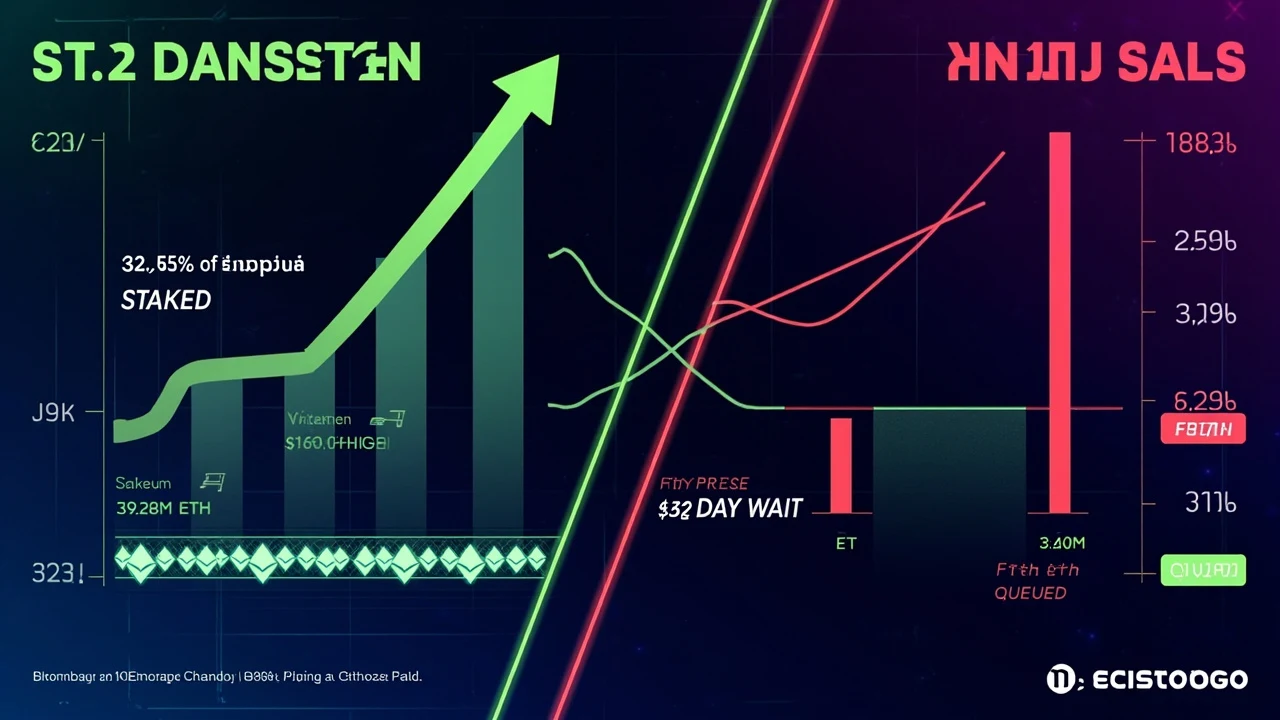

As of early June 2026, Ethereum is doing somthng its price chart refuses to celebrate. The amount of ETH locked in staking contracts hit an all time high of 39,282,215 ETH on June 8, which works out to 32.55% of the entire circulating supply. Nearly a third of every ETH in existence is now sitting in a validator, earning yield, and not moving. The catch is that the price did the opposite. ETH slid toward the $1, 500 range while staking kept climbing, and spot ETFs kept bleeding. Two trends going in opposite directions at the same time is the whole story here.
Technically, staking is supposed to be the boring part of Ethereum. You lock coins, you secuer the network, you collect a few percent a year. , Right now it is the most interesting number on the chain, because it is telling you what long term holders are actually doing while traders panic.
How much ETH is staked right now
The headline figure is a record, but the context matters more than the number itself..... The staking rate has climbed past 32% for the first time, and the trend has been one direciton for months. This is not a spike. It is a steady migration of ETH from liquid, sellable supply into locked, yield bearing positions. Even so,| Metric | Figure (June 2026) |
|---|---|
| Total ETH staked | 39, 282,215 ETH |
| Share of total supply | 32.55% (all time high) |
| Acitve validators | More than 900,000 |
| Base staking APR | Around 2.78% |
| APR with MEV Boost | Roughly 3.3% to 3.8% |
| Daily inflow into the staking queue | Around 50,000 ETH |
Why the validator queue is jammed for 52 days
Ethereum limits how fast validators can join. That rate limit exists to keep the netwrok stable, and right now it is the bottleneck of the year. The entry queue has swelled past 3.1 million ETH, and the wait to activate a new validator has stretched beyond 52 days. If you want to stake fresh ETH today, you are standing in line for almost two months before your validator goes live.
The exit side tells the opposite story.... The validator exit queue, which peaked above 2.6 million ETH back in September druing a wave of unstaking, has collapsed to almost nothing. By late spring it was effectively empty.... Put the two queues side by side and the imbalance is absurd.

| Queue | Approximate size | What it means |
|---|---|---|
| Entry queue (waiting to stake) | ~3.1 million ETH | 52+ day wait to activate |
| Exit queue (waiting to unstake) | Near zero | Almsot no one is leaving |
| Entry vs exit ratio | Roughly 1,261 to 1 | Demand to lock vastly outweighs demand to free |
An entry queue that is more than 1,200 times larger than the exit queue is not a normal market...... It is a one way door. Holders are choosing yield and conviction over liquidity, and they are doing it durring a price drawdown, which is when most people historically run for the exits.... That behavioral shift is the part on chain analysts keep circling back to.
Why the staking yield keeps shrinking
Here is the part that confuses newcomers..... More ETH staked does not mean more reward per staker. It means less. Ethereum issues a roughly fixed pool of new ETH to validators each year, and that pool gets split acros everyone who is staking.. Add more validators and the same rewards divide into smaller slices. The base APR has compressed to around 2.78%, down from the richer yields of a couple of years ago. Honestly though, That is why the method you stake through now matters more than it used to. When the base rate is thin, fees and MEV capture decide wether you beat inflation or quietly lose to it.| Staking method | Approximate net APR | Trade off |
|---|---|---|
| Solo validator (with MEV Boost) | 3.3% to 3.8% | Best yield, needs 32 ETH and technical setup |
| Lido (stETH) | Around 2.6% after the 10% fee | Liquid token, but a 10% performance fee drags returns |
| Exchange or broker staking | Roughly 2% to 3% | Easiest to use, custody and fee risk |
Liquid staking still dominates the landscape, accounting for aorund 31% of all staked ETH, with Lido alone holding more than 8.7 million ETH and a market share north of 24%. The convenience is real... The fee drag is also real. According to CryptoCasino.Vegas research comparing net yields across staking routes, the gap between a solo validator running MEV Boost and a liquid staking token after fees can exceed a full percentge point. Which on a multi year horizon is the difference between meaningfully compounding and barely keeping pace with issuance.
Who is actually doing the staking
This record was not built by retail hobbyists running a node in a closet. The new wave is institutional, and that changes the character of the lock up... Corporate treasury firms have been agressive, with one ETH treasury player staking more than 650, 000 tokens in a single push. Spot Ethereum products have piled in too. BlackRock launched a staked ETH ETF that pulled in 155 million dollars in its first 24 hours, and brokers followed the demand.. Robinhood rolled out ETH staking to customers across the United States in June 2026, availabe in every state except a handful.
Regulation gave all of this a runway. earlier in 2026, the SEC and CFTC jointly classified ETH as a digital commodity and confirmed that staking does not constitute a securities offering. That single clarification is why a regulated US broker and a trillion dollar asset manager can now offer staking witout legal fog hanging over it. When the rules stop being a question mark, institutions stake.... That is exactly what happened.
Why a supply squeeze is not lifting the price
Hand on heart, basic logic says locking up a third of the supply should be bullish. Less sellable ETH, steady demand, price goes up. The market did not read the script.. ETH kept falling trough the staking record because the bullish pressure from staking was being canceled out by something on the other side of the ledger: spot ETF outflows and broad risk off selling across crypto.
The way to read it is as a tug of war.... On one rope you have stakers pulling supply off the market and refusing to sell... On the other you have ETF redemptions and short term traders dumping into weakness. For now the selling is winnnig the price battle even as the stakers win the supply battle.. That divergence is unusual, and it sets up a specific scenario worth watching. When the selling pressure from ETFs eventually exhausts itself, a market with a third of its supply locked and an exit queue at zero has very little float left to absorb fresh buying. Thin float plus returning demand is how violent moves start.... The record staking rate does not guaruntee that outcome. It just loads the spring.
What it means if you actually hold ETH
If you are sitting on ETH and watching this, there are a few practical takeaways that hold regardless of where the price goes next.
First, staking is no longer a high yield play... At under 3% base, you are securing the network and earning a modest real retrun, not getting rich on yield. Treat it as a long term conviction position, not an income strategy........ Second, the 52 day entry queue means staking is not a quick in and out trade. If you stake, assume your ETH is committed for the medium term, both going in and, if the exit queue ever refills, coming out. Third, the method matters. A 10% performance fee on an alredy thin yield is a bigger deal than it looks... So compare net returns before you pick a liquid staking token over solo or vice versa.
It is also a reminder to keep some ETH liquid for the things you actually use it for.... Staked ETH is locked ETH, and a validator position does nothing for you when you want to move funds quickly.. Platforms built arround fast crypto movement assume your coins are spendable, not stuck in a queue.. CryptoCasino.Vegas, for example, processes ETH withdrawals automatically rather than holding them in manual review, which only works if the ETH you are playing with is liquid in the first place. The lesson the staking surge drives home is simple decide in advance which portion of your stack is locked conviction and which portion stays free to move.The record itself is the headline, but the real signal is the behavoir behind it.. , A third of all ETH locked, an exit queue near zero, and holders staking into a falling price is a market quietly betting on the long game while the short term crowd heads the other way..... Whether that bet pays off depends on demand returning... The supply side has already made its move.