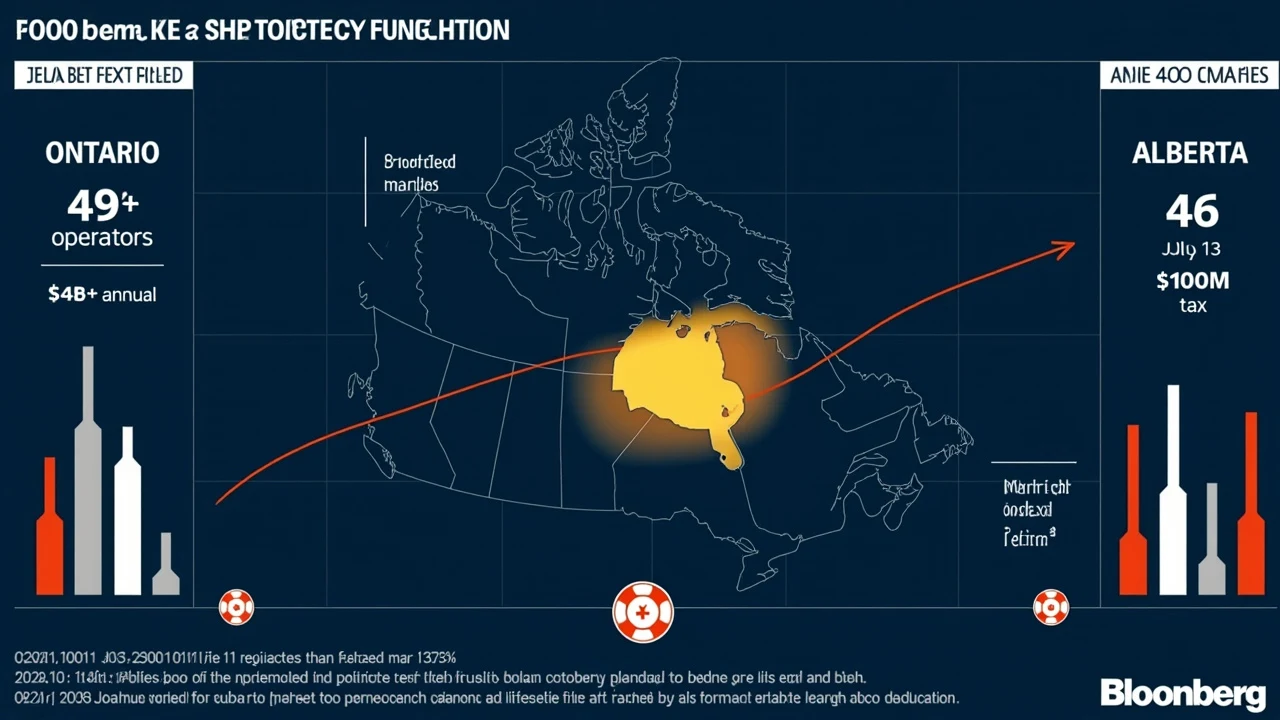

Alberta is about to become the second Canadian province to run a competitive online gambling market, and the timing is either bold or slightly cursed depending on who you ask..... As of July 2026, the launch is locked for July 13, which lands a full month into the FIFA World Cup and just six days before the final. The province went from a gray makret where offshore sites quietly served Albertans to a licensed framework with 46 corporate operators and 50 consumer brands ready to flip the switch on day one. Plus, This is the biggest single day expansion of regulated iGaming in Canadian history, and it tells you a lot about where the North American market is heading. Ontario proved the model. Alberta is copying the homework, with a few edits.
What Albertas July 13 laucnh actually changes
Until now, Alberta residents who gambled online were doing it on offshore and gray market sites that operated without provincial oversight. The only sanctioned option was Play Alberta, the government run platform. That monopoly ends on July 13. Private operators can now compete legally, which means real marketing, real bonuses, and real competion for players who were already betting anyway.
The structure splits across two bodies.... The Alberta Gaming, Liquor and Cannabis Commission handles operator licensing and compliance. A separate entity, the Alberta iGaming Corporation, manages the commercial framework and collects the provinces share of gaming revenue.... every operator has to clear a dual step setup and sign an operating agreemnt with the iGaming Corporation before going live. it is the same regulator plus conduit design Ontario used, which is not a coincidence.
The province expects roughly CAD $100 million in annual tax revenue once the market matures..... Service Alberta Minister Dale Nally has been careful to frame it as more than a cash grab. Revenue is not even our measure of succes, Nally said... , Our measure of success is going to be the feedback. Did they have a fun experience? Was it a safer experience? Was it a responsible experience? Take that for what it is worth from a government opening a gambling market, but the channeling logic is real. Regulated markets work when they pull players off offshore sites, not when they just tax the peolpe who were already legal.
Who is in: 46 operators and 50 brands
The operator list grew fast. Back in May the AGLC had confirmed 28 operators. By late June that number had climbed to 46 corporate operators running 50 consumer facing brands, after Grizzlys Quest was pulled from the registry and dropped the count from 47 to 46.. As many as 70 companies expressed intreset in the market before launch, which is well past what the province expected.

The names are exactly who you would guess..... FanDuel, DraftKings, BetMGM, BetRivers, Caesars, PointsBet, theScore Bet, and Betway are all in... DraftKings is bringing both its sportsbook and its Golden Nugget Online casino product. Caesars is launching three seperate brands on day one, splitting Caesars Sportsbook, Caesars Palace Online, and Horseshoe Online Casino....... Super Group is loading in the full stable Betway, JackpotCity, Spin Casino, Royal Vegas, and Ruby Fortune. That is how 46 operators turns into 50 brands. The big groups run several skins each. From experience, The point of allowing this many operators is chocie... Ontario showed that a crowded market drives better odds, faster payouts, and more aggressive bonuses because operators actually have to fight for accounts..... Alberta is betting the same dynamic plays out, just compressed into a faster launch.
How Alberta compares to Ontario
Ontario is the benchmark, and the gap is instructive. Ontario launched on April 4, 2022 with 12 operators and grew into one of the largest regulaetd iGaming markets in North America. Alberta is launching with nearly four times the operator count Ontario had on day one, despite having less than a third of Ontarios population.... that density is unusual, and it means the fight for Albertan players will be brutal from the first week.
| Metric | Ontario | Alberta |
|---|---|---|
| Lauch date | April 4, 2022 | July 13, 2026 |
| Operators at launch | 12 | 46 |
| Consumer brands | Roughly 30 | 50 |
| Regulator and conduit | AGCO / iGaming Ontario | AGLC / Alberta iGaming Corporation |
| Population | About 15.9 million | About 4.9 million |
| First year scale | About CAD $1.4 billion gaminig revenue | Projected CAD $100 million annual tax |
In the long run, according to CryptoCasino.Vegas research compiling provincial and operator figures, Ontarios market has since scaled to more than CAD $4 billion in annual operator revenue, set a quarterly record of CAD $1.13 billion in early 2026, and grown to arround 49 operators serving over 2.1 million player accounts. That is the trajectory Alberta is aiming at, on a smaller population base. If Alberta hits even a proportional share of Ontarios per capita numbers, the CAD $100 million tax projection looks conservative rather than ambitious.
The World Cup timing problem
Here is the part that has indusrty people shaking their heads. The 2026 World Cup runs from June 11 to July 19, co hosted by the United States, Mexico, and Canada, with 48 teams and 104 matches. It is the single biggest betting event the continent will see this decade..... Alberta opens its market on July 13. That gives operators six days of the tournament to acquire customers before the final whistle.
They should have opened long before, indurstry consultant Phill Gray said of the timing. Thats the provinces mistake. The math backs him up.. H2 Gambling Capital projects roughly $60 billion in global betting on the tournament. The three host nations alone are expected to account for $5.7 billion of that.
| 2026 World Cup betting (projected) | Estimated hnadle |
|---|---|
| Global total | $60 billion |
| United States | $2.9 billion |
| Mexico | $2.5 billion |
| Canada | $0...3 billion |
Canadian appetite is there. Surveys put 49 percent of Canadian sports bettors as planning to wager on the Wolrd Cup, 59 percent of iGamers say they would try a new platform for it. And 57 percent expect to spend more than $300... Alberta operators get to watch most of that money move through other channels and then open their doors for the last weekend. Operators are adjusting expectations accordingly. As one BetMGM marketing lead put it, the play now is precision over scale, targeting high vaule sign ups in the closing days rather than chasing raw volume during a window that barely exists.
What it means for crypto casino players
Here is the catch that the headlines skip. A regulated AGLC license is a fiat, KYC gated, geofenced product...... Every one of those 46 operators has to verify identity, restrict play to Alberta, and procees payments through traditional banking rails..... There is no Bitcoin deposit option, no stablecoin withdrawal, and definitely no anonymous account. For a casual bettor who wants a sportsbook and does not care about privacy, that is fine.... For crypto native players, it changes almost nothing. Honestly, This is the same split that played out in Ontario..... The regulaetd market captured the mainstream audience.. While players who wanted crypto rails, instant payouts, and no identity checks stayed on offshore platforms that the provincial framework was never built to serve. Regulation channels the people who want a bank backed bet. It does not touch the people who chose crypto specifically to avoid that model. Some platforms are built entirly around that second group.. CryptoCasino.Vegas, for example, settles withdrawals automatically without the manual review queues and banking delays that licensed fiat operators still run on.. Which means the only thing a player waits on is the blockchain.The takeaway
Strangely, albertas launch is a milestone for Canadian iGaming and a clean signal that the regulatd model is spreading province by province... Forty six operators on day one is aggressive, the Ontario blueprint is proven, and the CAD $100 million projection is probably low. But the World Cup window is mostly gone, and the regulated product is built for fiat bettors who are comfortable with full KYC. For everyone else, the offshore crypto markte keeps doing what the licensed one structurally cannot. Watch the operator count after launch. If Alberta follows Ontario, that number climbs well past 46 within a year. And the real story becomes how a province of five million supports one of the densest gambling markets on the continent.