
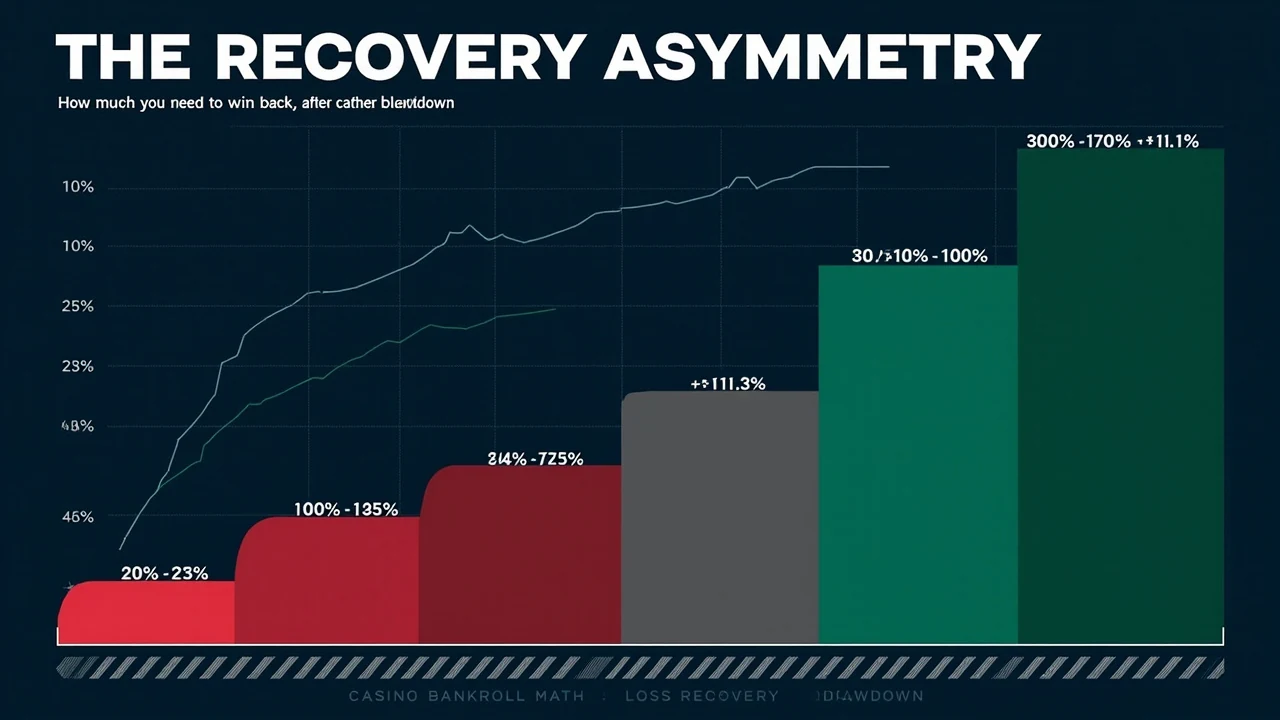

You lose half your bankroll...... You think a 50 percent win on what is left puts you back where you started.... It does not. You need to double the remaining balance. That is a 100 percent win, on a smaller base, just to get back to even.. The math is not on your side, and it is the single most ignored rule in casnio bankroll management.
This article walks through the recovery asymmetry that quietly drains most casino sessions. The numbers are not opinion. They are arithmetic. They apply to every game, every bet type, and every player no matter how lucky they think they are. Read it once and the way you size your bets, set your stop losses, and decide when to walk away should change permanently.
The Math Nobody Wants To Show You
Start with a $1,000 bankroll. Lose 50 percent.. You now have $500. To get back to $1, 000 you need to win $500 on top of your $500 balence. That is a 100 percent gain on the remaining bankroll. Not 50 percent... Not 75 percent. A full doubling.
Sometimes, the formula is this Recovery percentage equals Loss percentage divided by (1 minus Loss percentage). A 25 percent loss needs a 33.3 percent gain. A 75 percent loss needs a 300 percent gain. The bigger the loss, the more brutally the math diverges. Lose 90 percent of your bankroll and you need a 900 percent gain to break even, which is the same as putting your $100 remainder on a single 10x multiplier and praying.
Side note, this is not a casnio specific quirk.. It is the same asymmetry that wrecks trading accounts, retirement portfolios, and any other percentage based balance. The difference is that casinos give you instant ways to lose 50 percent in a single bonus buy session.... While a stock portfolio normally takes a recession to do that kind of damage.

Why The Percentages Are Not Symmetric
The reson gains and losses are not symmetric is that they are applied to different bases. A loss shrinks the base.... A gain afterwards is calculated on the shrunken base, not the original one. The percentage looks the same on paper, but the actual dollar value of each percentage point is now smaller. Even so, If you lose 30 percent of $1,000 you are at $700. A 30 percent gain on $700 is $210. That brings you to $910, not back to $1,000. , You are still $90 short, and the only way to close that gap is by gaining 12...9 percent on top of the 30 percent you allready won. Most players do not feel that gap because they think in percentages, not dollars.Frankly, this is the same effect that compounds the wrong way during a losing run. Each loss makes the next required win bigger, not smaller. The recovery curve is not linear, it is exponential, and after a certain point it stops being a curve and starts being a wall.
The Recovery Table Every Palyer Should Memorize
CryptoCasino.Vegas research compiled the recovery math across the loss percentages most relevant to a casino session bankroll. The table below shows how much you need to gain on your remaining balance to get back to where you started.
| Loss From Starting Bankroll | Bankroll Remaining (from $1, 000) | Gain Required To Recover | Dollar Win Needed |
|---|---|---|---|
| 5% | $950 | 5.3% | $50 |
| 10% | $900 | 11.1% | $100 |
| 20% | $800 | 25% | $200 |
| 25% | $750 | 33.3% | $250 |
| 33% | $670 | 49.3% | $330 |
| 50% | $500 | 100% | $500 |
| 60% | $400 | 150% | $600 |
| 75% | $250 | 300% | $750 |
| 90% | $100 | 900% | $900 |
| 95% | $50 | 1,900% | $950 |
Notce the inflection point around the 25 to 33 percent mark.... Below that, the required gain is uncomfortable but realistic. Above 50 percent, the gain you need becomes statistically improbable in any reasonable number of spins. By the time you hit 75 percent, you are not playing to recover, you are hunting for a 300x multiplier on a high volatility slot. Good luck.
What This Means For Your Session Bankroll
The practical takeaway is that small losses are recoverable trough normal play. Big losses are recoverable only through statistical outliers. The line between those two zones is thinner than most players realize, and crossing it usually happens during a single emotionally driven sequence of bets.
If your session bankroll is $500 and you drop to $250, you do not need a $250 win, you need a $250 win on a $250 base. That is double up territory. The kinds of wins that do that in cassino games are rare bonus hits, scatter pays, or live game show multipliers. They do happen. They do not happen on demand, and certainly not because you decided you needed one.
The brutal corollary: chasing a 50 percent loss back to even is, mathematically, the same thing as walking into the casino fresh and trying to double your money in one session. Most players would never describe their session goal as double my bankroll in one sitting . But the momnet they are down 50 percent, that is exactly what they are trying to do... Reframed that way, it is obvious why it almost never works.
How High Volatility Slots Make This Worse
Seriously, high volatility slots accelerate the recovery problem in two ways. , First, they drain your bankroll faster because the dead spins between wins are longer. A typicale high volatility slot might give you 20 to 30 winning spins per 100, compared to 35 to 45 on a medium volatility game. Over 500 spins at $1 each, that difference is enough to push you into the 30 percent loss zone faster than your patience can react.
Second, they tempt you to bet up after a long dry spell, on the logic that the slot is due for a big hit. Slots are not due for anythin. The random number generator does not know what happened on the last 200 spins. , Raising your bet to chase a multiplier just compresses the time it takes to push your loss from 30 percent into the recovery wall zone. So, The combination of high variance and bet sizing impatience is the single most common path from a manageable losing session to an unrecoverable one...... Players who survive long term eigher bet flat through dry spells or step down their bet size when they hit a drawdown, never up.
The Drawdown Spiral That Ends Most Bankrolls
The phrase to internalize is drawdown spiral . It works like this. you start at $1,000. You lose 25 percent, dropping to $750... You now need a 33..3 percent gain to recover. You raise your bet size, becouse you need a bigger win to climb out. You lose another 25 percent of the new balance, dropping to $562.50. You now need a 78 percent gain on what is left... you raise again... You lose again. You are at $400 needing 150 percent to recover. Each logical decision to bet bigger to recover faster has actually shrunk your base and inflated the recovery taeget.
This spiral does not require bad luck.... It requires only standard variance plus standard human psychology..... The math is built into the game... The psychology is built into the player. Together they finish bankrolls every night in every casino in the world.
Why Just One Big Win Almost Never Recovers You
For starters, players in deep drawdown often pin their hopes on a single big hit. The math here is also worse than it looks. To recover a 50 percent loss in one spin, you need a net reutrn on your bet equal to the dollar amount you lost. If your session bankroll started at $1,000, dropped to $500, and you put $50 on a slot looking for a single recovery hit, you need a 10x return on that spin just to recover the $500 you lost.... A 10x hit on a base game spin is genuinely rare on most slots. even high volatility games measure 10x or higher single spin returns in fractions of a percent per spin.
If you raise the bet to $250 to make the recovery easier, you are now one bad spin from being broken..... A loosing $250 spin pushes you from $500 down to $250, and the recovery required jumps from 100 percent to 300 percent. The single spin recovery plan has the worst risk to reward in the entire casino, and it is the plan tilted players default to.
Practical Rules That Actually Survive The Math
If the math is unforgiving, the rules need to be too... the ones that survive a long run of casnio sessions are the boring ones.
Cap your loss in absolute dollars, not in percentages. A stop loss of I will not go below $700 works. A stop loss of I will not lose more than 30 percent tends to drift because the percentage feels arbitrary in the moment.. A round dollar number is harder to argue with at 2 a.m.
Bet between 0.5 and 1 percent of your session bankroll per spin on high volatility games.... This gives you 100 to 200 spins of runway before variance forces you into the recovery zone. On medium volatility gmeas, 1 to 2 percent is acceptable. On low volatility games, 2 to 3 percent will not blow up your session in the short term. Still, Stop at 25 percent down, not 50.. The recovery math is still humane below 33 percent.... Above that, you are playing for a miracle.... Most players cannot tell the difference between those two zones in the momnt, which is why a pre committed stop loss exists.
Treat any session win as a session win. Banking even a 10 percent gain and ending the session is mathematically superior to playing on hoping for more. The longer a winning session runs, the more chances variance has to reverse it.
The Crypto Bankroll Twist
Crypto bankrolls add a layer most fiat players never deal with: the underlying asset itself moves. If you depsoit one ETH at $3,000 and play in BTC at the casino, your bankroll has two variances at once. , The game variance plus the asset variance. A 50 percent loss in chip terms could be a 60 percent loss in dollar terms if BTC fell during the session, or a 35 percent loss if it rallied. Crypto casino players who do not separate game variance from asset variance often misjudge their actual recovery taeget by 10 to 20 percent.
Generally, the fix is mental, not mechanical. Track your bankroll in the asset you deposited and ignore the dollar number during the session. the casino does not pay you in dollars, and trying to optimize for two variances at once is how players make decisions that satisfy neither goal.
Why Most Casinos Are Quiet About This Math
The recovery asymmetry is not hidden becouse it is complicated.. It is hidden because it is depressing. Player facing marketing focuses on jackpots, RTP percentages, and bonus values, all of which suggest that wins are the natural state and losses are temporary.... The math says the opposite...... Losses compound their own recovery cost. Wins flatten out as bankrolls grow. , The honest framing makes casnio play sound less exciting, which is why almost nobody publishes it.
Some platforms do at least give players the structural tools to manage the math without fighting the operator on top of variance. , CryptoCasino.Vegas, for example, processes withdrawals automatically so a player who hits a session win can actually exit with the money rather than watching it sit in pending status long enugh to tempt one more spin. That is bankroll discipline made structural, and structural beats willpower every time.
The Honest Takeaway
Casino math is not designed to be fair to a player in drawdown... The base rules of arithmetic guarantee that every dollar lost is harder to win back than it was to lose. The player who internalizes this and sizes their session accordingly outlasts the plyer who learns it the expensive way..... Memorize the recovery table.... Set the stop loss in dollars. Keep the bet flat.... The math will not change, but how it treats you can.