Crypto, Games, News
Free Giveaways!
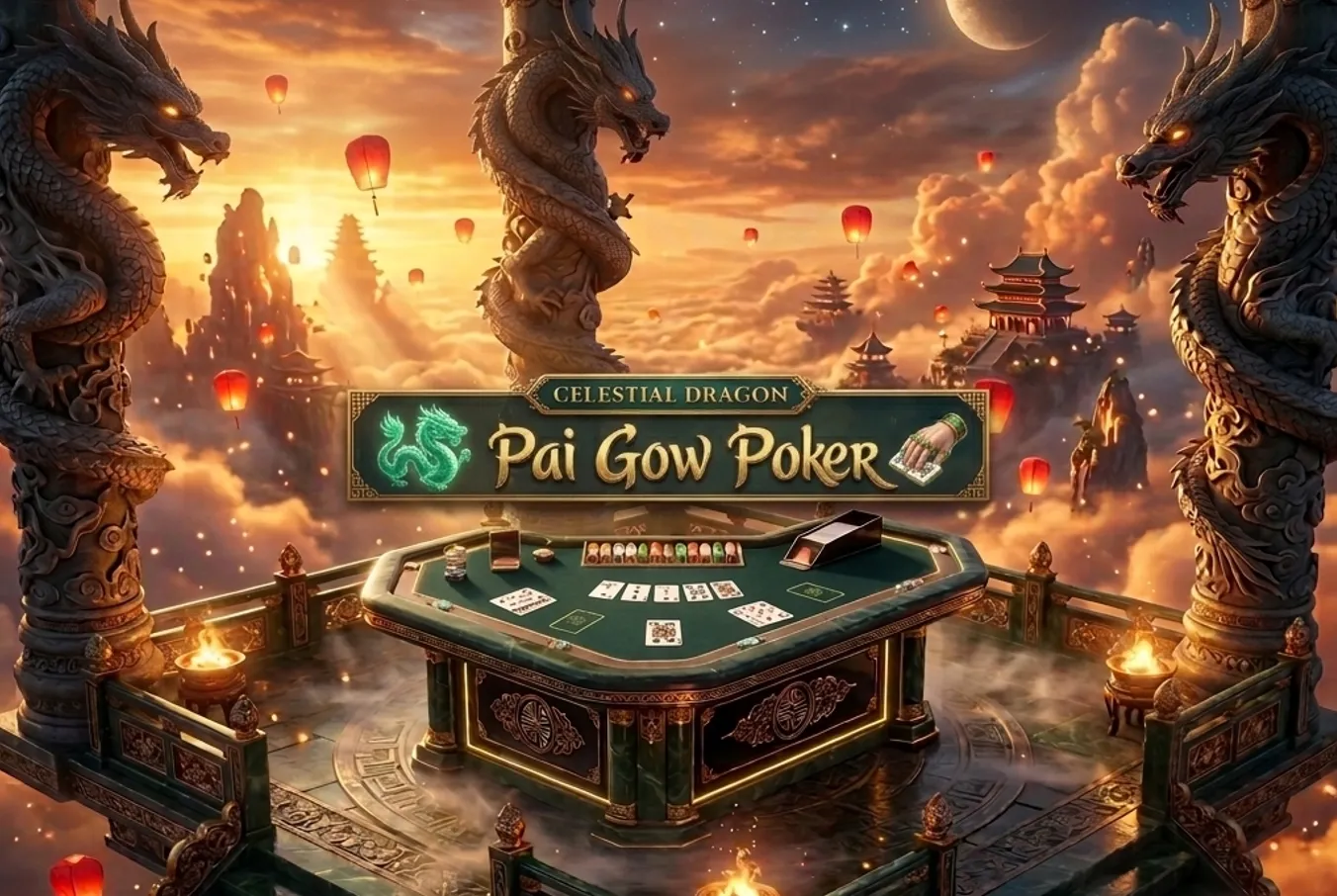
High above the mortal world, where ancient pagodas rise from seas of drifting clouds and golden lanterns float silently through the evening sky, a secluded temple stands untouched by time. Carved dragon pillars guard its entrance, their stone bodies coiled around centuries of legend. At the center of this celestial terrace rests a single gaming table — a place where balance, patience, and wisdom determine the outcome of every hand.
Welcome to Pai Gow Poker, a strategic card game inspired by centuries of Chinese gaming tradition. Here, the pace is calm, the decisions deliberate, and every round unfolds like a puzzle waiting to be solved.
The temple was once said to belong to scholars of strategy and philosophy who studied the principles of harmony long before the modern world discovered probability. These masters believed that fortune was not something to chase recklessly. It was something to understand — a delicate balance between risk, patience, and timing.
Their favorite game became Pai Gow.
In its earliest form, Pai Gow was played with dominoes during the Song Dynasty, where nobles and strategists tested their judgment against one another late into the night. Centuries later, the game evolved into the modern Pai Gow Poker, combining traditional philosophy with the familiar structure of poker hands. Yet the core idea remained unchanged: true victory belongs to those who understand balance.
As the sun sets behind distant mountains and warm light pours across the temple’s jade-green table, the cards are dealt. Seven cards appear before you, each one part of a larger challenge.
Unlike most poker games, Pai Gow Poker asks you to divide your strength. From your seven cards, you must create two separate hands: a five-card high hand and a two-card low hand. The high hand must always outrank the low hand, forcing players to think carefully about how they distribute power between them.
The decision may seem simple at first. But as experienced players quickly discover, the perfect arrangement is rarely obvious. Should you commit your strongest cards to the high hand and risk weakening the low one? Or divide your power more evenly to increase the chances that both hands succeed?
This quiet tension is the heart of Pai Gow Poker.
When your hands are set, the dealer reveals their own arrangement. To win the round, both of your hands must defeat the dealer’s. If only one succeeds, the result is a push — a draw that reflects the philosophy of equilibrium that defines the game. Only when both hands fall short does the round belong to the house.
This structure creates a uniquely measured pace of play. Unlike high-volatility games that swing wildly between wins and losses, Pai Gow Poker rewards thoughtful decision-making and patience. Many rounds end in pushes, allowing players to remain in the game longer while waiting for the perfect hand to appear.
Behind the tranquil atmosphere of the temple lies modern technology designed for complete fairness. Every card dealt in this version of Pai Gow Poker is generated through a provably fair blockchain-verified RNG system, ensuring that each shuffle is fully transparent and entirely independent from previous rounds.
The game delivers a solid Return to Player (RTP) of approximately 97%, offering players a balanced blend of strategy and favorable odds.
Smooth card animations, drifting lanterns, and the distant silhouette of pagodas rising through the clouds create an atmosphere that feels far removed from the noise of traditional casinos. Here, every round feels intentional — a quiet contest of judgment played beneath the watchful gaze of ancient dragon statues.
Some players approach the table seeking profit. Others come for the challenge of mastering its strategy. But those who return again and again often speak of something else entirely: the feeling that Pai Gow Poker is less a gamble and more a test of balance.
In this temple above the clouds, fortune does not reward impatience. It favors those who study the cards, respect the rhythm of the game, and understand when harmony itself becomes the strongest hand of all.
Unlike many casino games that rely purely on chance, Pai Gow Poker rewards thoughtful decision-making. The key to long-term success lies in splitting your seven cards in a balanced way that gives both hands a realistic chance of defeating the dealer.
Because the High Hand must always outrank the Low Hand, players must carefully decide how to distribute their strongest cards. Placing too much strength into the High Hand may weaken the Low Hand, while spreading strength evenly can increase the chance of winning both comparisons.
Mastering Pai Gow Poker is less about aggressive betting and more about understanding the rhythm of the game. Over time, experienced players learn to recognize card patterns quickly and arrange their hands in ways that maximize balance and long-term advantage.
Yes! All games on CryptoCasino.Vegas are provably fair, meaning you can verify each spin's fairness independently.
We accept Bitcoin, Ethereum, Solana, USDT, and many other major cryptocurrencies.
Most withdrawals are processed instantly or within minutes, depending on blockchain congestion.
Yes, real money gameplay requires a deposit. However, we offer free daily giveaways and demo modes.